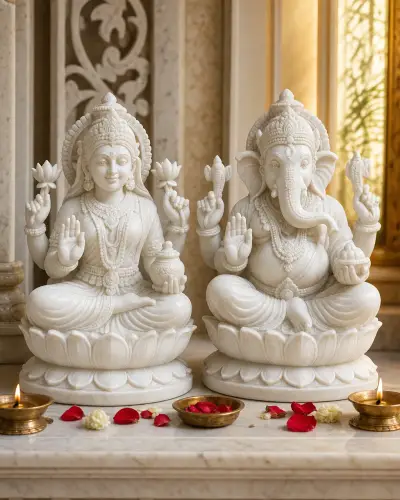
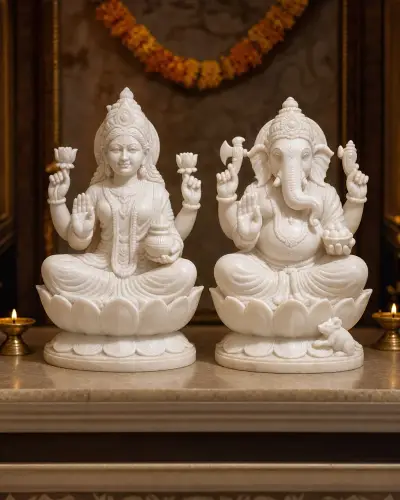
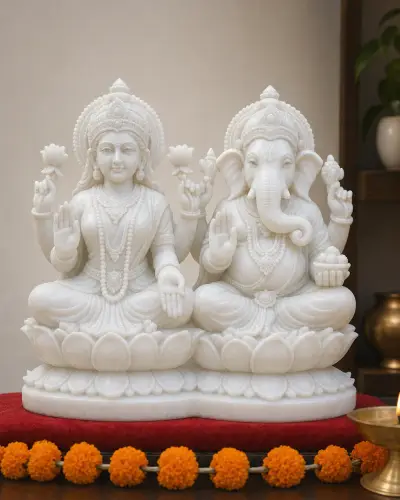
Handcrafted Makrana White Marble Lakshmi-Ganesh Pair on Lotus Thrones, 30in
Hand-carved Makrana white marble Lakshmi-Ganesh pair on lotus thrones. A 30-inch pooja centrepiece with crowned ornamentation.
Made to order. The pictures here are concept images. This is not a ready item. We get it made for you as per this design, as close as possible, in the size and stone you choose.
Want this design made for you?
Tell us the size, the stone and where it is going. We will send you a quote and a timeline.
Chat on WhatsAppWe'll respond within 5 minutes
About This Piece
The Makrana block and the temple-grade size tier
This Lakshmi-Ganesh pair is sculpted from Makrana white marble, the same stone the Mughal builders chose for the Taj Mahal's facades. Quarried in Makrana town (Nagaur district, Rajasthan), the calcitic block is dense, low-porosity, and carries a slightly warm neutral white that distinguishes it from cooler Italian Carrara and brighter Vietnam marble. The matched pair sits on individually carved lotus thrones, four-armed in their canonical forms, scaled at thirty inches, the temple-grade size tier that anchors a pooja-room installation.
From rough chisel to an eight-grade satin polish
At the Jaipur workshop we work with, both figures begin as one continuous block. The artisan rough-cuts both forms in parallel so that pose, crown elevation, and lotus throne dimensions match across the pair. Primary shaping with heavy chisels gives way to detail work: the crown ornamentation, the symmetrical attribute-bearing hands (Lakshmi's lotuses and abhaya-varada mudras; Ganesha's modaka, ankusha, pasha, and abhaya), the flowing dhoti and saree drapery, the lotus-petal layering on each throne. Face-finishing is entirely by hand, and no machine-polish touches the deity features. The pair is then progressively polished through eight abrasive grades to a satin soft-polish, bringing out the marble's depth without glazing it.
The canonical Diwali arrangement of the two deities
The Lakshmi-Ganesh pair is the canonical Diwali pooja arrangement across North India. Lakshmi, seated to Ganesha's right, holds twin lotuses with her upper hands while the lower two rest in abhaya (fearlessness) and varada (boon-granting) mudras. Ganesha, on the left, holds his traditional ankusha (elephant goad), pasha (noose), and modaka (sweetmeat), with the fourth hand in abhaya. Both deities are presented in Padmasana, the seated lotus posture, on individual carved lotus thrones, a Pala-era convention that survived into Rajasthani sculptural tradition through the Mughal period.
Fitting a 30-inch pair on a mandir platform
A 30-inch pair anchors a pooja room properly. It is large enough to read as a central installation rather than a tabletop figurine, but contained enough to live on a standard wooden mandir platform with diya thali and incense holders flanking. North-east placement (Ishanya) is the conventional Vastu orientation for the household altar; the pair faces the practitioner during morning aarti. Allow roughly 36 inches of clear width on the platform to accommodate the lotus-throne footprint and the customary brass arati lamps.
Available in Vietnam white marble, Makrana variants (Albeta, Kumari, Doongri), and select inlay-finish options on commission. Custom sizes from 12 inches to 60 inches; lead time scales with size. Message us on WhatsApp for stone samples and installation specifications.
Specifications
Pose
Seated Padmasana on individual lotus thrones, side by side, four-armed forms with canonical attributes
Color
Natural White
Finish
Soft polish — satin glow, traditional Rajasthani hand-finish
Material
Makrana White Marble
Ideal For
Pooja room centerpiece, Temple installation, Family altar
Weight In Kg
36
Depth In Inches
12
Width In Inches
21
Height In Inches
30
Region Or Tradition
Indian / Mughal (Rajasthan)