Black Marble Moreshwar Ganpati of Morgaon, Raw Unpolished Finish, 18 in
The first of the eight Ashtavinayak swaroops, in raw unpolished black marble with a Nagraj cobra canopy and silver-inlaid eyes.
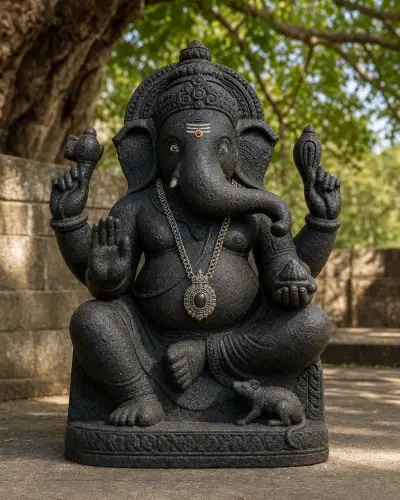
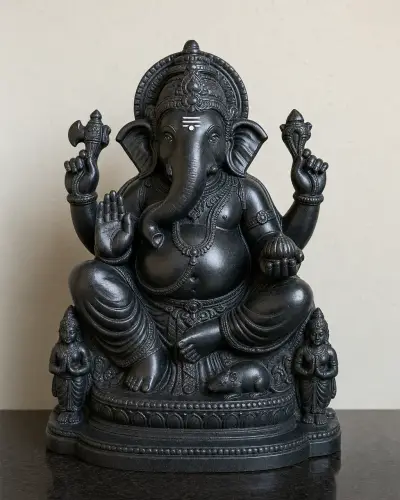
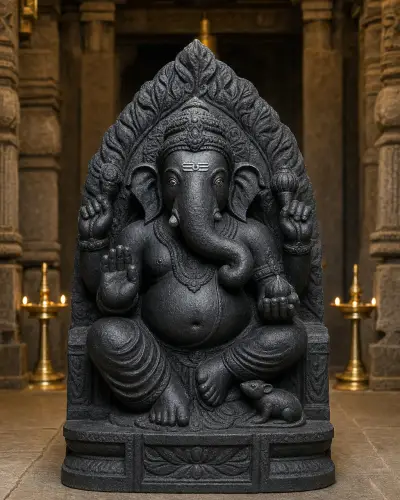
Made to order. The pictures here are concept images. This is not a ready item. We get it made for you as per this design, as close as possible, in the size and stone you choose.
Want this design made for you?
Tell us the size, the stone and where it is going. We will send you a quote and a timeline.
Chat on WhatsAppWe'll respond within 5 minutes
About This Piece
Morgaon is where the Ashtavinayak yatra opens and where it has to close. The village sits on the Karha river in Pune district, and its Ganpati, Moreshwar, also called Mayureshwar, is counted the first of the eight swaroops. Devotees who complete the full circuit return to Morgaon a second time to finish it properly, which is why this swaroop carries a weight the other seven do not. This is a home-mandir reading of that murti, standing 18 inches tall in black marble left deliberately raw.
What the carving holds
Four arms, a full potbelly, and the single broken right tusk that gives Ganesha the name Ekadanta. A modak rests in one lower hand; the mushak, his vahana, is cut small at the base beside his feet. The trunk curls to his own left, which means it sweeps toward the right of the piece as you face it. That is the direction most families ask for in a murti meant for daily puja. Above and behind the head a multi-hooded Nagraj arches into a canopy, and a peacock stands at the plinth. Those last two belong to Morgaon in particular rather than to Ganesha in general: Mayureshwar means lord of the peacock, and the bird is carved as a companion at the base, not as a mount. The eyes are inlaid in bright silver, and a three-line tilak with a round bindu is cut into the brow.
Why the stone is left unpolished
The black marble on this piece is deliberately not brought to a shine. A low-gloss, leathered surface keeps the grain of the rock legible right across the body, so the murti reads as stone first and ornament second, much closer in character to the dark, weathered Morgaon murti than a mirror-finished statue would be. Under a lamp the surface takes light unevenly, so every chisel pass across the belly and the cobra hood stays visible instead of disappearing into a reflection, and the silver eyes become the only bright note on the whole piece. The trade-off is worth stating plainly: an unpolished surface hides fingerprints but holds dust, and it wants a dry cloth rather than any polish, wax or oil.
Size, weight and where it sits
At 18 inches tall, roughly 10 inches across and 9 inches deep, this is a piece for a home mandir shelf or a wall niche rather than a full-height temple installation. It weighs about 26 kg, so it wants a shelf that can carry the load and a spot you will not need to move it from often. Households who keep the Ashtavinayak tradition usually place Moreshwar at the centre of the mandir, with the remaining seven swaroops arranged around him as the collection grows. Outside a mandir it sits equally well on a study console or a collector's shelf, where the raw stone surface can be read close up.
Making yours
Every piece like this is made to order and carved for you by the master sculptors we work with in Jaipur, and we stay with it from the first drawing through to the day it reaches your door. Height, the spread of the cobra hood, whether the peacock stands to the left or the right of the plinth, and the height and moulding of the plinth itself are all yours to decide. Tell us the shelf or niche it has to fit and the budget you have in mind, and we will come back with a drawing, a stone recommendation and a timeline. If you would rather have this same swaroop in Makrana white marble, Vietnam white marble, Dholpur pink sandstone or cast marble dust, that is a straightforward change to make before carving starts.
Specifications
Pose
Seated four-armed Moreshwar (Mayureshwar) Ganpati of Morgaon: potbelly, a single broken right tusk, a modak held in one hand, the small mushak at the base. His trunk curls to his OWN LEFT, which means it appears on the VIEWER'S RIGHT side of the piece. A multi-hooded Nagraj cobra arches over and behind his head as a canopy, and a peacock stands at the plinth. The eyes are inlaid in bright silver and a three-line tilak with a round bindu sits on the brow. The black stone is left raw and unpolished so the natural texture of the rock reads across the whole body.
Color
Jet Black
Finish
Matte with natural grain
Material
Black Marble
Ideal For
Home mandir, Ashtavinayak devotees, Collectors
Weight In Kg
26
Depth In Inches
9
Width In Inches
10
Height In Inches
18
Region Or Tradition
Indian / Maharashtrian (Ashtavinayak, Morgaon)