

Custom Made Khatu Shyam Ji Statues in Marble Stone
Shyam Baba in the forms Khatu keeps him - the shish darshan, the crowned darbar murti, and Veer Barbarika with his three arrows - made to order in Makrana white, Vietnam white, black stone or cast marble dust.
Khatu Shyam Ji Murtis Made to Order
Every piece below is made to order. Choose a form, then tell us the stone, the size and the finish you want for your mandir.
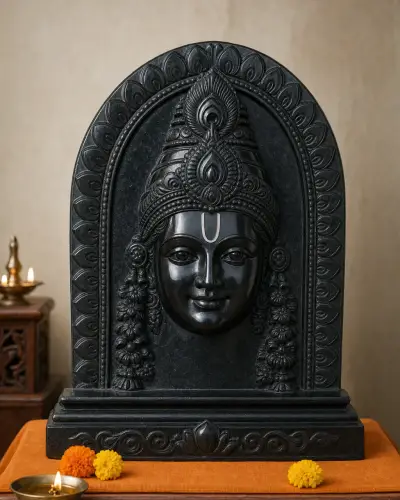
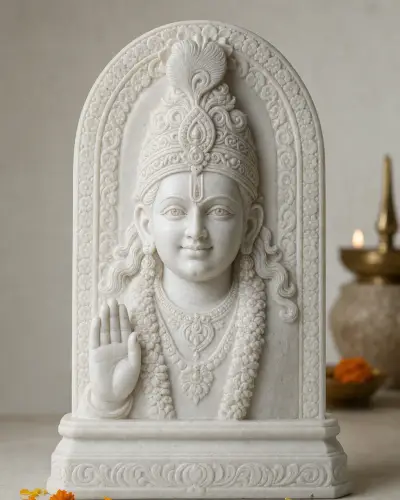
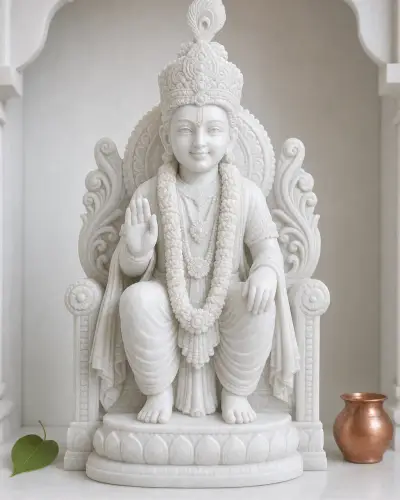
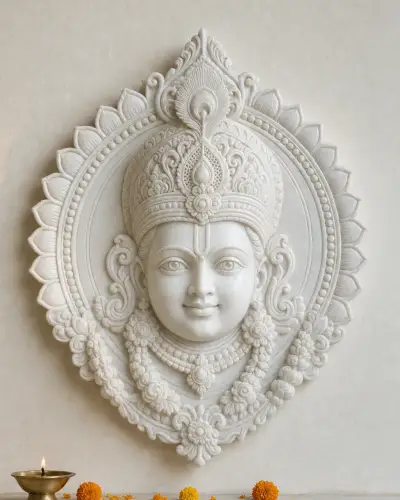
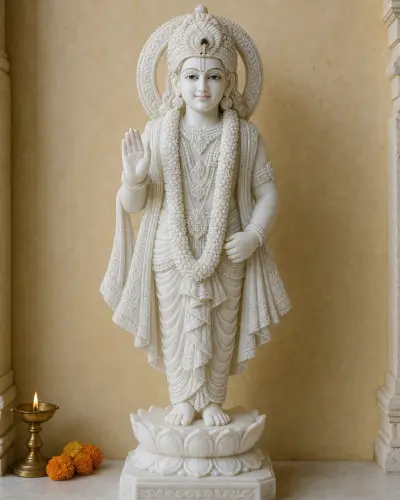
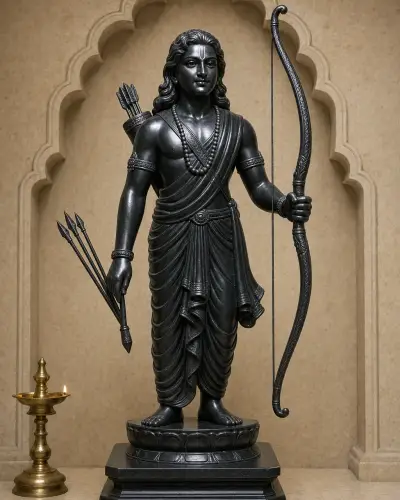
Khatu Shyam Ji murtis, in the forms Khatu keeps him
Khatu Shyam Ji is Barbarika: grandson of Bhima, son of Ghatotkacha, and an archer good enough to have ended the Mahabharata war in a single day. Krishna asked him for his head before the fighting began, and he gave it. For that Krishna blessed him to be worshipped in the Kali Yuga under Krishna's own name, as Shyam. His shish was later found and enshrined at Khatu, in Sikar district, about a hundred kilometres from our shop, and the temple there is built of the same Makrana marble several of these murtis are carved from.
He is the kuldevta of a great many Marwari and Agarwal families, and the devotion has travelled with them: to Kolkata, to Delhi and Haryana, and to Houston, Dallas and New Jersey. Of all his names, the one people say most often is haare ka sahara: the support of the defeated. It is worth knowing before you choose a murti, because it explains why so many of these pieces are commissioned at a hard moment rather than a happy one.
The forms carved in this collection
Three forms of the same deity, and they are not interchangeable.
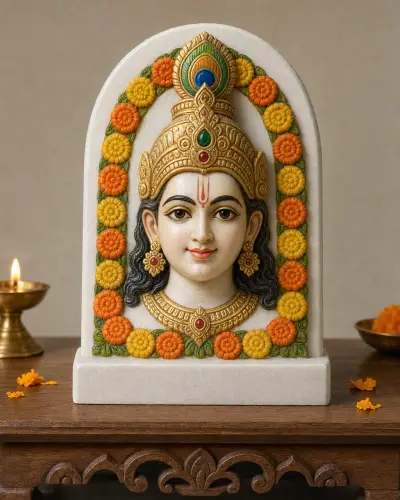
The shish darshan is the face alone, which is what Khatu itself enshrines. It is carved here as a panel: a 12in stele murti in Makrana white, a 15in mukh darshan in black stone, an 18in version made to hang on a wall, and a 6in hand-painted piece for a small altar.
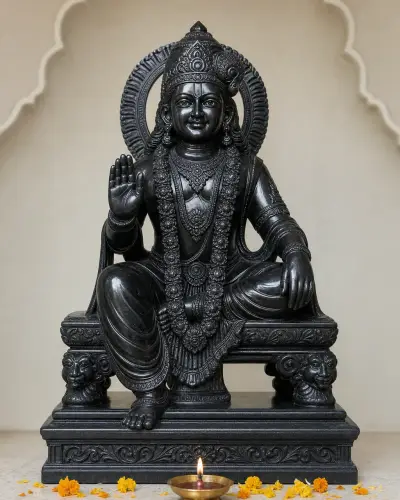
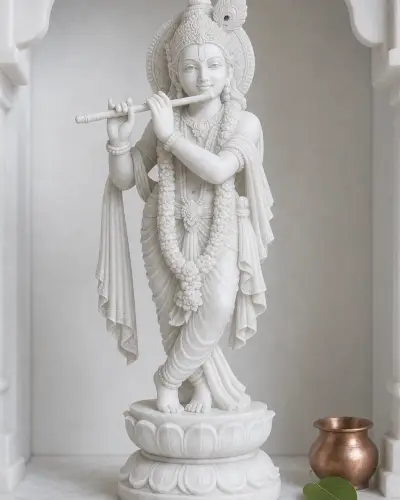
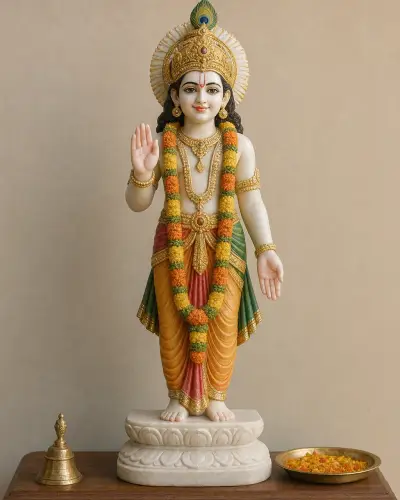
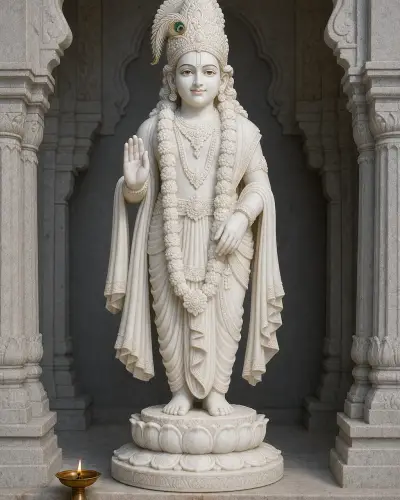
The darbar murti shows him crowned and garlanded, standing or seated, with his right hand raised in ashirwad. It runs from a 9in hand-painted murti through an 18in seated singhasan form, a 21in seated darbar in black stone, a 24in standing darbar, and a 36in temple-scale piece for a mandir or a satsang hall. One murti carries the flute, because he is worshipped under Krishna's name; the beardless face and the plumed mukut are what keep it Shyam Baba.
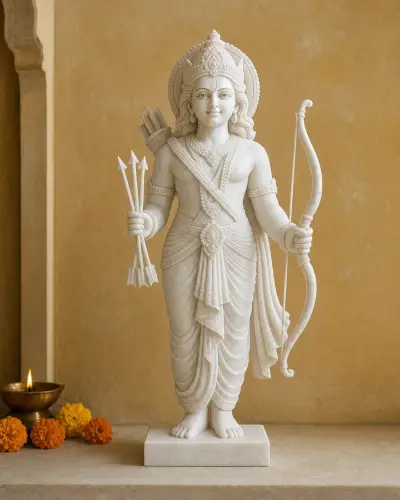
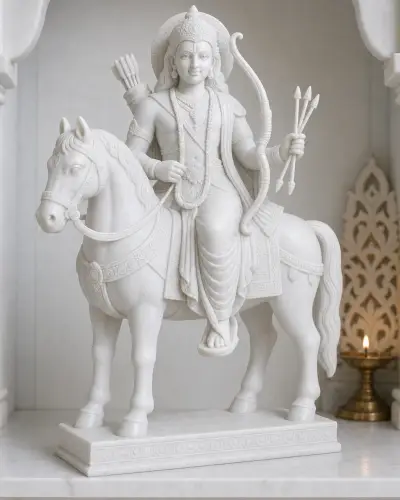
Veer Barbarika is the archer, before the boon: a 15in figure with his bow, a 24in version in black stone, and the leele ra aswar form, mounted on his horse. These suit a study or a hall better than a pooja shelf.
The shish, and why it is carved as a panel
This is the one thing to understand before ordering a Khatu Shyam murti. What is worshipped at Khatu is a head, and a head carved as a free-standing object would read as something broken, which no one wants on an altar. So the shish is always carved as a mukhota: the face in relief against its own ground, an arched stele or a garland border, with the base part of the same stone. It is the same tradition that gives us wall-mounted face masks, and it is why every shish piece here has a panel behind it rather than a cut edge.
That has a practical consequence. A 12in shish stele is only about three inches deep, and the wall-mounted 18in panel needs no shelf at all. If your mandir is a shallow niche or a wall with nothing to stand a murti on, the shish form solves a problem the darbar murti cannot.
Teen baan dhari: the three arrows
Barbarika is teen baan dhari, the bearer of three arrows, and the count is not decorative. Shiva gave him three, and three were enough for all three worlds. On the archer pieces here you can count them in the hand: three, never four, never a full quiver. It is the quickest way to tell a correctly made Barbarika from a generic warrior figure, and it is worth checking on any murti you are shown, from us or anyone else.
Choosing the stone
Baba is dressed differently through the month at Khatu: a lighter shringar for most of it, and the darker Shaligram form for about seven days. That duality makes stone choice here less arbitrary than it looks.
Makrana white marble is the temple stone, the one Khatu itself is built from, and it warms under diya light. Vietnam white marble is cooler and brighter, closer to a modern interior. Black stone, taken to a mirror polish, is the one families choose when they want the Shaligram darshan at home. It is also the most forgiving of a dimly lit mandir, because the polish carries the light rather than the surface. Cast marble dust is the value option and the usual choice for small altar murtis, especially where the piece is going to be hand-painted anyway, since the paint is what you see. Dholpur pink sandstone is available if you want it, though it is rarely asked for on this subject.
Size and placement
The pieces here run from 6 to 36 inches. For a home mandir shelf, 6 to 12 inches is the common choice and leaves room for the shringar, the thali and the flowers; the 9in hand-painted darbar murti is sized for exactly that. A dedicated pooja room takes 15 to 24 inches comfortably. Above that you are into temple and hall scale: the 36in Makrana piece weighs upwards of a hundred kilos and wants a plinth built for it, not a shelf.
Measure the internal height of your mandir before you decide, and allow clearance above the mukut: Shyam Baba's crown and peacock plume add real height that a bare figure measurement misses.
Kartik Ekadashi, and ordering in time
Baba Shyam's day is the Ekadashi of Kartik, kept as his birthday at Khatu, and Ekadashi is observed monthly by many of his devotees. If you are working towards a date, tell us the date first. Some Khatu Shyam murtis are already carved and sitting with the sculptors we work with; we will ask, and send you photographs of the actual piece, so there is no carving wait on those. A fresh commission is carved to your brief and takes eight to twelve weeks, depending on size and how much detail the shringar carries. For an address outside India, add shipping time on top of whichever lane you choose.
Caring for your Khatu Shyam murti
Dust a marble or black stone murti with a dry, soft cloth, and use a barely damp one for the carved recesses of the mukut and garlands where dust settles. Nothing acidic (no vinegar, no lemon, no bathroom cleaner) on any of these stones. A hand-painted Khatu Shyam murti should only ever be dry-dusted, and kept out of direct sun, which fades the polychrome and the gold over years. Marble that has yellowed slightly with lamp smoke can be left alone; on a murti in daily use it is patina, not damage.
Make it yours
Every piece in this collection is made to order, so treat what you see as a starting point rather than a catalogue. If a shish panel is right but you want it larger, or the seated darbar form in black stone instead of white, or the 24in standing murti scaled to 30 inches for a particular niche, that is an ordinary request and not a special one.
An idea of your own is just as welcome. Families send us a photograph of the murti at their own Shyam mandir, or of a piece a grandparent commissioned, and ask for something in that spirit. We will talk it through, tell you honestly what the stone will and will not hold at that size, brief the sculptor, and follow the piece through to your door.
Why choose Tilak Mandirwala for your Khatu Shyam Ji murti
Shyam Baba is Rajasthan's own deity, and we are a Rajasthan house. Here is what that means for your order.
The shish darshan, made the way the tradition holds it
Khatu keeps Shyam Baba as the shish. We design that form as a mukhota - the face carved in relief against its own arched stele or marigold-garland frame, on an integral base or as a wall panel - so it reads as darshan rather than as a fragment.
All three forms, not just the common one
The shish darshan, the crowned darbar murti seated or standing, and Veer Barbarika the young archer with his bow and three arrows. Tell us which one your family keeps and we design to it.
Made a short drive from Khatu itself
Khatu sits in Sikar district, about a hundred kilometres from our shop. The sculptors we work with have been making Shyam Baba for the Shekhawati belt for years, and know the shringar conventions without being told.
Your stone and your size, not a fixed catalogue
Makrana white marble, Vietnam white marble, black stone or cast marble dust, from a six inch altar murti to a temple-scale installation. Nothing here is a fixed SKU - each piece is made to your brief.
Hand-painted shringar if you want it
Many families want Baba in full polychrome with gold on the mukut and jewellery, the way he is dressed at Khatu. That is a decoration choice we can apply to any form and any size.
Packed and tracked to your door, anywhere
We project-manage the order from brief to delivery, including export packing and freight for families in the USA, the UK, Canada, Australia and the Gulf.
How we make your Khatu Shyam Ji murti
You talk to one person from the first message to the day it arrives.
1. Tell us the form
Shish darshan, darbar murti or Veer Barbarika. Send a photo of a murti you like, or of the mandir it has to sit in, and we will tell you what works.
2. Ask about ready pieces first
If your date is close, we ask the sculptors we work with whether a finished Shyam Baba is already carved, and send you photographs of the actual piece.
3. Choose the stone and size
We quote Makrana white, Vietnam white, black stone and cast marble dust side by side, with the weight and the mandir clearance for each size.
4. Approve the design
We agree the mukut, the garland treatment, the base and whether the piece is hand-painted, so nothing is decided at the bench.
5. It is carved for you
The master sculptors we work with rough out and then hand-finish the piece. We check it at the block stage and again before polish, and send you pictures.
6. Shringar and finish
Polish, and where you have asked for it the hand-painted polychrome and gold detailing, applied and checked in daylight.
7. Packed, shipped and followed up
Multi-layer export packing, freight booked, tracking shared, and we stay with the shipment until you confirm it reached you intact.
Frequently asked questions
Get answers to common questions about our custom sculptures
Do you ship Khatu Shyam Ji murtis to the USA?
Can you ship internationally, and what does it cost?
How long will my Khatu Shyam Ji murti take?
Should I choose the shish darshan or a full murti?
The darbar murti, standing or seated on a singhasan, is the fuller form and reads better as the central piece of a larger mandir. Veer Barbarika with his bow and three arrows tells the origin story, and is often chosen for a hall or a study rather than the pooja room.
What size suits a home mandir?
Which stone should I choose?
Can the murti be hand-painted like the shringar at Khatu?
Bring Shyam Baba home
Tell us the form, the stone and the size you have in mind, and we will send you options and a quote.
Get a quote on WhatsAppImporting statues for your store or gallery? Marble statue supplier for importers
Prefer to see the marble before you order? Visit our showroom in Jaipur, or send us your size and budget.
Browse Other Collections
Discover more collections that might interest you
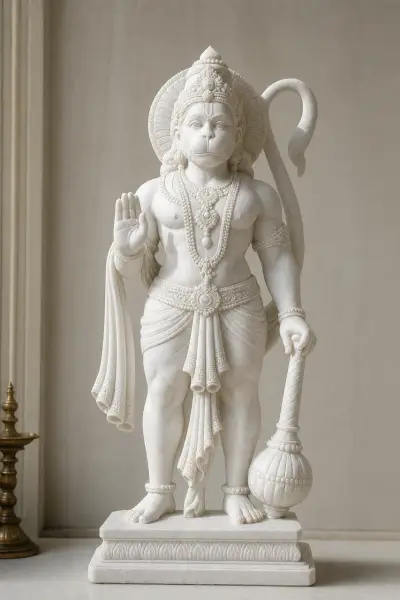
Custom Made Hanuman Statues in Marble Stone
Hand-carved Hanuman murtis in marble: standing blessing, Sankat Mochan kneeling, Panchmukhi, fierce Veer with gada, or flying with the Sanjeevani mountain. Choose your stone, size, and pose. Start with a free WhatsApp consultation.
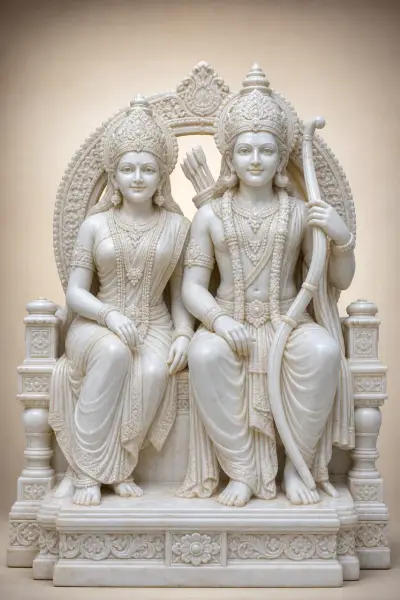
Custom Made Ram Sita Statues in Marble Stone
Hand-carved Ram Sita pairs in marble. Choose your stone, size, and pose. Seated on throne or standing, traditional Jaipur craftsmanship. Start with a free WhatsApp consultation.
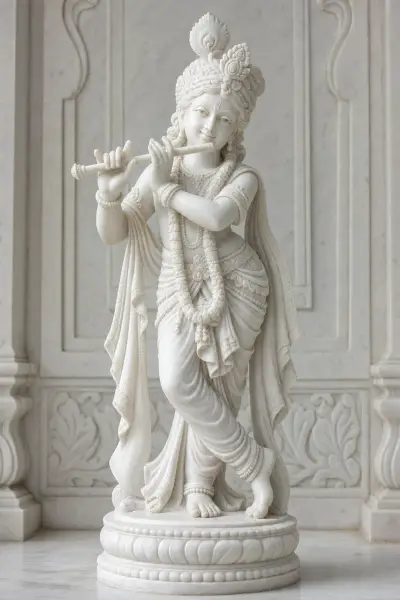
Custom Made Krishna Statues in Marble Stone
Hand-carved Krishna statues in marble: Murli Manohar with flute, Bal Gopal, Radha-Krishna pairs, and narrative forms like Kaliya Mardan. Choose your stone, size, and pose. Traditional Jaipur craftsmanship. Start with a free WhatsApp consultation.
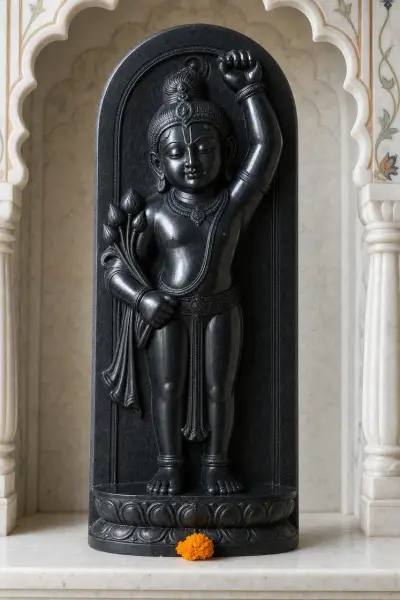
Custom Made Shrinathji Marble Murti — Nathdwara Swaroop
The Nathdwara swaroop, his left arm raised to the arch and his right hand at his waist, carved to order in black stone or white marble, from a 9-inch apartment mandir piece to a 36-inch wall panel.
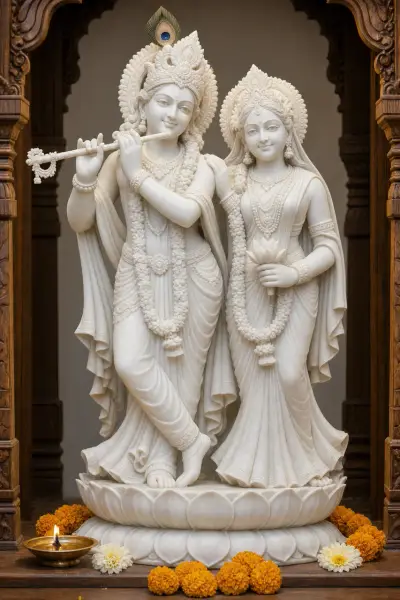
Custom Made Radha Krishna Jugal Jodi Statues in Marble Stone
Hand-carved Radha Krishna jugal jodi pairs in marble. Choose your stone, size and pose. Standing, seated, with peacock or cow. Start with a free WhatsApp consultation.
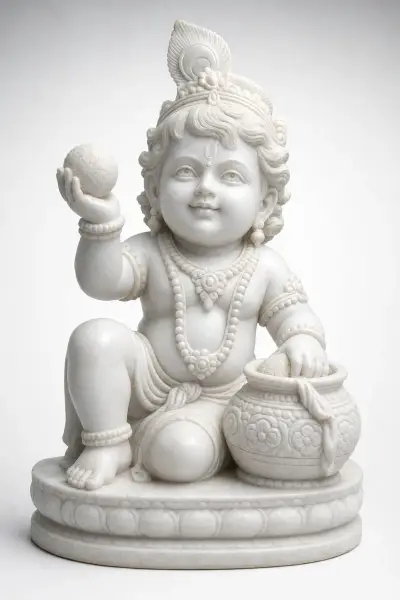
Custom Made Laddu Gopal Marble Murtis — Bal Gopal & Makhan Chor
The infant Krishna, carved to order in Makrana and Vietnam white marble, Dholpur pink sandstone, black stone and cast marble dust, from a 6-inch shelf murti to an 18-inch jhula.