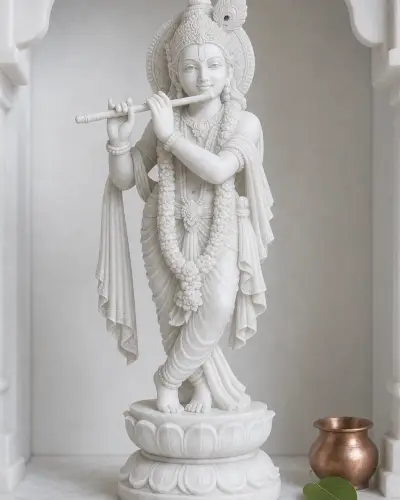
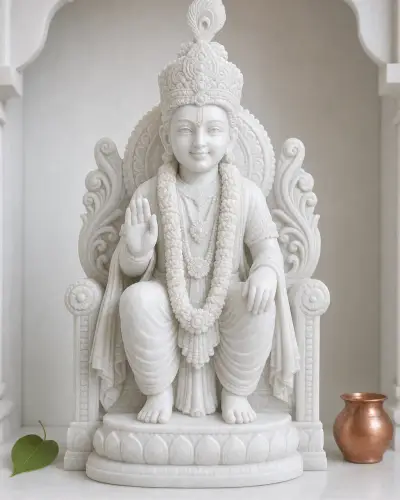
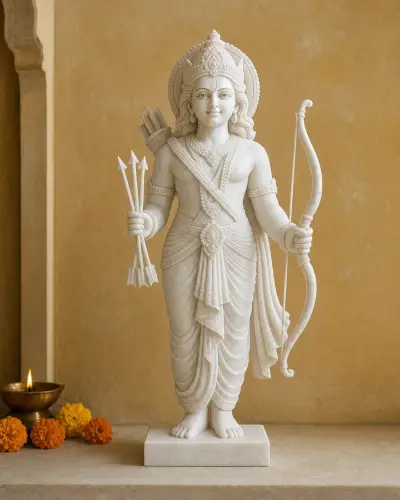
Handcrafted Vietnam White Marble Barbarika on the Blue Horse Murti, 18in
Sculptor-carved Vietnam white marble Khatu Shyam Ji on horseback, an 18-inch home-temple murti of Veer Barbarika with his three arrows.
Made to order. The pictures here are concept images. This is not a ready item. We get it made for you as per this design, as close as possible, in the size and stone you choose.
Want this design made for you?
Tell us the size, the stone and where it is going. We will send you a quote and a timeline.
Chat on WhatsAppWe'll respond within 5 minutes
About This Piece
The leele ra aswar form
Leele ra aswar, the rider of the blue horse, is one of Shyam Baba’s oldest epithets, sung on the Phalgun walk from Ringas to Khatu long before it reached print. This 18-inch murti carves that line: Veer Barbarika, the young Mahabharata archer, seated astride a horse standing four-square, both figures raised on one rectangular plinth. He is beardless and long-haired, a low crown across the brow, and he carries the mark that fixes his identity: the teen baan, three arrows held clear of the bow so they can be counted. In white marble the horse reads as stone; the blue lives in the name.
Vietnam white marble, softly polished
The stone is Vietnam white marble from Thanh Hoa province, a bright neutral white with a clean cool undertone and a fine crystalline grain, closer to porcelain than to the warmer cream of Makrana. The surface is taken to a soft satin polish rather than a mirror, which is the right call on a piece this busy: mirror gloss flares under an altar lamp and swallows small carved detail, while satin keeps the saddle borders, the bridle rosettes and the plinth moulding readable from a metre away.
Carving a rider and a horse from one block
An equestrian murti is among the harder things to ask of a block of marble. Four slender legs, the open space beneath the horse’s belly and the rider’s raised arm all have to come out of stone that has no give, and the sculptors we work with cut them together rather than joining separate pieces. Plinth, horse and rider are continuous. Machines set out the mass and rough the form, as they do across Jaipur; the face, the hands, the three arrowheads and the drapery folds are finished by hand, where a chisel is still faster and truer than the tools that replaced it.
Where an 18-inch piece sits
At 18 inches tall and roughly 19 inches across the plinth, this is a shelf-and-console murti rather than a floor piece, suited to a home mandir with a 24-inch clear span, a puja-room niche, or a living-room console where the horse’s profile has room to read. It weighs about 30 kg, so the shelf it stands on should be a fixed one. Place it at chest height or above and leave the front open: this is a form people like to look at from the side, where the whole line of the horse is visible.
Make it yours
We design the piece with you and follow it through to your door. The same form can be cut larger for a temple or an entrance, taken in Makrana white marble or black stone instead, or given a deeper plinth for a name inscription. If a murti in this form has already been carved, we ask the sculptors we work with and send you photographs of the actual piece, so there is no carving wait; a fresh commission runs eight to twelve weeks. Message us on WhatsApp with your shelf dimensions and we will tell you which sizes actually fit.
Specifications
Pose
Veer Barbarika mounted on his horse — the leele ra aswar form: a beardless youth with exactly two arms, a bow in one hand and the three arrows (teen baan) raised in the other, a quiver at the shoulder, the horse standing four-square with a carved saddle and bridle, both figures on a shared rectangular plinth
Color
Natural White
Finish
Soft polish (satin)
Material
Vietnam White Marble
Ideal For
home temple, living room
Weight In Kg
30
Depth In Inches
8
Width In Inches
19
Height In Inches
18
Region Or Tradition
Indian / Rajasthani (Khatu, Shekhawati — Shyam Baba tradition)