

Custom Made Marble Jhula for Laddu Gopal & Krishna
Swings carved to order for the murti you already have, in Makrana and Vietnam white marble, Dholpur pink sandstone, black stone and cast marble dust, from a 9-inch cradle to a 24-inch pavilion.
The jhula line
Every jhula here is sold with an empty seat, so the Laddu Gopal already in your house is the one that sits in it. Tell us the number or the height of your murti and we will size the seat to it.
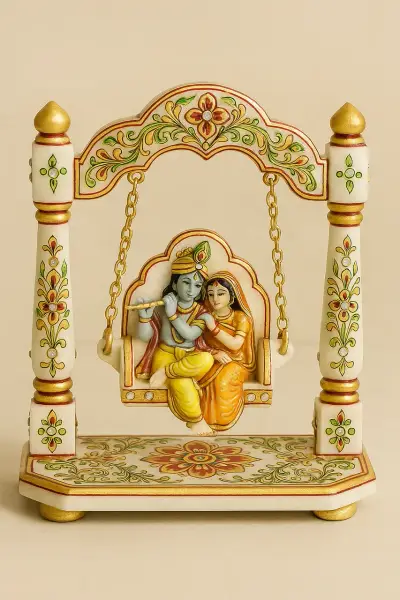
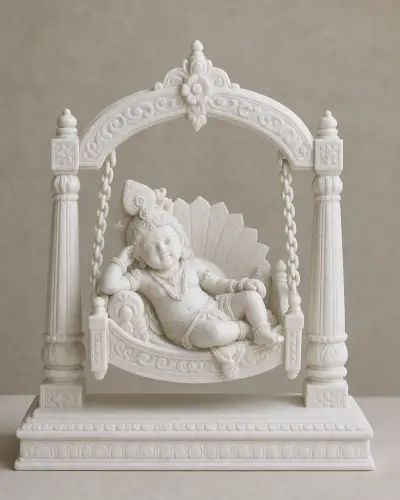
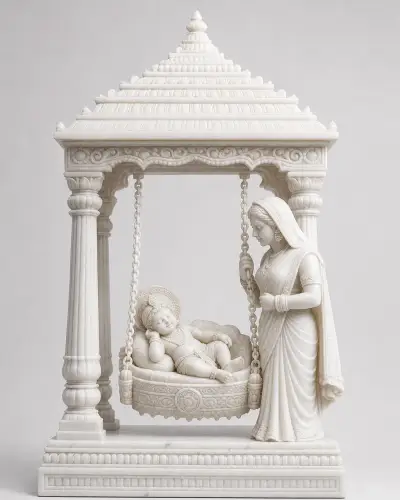
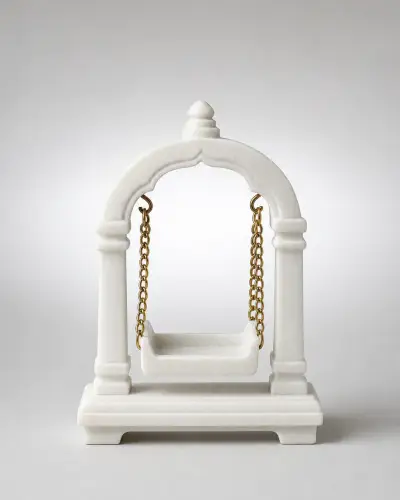
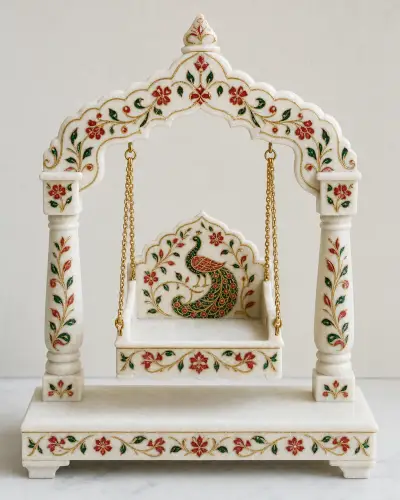
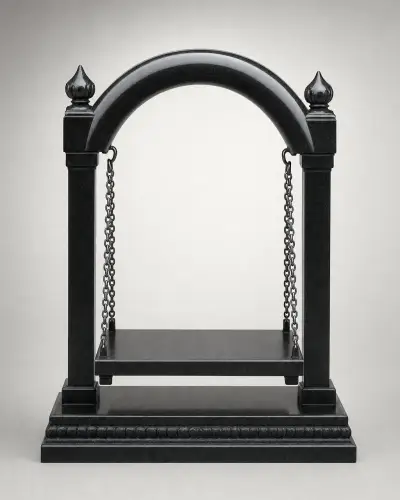
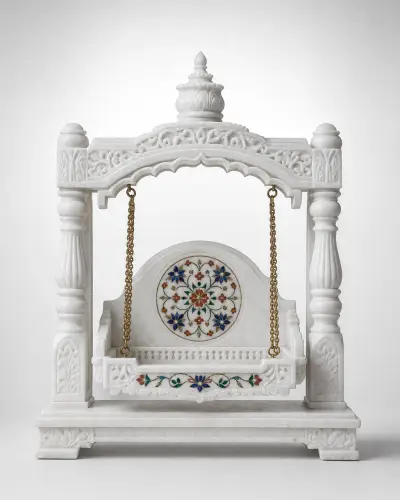
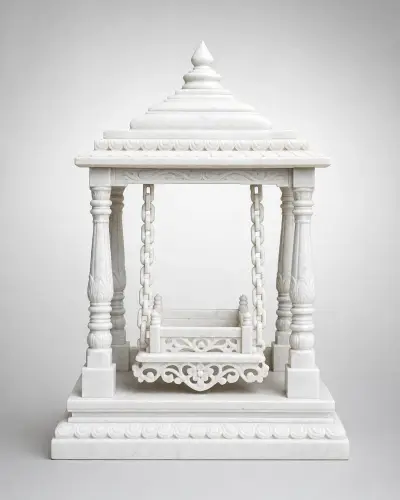
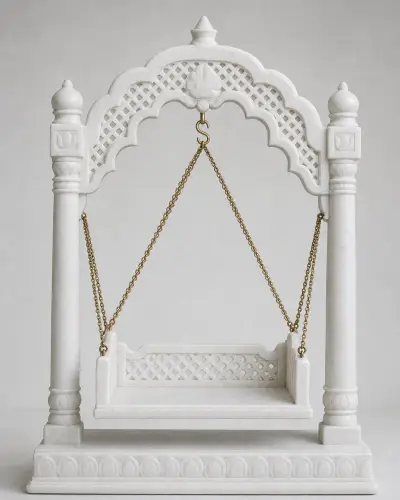
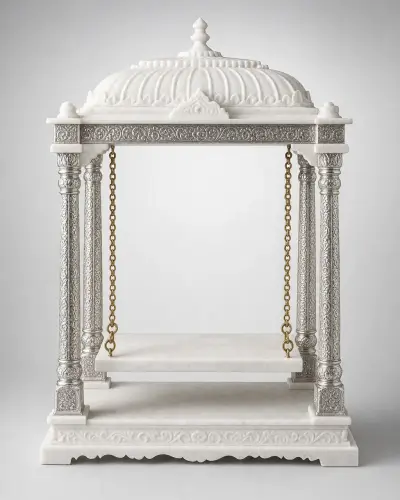
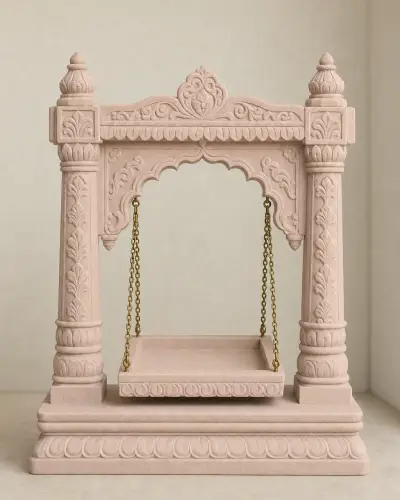
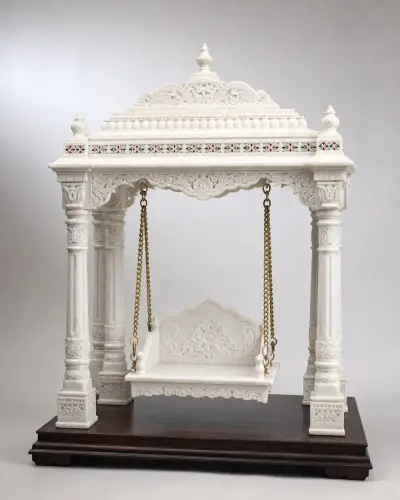
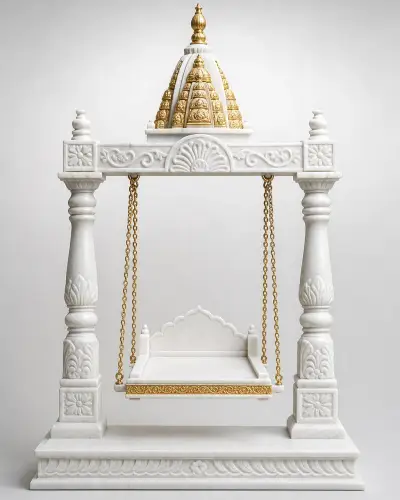
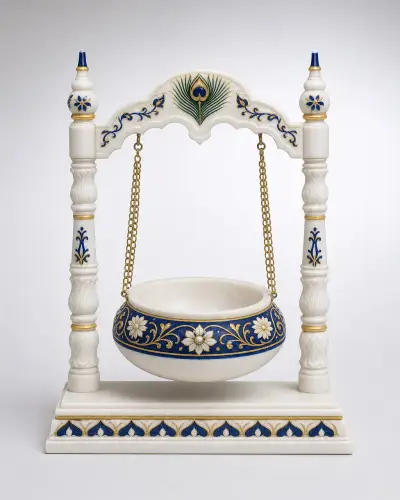
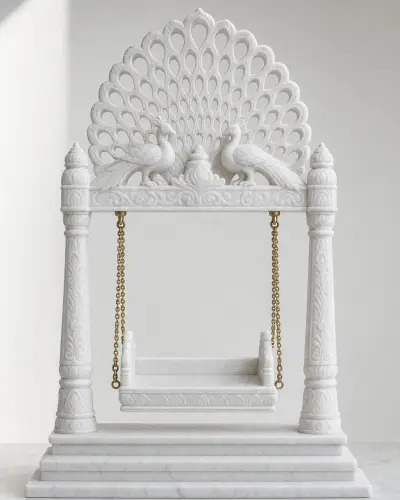
Marble jhulas for Laddu Gopal
A jhula is the swing a household keeps for its Thakurji. In Braj homes the Laddu Gopal is not only worshipped but looked after (dressed, fed, put to rest), and the jhula is the piece of furniture that belongs to that relationship. It is rocked on Janmashtami night, and through Shravan during Jhulan Yatra it becomes the centre of the mandir. The murtis themselves are on our Laddu Gopal page; this collection is the swings they sit in, cut in stone rather than the wood, brass or thread the trade usually offers.
The seat is empty, and that is the point
Every jhula in this collection is sold on its own, with a bare seat. That is deliberate. The Laddu Gopal in a house is very often one that has been there for years (inherited, or brought back from Vrindavan, or given at a wedding), and it is not a thing families replace to match a swing. So the swing is made to receive the murti you already have.
It also means the jhula has to be sized to something we have not made. That is the one measurement we ask you for, and it changes the whole piece: the width of the seat, the height of the crossbeam, the length of the chains. A few of the pieces here take the other approach and have the child carved into the cradle as part of the stone: the pavilion jhula with Yashoda and the compact cast one are single objects, murti and swing together. Both are worth knowing about, because they answer a different question: one is furniture, the other is a murti that happens to be in a swing.
The jhulas carved here
The line runs from a shelf-sized cradle to a piece that anchors a room.
At the small end, the compact cast jhula at 9 inches is sized for a no. 0 to 2 murti and is the lightest thing here. The matki jhula shapes the seat as an open butter pot, hand-painted in blue and gold.
In the middle sit the decorated pieces: the meenakari jhula painted in red, green and gold with a peacock on the back panel; the jali jhula with lattice pierced through the stone; the peacock jhula whose canopy is cut as a fanned tail; and the kalash-top jhula with coloured stone inlay set into the seat apron. For a modern mandir there is a black stone jhula with the ornament stripped out entirely, and in pink sandstone a Vrindavan courtyard jhula with a scalloped cusped arch.
At the top of the range are the architectural pieces: the pillared pavilion, the gold-leaf shikhar jhula for a no. 5 to 8 murti, the silver-clad pillar jhula, and at 24 inches a temple-scale jhula on its own hardwood plinth, sized for a no. 9 to 12 murti.
Carved chain, or brass
This is the fork that decides what a jhula costs and how long it takes.
On most pieces the seat hangs from brass chain, fitted to cast or carved lugs in the stone. Brass is sourced and fitted rather than made by us. It is strong, it is easy to replace if it is ever damaged, and it lets the seat hang from a thinner section of stone, which is what makes the smaller and lighter jhulas possible at all.
On a few pieces the chain links are carved free from the marble itself, one link at a time, out of the same block as the rest of the piece. Nothing is assembled: the sculptor drills and releases each link in turn, and a link that breaks means starting that run again. It is slow, it wastes stone, and it only works in a dense marble like Makrana. What you get is a jhula with no metal on it anywhere. If that matters to you, say so when you write to us, because it changes both the quote and the timeline.
Choosing the stone
Makrana white is the traditional choice and the one that carries the most carving. It is dense enough for pierced canopies, thin chain sections and deep bracket work, and it reads bright natural white with faint grey veining. Vietnam white is cooler and cleaner and suits a mandir with modern joinery. Black stone turns the jhula into a graphic object rather than a devotional one, which is right for some rooms and wrong for others. Dholpur pink sandstone has a claim here that it does not have everywhere: Vrindavan's own Govind Dev Ji and Madan Mohan temples are pink stone, so a pink jhula is closer to Braj than a white one. Cast marble dust is the lightest and most affordable, and is what the smallest pieces are made in.
Sizing the seat, and where the jhula sits
The line runs 9 to 24 inches overall, and the useful number is not the jhula's height but its seat. Leave room on either side of the murti so it can be dressed without lifting it out. A poshak adds bulk, and a seat cut exactly to the murti stops being usable the first time it is dressed for a festival.
Weight decides the rest. The cast pieces sit comfortably on an ordinary mandir shelf. The larger marble ones do not: an 18-inch pavilion in Makrana is heavy enough to want a stone slab, a marble shelf or a solid hardwood chowki under it, and the 24-inch piece comes with its own plinth for that reason. Leave clear space above the finial as well, so the roof is not pressed against whatever sits over it, and enough in front that the seat can actually swing.
Jhulan seva: the swing is meant to move
A jhula that cannot move is an ornament. These are built so the seat swings, because the rocking is the seva: during Jhulan Yatra in Shravan the deity is swung while bhajans are sung, and on Janmashtami night the cradle is rocked at midnight. The same practice runs under other names elsewhere: Dolotsavam in the Agama tradition, Unjal seva in South Indian temples, where the deity is seated in a swing pavilion before the congregation.
Two practical consequences. The seat is hung slightly forward of the pillars so it clears them through its travel, and the chains are made a little longer than they need to be, because a short chain gives a jerky swing rather than a slow one.
Caring for it
Dry dust it with a soft cloth; a barely damp cloth for anything stubborn. The thing that actually damages a jhula is not wear but staining. Haldi, kumkum and the dye in a freshly washed poshak all bleed into porous stone, and a seat is exactly where they land. Dry the piece after abhishek rather than letting milk or panchamrit stand on it. No acidic cleaners. Brass chain can be polished with an ordinary brass cleaner, kept off the stone; carved stone chain needs nothing but dusting.
Make it yours
Pick a jhula you like and tell us the number or the height of your Laddu Gopal, and we will size the seat to it. Almost everything else is open too: a different stone, a plainer roof, meenakari instead of inlay, a name or a date cut into the plinth for a first Janmashtami or a housewarming. And if what you have in mind is not on this page at all, send us a photograph or a drawing. A jhula copied from one a family already owns is a normal request here, not an unusual one.
Why choose Tilak Mandirwala
Discover why families and temples worldwide trust us for their sacred sculptures
Fully customizable designs
Every statue is made-to-order. Choose the size, marble type, posture, expression, and more to suit your space and spiritual needs.
Crafted in Jaipur by skilled artisans
Rooted in the Pink City's marble heritage, our artisans have a rich history of sculpting custom spiritual statues. Our studio in Khazane Walon Ka Rasta, Jaipur, sits at the heart of this tradition.
Trusted by 300+ families & temples
From NRIs to temple trusts, our clients rely on us for authentic, high-quality spiritual statues and marble temples.
Secure & global delivery
We ship across India and worldwide with multi-layered packaging and transport you can trust.
Better value from local production
Direct artisan collaboration allows us to offer unmatched quality at fair, factory-direct pricing, whether you're ordering a single spiritual statues or multiple pieces for a full temple setup.
Spiritual intent in every sculpture
We understand that every idol holds emotional and devotional meaning, and our process honors that, from first sketch to final polish.
How we create your custom spiritual statues
From your vision to sacred sculpture: our transparent 7-step process
Share your requirement on WhatsApp
Send us a picture you like, from our gallery or something you found elsewhere. Just share your ideas and preferences over WhatsApp.
We understand your vision
We'll connect via WhatsApp or a quick call to discuss size, marble, pose, and finish, and confirm what's possible with our artisans.
Quotation & timeline
Once details are clear, we'll share a quotation and estimated timeline to craft your custom spiritual statues.
Advance payment to get started
A small advance helps us begin. It covers the cost of stone and artisan time, as the process can't be reversed. (Varies by design and size.)
Production & progress updates
Our artisans begin sculpting your statue. We share images at key stages so you stay involved throughout.
Final approval & dispatch
You approve the final photos before we pack and ship the finished statue securely.
Delivery first, then final payment
We collect the remaining amount only **after your statue arrives safely**, because your peace of mind comes first.
Frequently asked questions
Get answers to common questions about our custom sculptures
Can I get a jhula in time for Janmashtami?
What size jhula do I need for my Laddu Gopal?
Does the jhula come with the Laddu Gopal murti?
Does the jhula actually swing?
Which stone should I choose?
How do I look after a marble jhula?
Commission your jhula
Tell us the size of your Laddu Gopal, the stone you want and the decoration. We will send you a quote and a timeline, and follow the piece through to your door.
Get a quoteImporting statues for your store or gallery? Marble statue supplier for importers
Prefer to see the marble before you order? Visit our showroom in Jaipur, or send us your size and budget.
Browse Other Collections
Discover more collections that might interest you
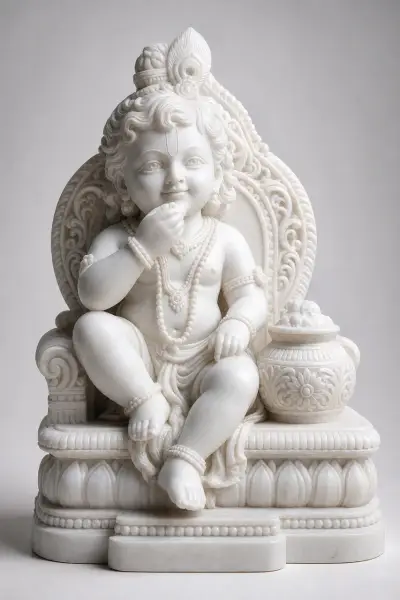
Marble Krishna Murtis for Janmashtami
Hand-carved marble murtis for Janmashtami: the infant Laddu Gopal, the Radha Krishna jugal jodi, Shrinathji and the flute-playing Murli Manohar. Start with a free WhatsApp consultation.
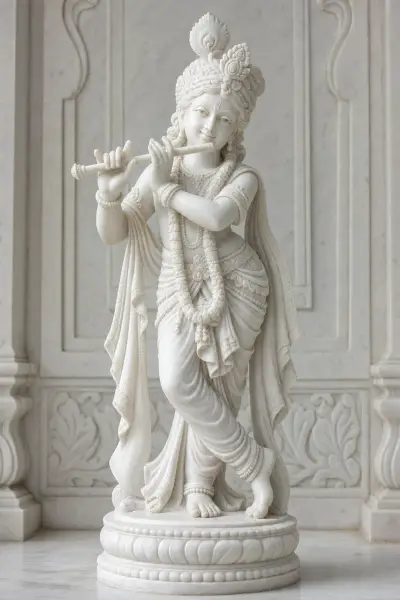
Custom Made Krishna Statues in Marble Stone
Hand-carved Krishna statues in marble: Murli Manohar with flute, Bal Gopal, Radha-Krishna pairs, and narrative forms like Kaliya Mardan. Choose your stone, size, and pose. Traditional Jaipur craftsmanship. Start with a free WhatsApp consultation.
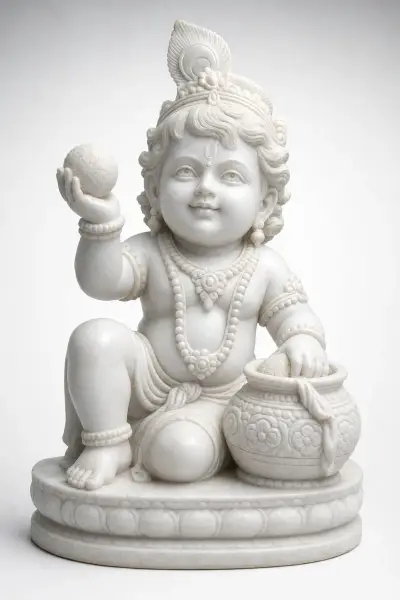
Custom Made Laddu Gopal Marble Murtis — Bal Gopal & Makhan Chor
The infant Krishna, carved to order in Makrana and Vietnam white marble, Dholpur pink sandstone, black stone and cast marble dust, from a 6-inch shelf murti to an 18-inch jhula.
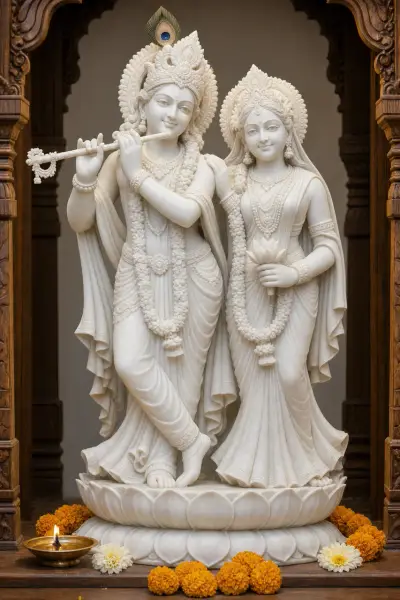
Custom Made Radha Krishna Jugal Jodi Statues in Marble Stone
Hand-carved Radha Krishna jugal jodi pairs in marble. Choose your stone, size and pose. Standing, seated, with peacock or cow. Start with a free WhatsApp consultation.
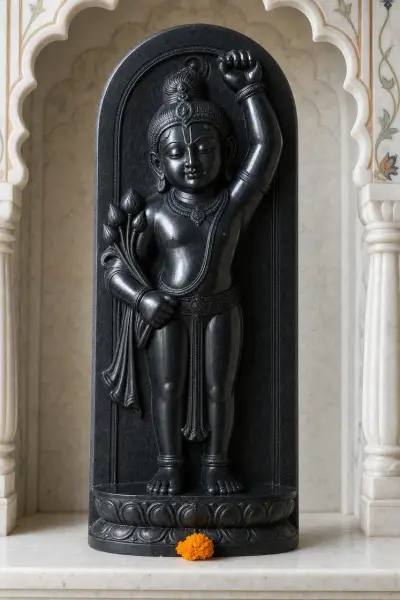
Custom Made Shrinathji Marble Murti — Nathdwara Swaroop
The Nathdwara swaroop, his left arm raised to the arch and his right hand at his waist, carved to order in black stone or white marble, from a 9-inch apartment mandir piece to a 36-inch wall panel.
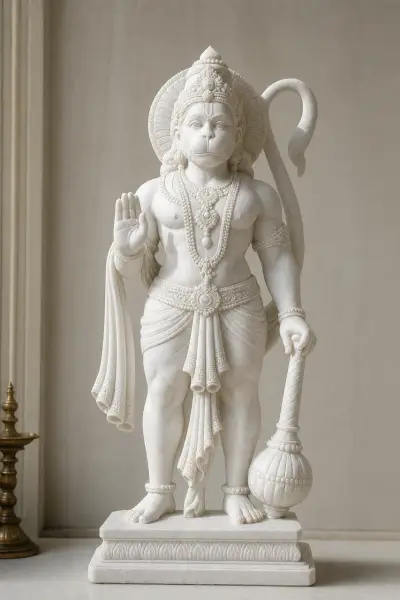
Custom Made Hanuman Statues in Marble Stone
Hand-carved Hanuman murtis in marble: standing blessing, Sankat Mochan kneeling, Panchmukhi, fierce Veer with gada, or flying with the Sanjeevani mountain. Choose your stone, size, and pose. Start with a free WhatsApp consultation.