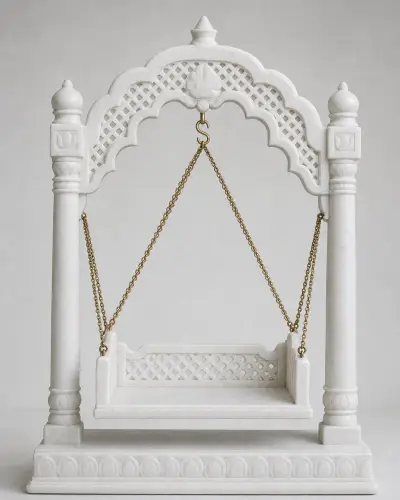
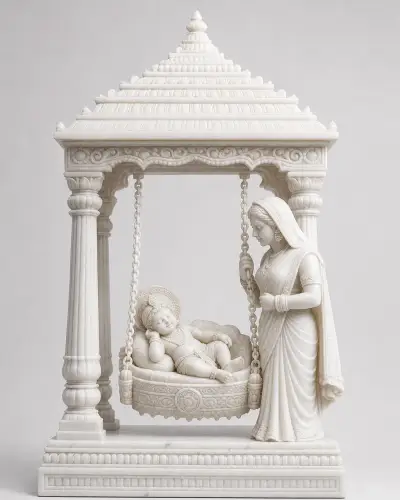
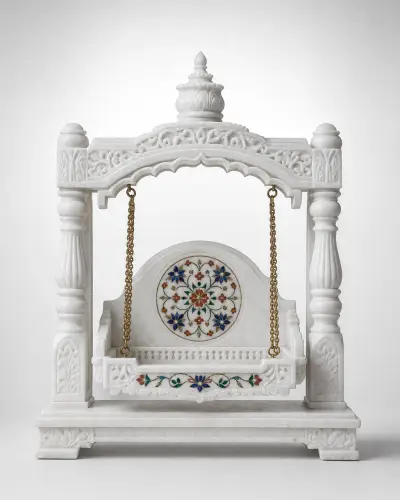
Vietnam White Marble Peacock Jhula with Pierced Canopy, 16 in
Master-carved Vietnam white marble peacock jhula. 16 inches, with a pierced fanned-tail canopy above a bare seat on brass chains.
Made to order. The pictures here are concept images. This is not a ready item. We get it made for you as per this design, as close as possible, in the size and stone you choose.
Want this design made for you?
Tell us the size, the stone and where it is going. We will send you a quote and a timeline.
Chat on WhatsAppWe'll respond within 5 minutes
About This Piece
The stone
Vietnam White Marble comes out of the quarries around Thanh Hoa province in northern Vietnam, and it has been a working stone in Jaipur's carving sheds since the 2000s. It reads a clean, cool white, brighter and less creamy than Makrana, with a fine crystalline grain and only faint hairline veining. On a jhula that grain matters more than it would on a solid figure, because a swing is mostly air. Every eyelet cut through the peacock-tail canopy leaves a thin bridge of stone that has to hold its edge, and the posts and crossbeam have to stay slender enough to read as a swing rather than a block. Tight, even stone lets the carver take the lattice right through the panel without the openings chipping at the rim, and it holds the satin polish this piece is finished to without tipping into a glassy shine.
The peacock canopy
Above the crossbeam a peacock's tail opens into a full fan and is pierced clean through the marble, so the canopy is a screen of stone eyelets rather than a solid back panel. Light passes between them, and a diya set to one side throws the pattern onto the wall behind. Two small peacocks stand on the beam itself, facing each other across a carved kalash, their tails trailing down either side. The motif is not borrowed decoration. In Braj the peacock belongs to Krishna: its feather sits in his crown, and the birds of Vrindavan are described dancing when he plays. Carving that tail as the canopy over the cradle keeps the association in the object rather than in a label. The frame below it carries a running floral band, and the two posts are worked with lotus-petal collars and small pot finials.
The empty seat
The seat is bare on purpose. TMW's earlier jhulas carry the child carved into the cradle, which means the swing and the murti arrive as one object; this one is mandir furniture sold on its own, so the Laddu Gopal you already do seva for is the one that goes into it. The seat is a flat carved platform with low side rails, sized for a murti of roughly five to six inches, and it hangs from the crossbeam on slender brass chains. The chains and their hooks are sourced brass, cut to length and fitted to the carved stone at the workshop rather than made there. The marble is the piece; the brass is the hardware. There is enough travel in the chains to rock the swing gently by hand during jhulan seva without the seat knocking against the posts.
Sizing it for a home mandir
At 16 inches tall on a plinth about 12 inches across, this sits as the centre object on a mandir shelf rather than beside one, so allow around 20 inches of clear height above the shelf so the peacock fan is not crowded by the tier above. It weighs roughly nine kilos, so a wall-mounted shelf wants proper anchoring; a stone or wooden platform is easier. Wipe it with a soft dry cloth, use a barely damp one for the recesses in the lattice, and keep water off the brass. If the murti you keep is larger or smaller than this seat takes, or you would rather have the same canopy in Makrana white marble, on a wider plinth, or with the peacocks left off the crossbeam, each is carved to the drawing.
Specifications
Base
Stepped rectangular marble plinth, integral to the piece
Color
Natural White
Finish
Soft polish (satin)
Material
Vietnam White Marble
Ideal For
Home mandir, Pooja room, Janmashtami
Set Or Pair
Single
Primary Size
16 inch tall x 12 inch wide x 6 inch deep; seat sized for a 5 to 6 inch murti
Weight In Kg
9
Depth In Inches
6
Width In Inches
12
Height In Inches
16
Companion Elements
brass chain, brass S-hook
Region Or Tradition
Indian / Braj (Vrindavan, Vaishnav jhulan seva tradition)
Motif Or Iconography
Fanned peacock-tail canopy pierced through the stone, with a facing pair of peacocks on the crossbeam