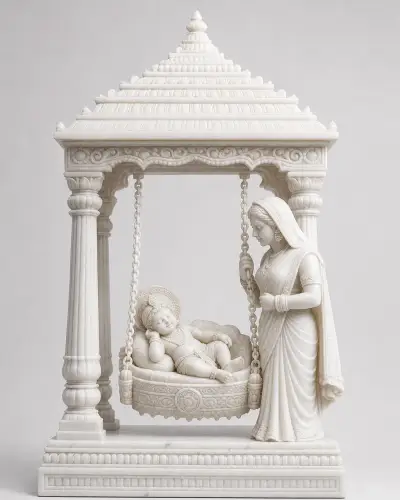
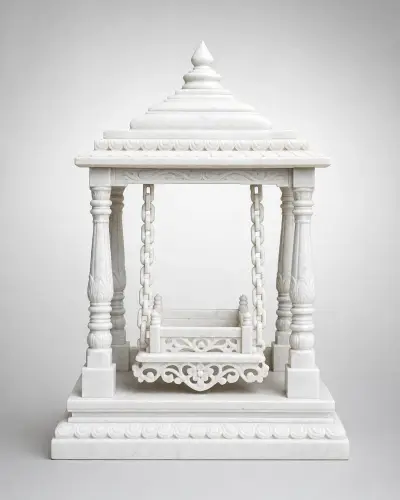
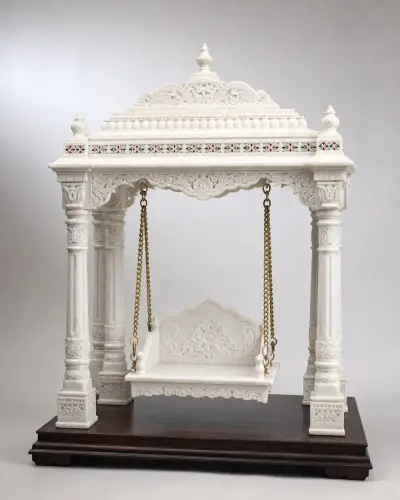
Makrana White Marble Kalash-Top Jhula with Pietra Dura Inlay, 16 in
Hand-carved Makrana marble jhula with a kalash crown and pietra dura inlay, 16 inches tall, with the seat left empty for your own murti.
Made to order. The pictures here are concept images. This is not a ready item. We get it made for you as per this design, as close as possible, in the size and stone you choose.
Want this design made for you?
Tell us the size, the stone and where it is going. We will send you a quote and a timeline.
Chat on WhatsAppWe'll respond within 5 minutes
About This Piece
The stone
Makrana marble comes out of the quarries in Nagaur district, Rajasthan, the stone that faces the Taj Mahal and a good deal of Rajasthan's temple architecture besides. It is a dense, fine-grained calcite marble with a bright natural white body and faint grey hairline veins drifting through it, and it holds a satin polish that stays warm under a lamp rather than turning glassy. On a piece this small the density matters more than it appears to: the turned side posts, the cusped arch and the pierced railing along the seat front are all thin sections, and a softer or coarser stone would chip at those edges within a season of handling. The surface here is finished to a soft satin polish, worked by hand so the carved faces keep a little tooth while the flat panels read smooth.
The kalash crown and the carved frame
The jhula stands on a stepped rectangular plinth, with two turned posts rising to a carved crossbeam. Above the beam sits a scalloped cusped arch, the multifoil profile found over temple doorways across Rajasthan and Gujarat, and the whole frame is topped by a kalash finial, the pot-and-lotus form that crowns a shikhara and marks this as a shrine object rather than a decorative swing. Foliate scrollwork runs along the beam and down the outer faces of the posts. The seat hangs from slender brass chains, sourced and fitted rather than worked in stone, so it swings the way a jhula is meant to when someone in the house sets it moving on Janmashtami night.
The pietra dura inlay
The colour comes from parchin kari, the stone-inlay craft Mughal workshops carried into Agra and Jaipur in the seventeenth century and that Rajasthani inlay families have kept alive since. Shaped slivers of lapis, malachite, carnelian and mother-of-pearl are set into channels cut in the marble, then ground flush so the finished surface stays level to the hand. A single floral roundel fills the arched back panel, an eight-petal rosette at its centre with blue lotus heads at the compass points. A running vine of the same stones crosses the seat apron below. Under a lamp the lapis reads a deep blue and the malachite a true green. This is mineral colour, not paint, so it will not fade or lift with cleaning.
An empty seat, by design
Most marble jhulas arrive with the infant already carved into them, cut from the same block. This one does not. The seat is a bare carved platform and it is meant to stay that way until you set your own Laddu Gopal into it: the murti a household already has, already dresses, already feeds. The seat is sized for a 5 to 6 inch murti, with a pierced railing on three sides to keep it steady, and the cavity is open so a poshak and its ornaments clear the edges rather than being pressed against them. That makes the jhula an accessory to a family's existing puja rather than a substitute for it, which is how a jhula is actually used at Janmashtami.
Sizing it for a home mandir
At 16 inches tall and roughly 13 inches across, the piece sits on a mandir shelf, a console beside one, or the floor of a puja alcove, and it wants about a foot of clear height above the finial so the kalash is not crowded by whatever sits over it. Marble is a still material and a jhula is a moving one, so give it a level surface; an uneven shelf lets the seat swing off-axis and knock against the posts. Wipe it with a dry or barely damp cloth. Keep lamp oil, flower water and any acidic cleaner off the inlay, since acid dulls the polish and etches the softer stones. Other heights, a plain uninlaid frame, or a different inlay palette can be made to your brief.
Specifications
Base
Stepped marble plinth, 1.5 inch thick
Color
Natural White
Finish
Soft polish (satin)
Palette
White marble with lapis, malachite, carnelian and mother-of-pearl inlay
Material
Makrana White Marble
Ideal For
Home mandir, Pooja room, Janmashtami
Set Or Pair
Single
Primary Size
16 inch tall × 13 inch wide swing frame, seat sized for a 5 to 6 inch murti
Weight In Kg
12
Height In Inches
16
Companion Elements
brass suspension chains
Region Or Tradition
Indian / Mughal (Agra–Jaipur parchin kari inlay tradition)
Motif Or Iconography
Kalash finial above a cusped arch, with pietra dura floral roundels in the back panel and seat apron