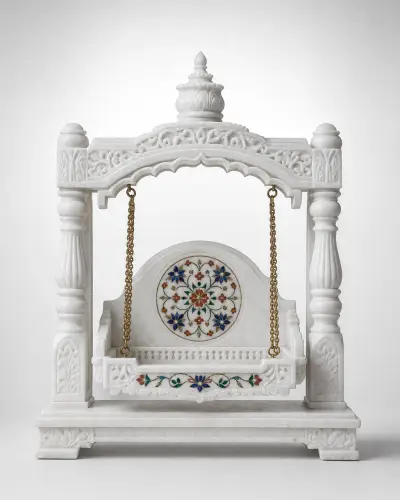
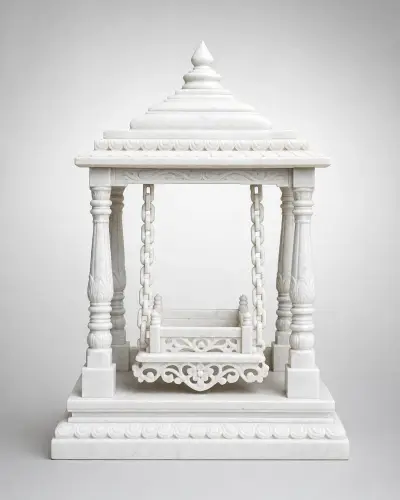
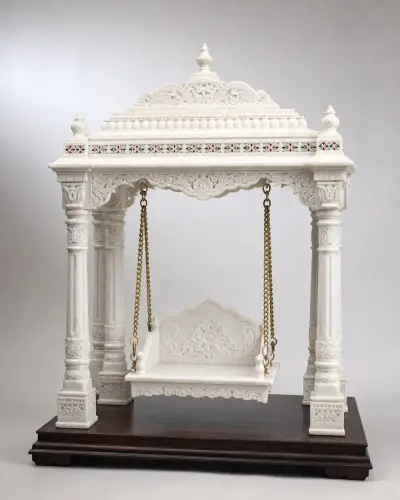
Makrana White Marble Bal Gopal on Carved Jhula with Pavilion, 18 in
Sculptor-carved Makrana white marble Bal Gopal in a chain-hung jhula, an 18-inch home mandir centrepiece under a pillared pavilion.
Made to order. The pictures here are concept images. This is not a ready item. We get it made for you as per this design, as close as possible, in the size and stone you choose.
Want this design made for you?
Tell us the size, the stone and where it is going. We will send you a quote and a timeline.
Chat on WhatsAppWe'll respond within 5 minutes
About This Piece
The Janmashtami cradle, carved whole
Bal Gopal is Krishna as the infant of Gokul, and the jhula, the cradle rocked for him on Janmashtami night, is the form this murti takes. The whole tableau is cut from a single block of marble: four pillars carrying a tiered roof and kalash finial, a cradle hung on carved chains from the crossbeam, and Yashoda standing beside it with one hand resting on a chain. The infant lies on his side asleep, with the large head and soft rounded limbs of a real child rather than a shrunken adult, wearing anklets, bead strands and a small crown. There is no flute anywhere on the piece: the murli belongs to the grown Krishna of Vrindavan, not to the child in the cradle.
Makrana white marble
Makrana marble is quarried in the Nagaur district of Rajasthan, roughly 300 km west of Jaipur, and it is the stone the Taj Mahal was faced with in the seventeenth century. It reads bright natural white with a faint warm undertone, never the cool blue-grey of Italian stone, and carries fine grey hairline veins through a compact, lightly sugary grain. That density is what makes this composition possible: the suspended chain links and the pierced canopy above them are thin sections, and a softer stone would chip at them. The satin polish keeps the sheen low, so the carved band along the roof and the floral apron under the cradle stay legible instead of disappearing into highlights.
How this one is made
Every Bal Gopal jhula is cut to order. Nothing is carved ahead and warehoused. TMW designs the piece with you, briefs the master sculptor who will take it on, and follows it through to delivery at your door. Work moves from rough block to primary shaping, then to detail carving and a graded polish. The chains are the slow part: each link is drilled and released from the solid, one at a time, and a broken link means starting that run again. Faces, hands and the fall of Yashoda's sari are finished entirely by hand, without machine passes, which is why no two pieces read exactly alike even when they come off the same drawing.
Sizing it for a home mandir
At 18 inches tall, 13 inches wide and 8 inches deep, this Bal Gopal jhula works as the centrepiece of a home mandir rather than as a shelf ornament. It weighs close to 22 kg, so it wants a marble slab, a stone plinth or a solid hardwood chowki underneath. A light wall shelf will not carry it. Leave six to eight inches of clear space above the finial so the roof does not sit pressed against whatever is above it. The composition is meant to be read from the front and slightly below, which is how it falls when the mandir is at chest height and you are seated for aarti.
Making it yours
The same jhula can be cut at other heights, and in Vietnam white marble, black stone, Dholpur pink sandstone or cast marble dust instead of Makrana. The pavilion roof can be simplified or made more ornate, and a name or a date can be carved into the plinth for a first-Janmashtami or a housewarming gift. Message us on WhatsApp with the size you have in mind and we will quote it.
Specifications
Pose
Reclining asleep in a chain-hung jhula cradle within a pillared pavilion, Yashoda standing beside with one hand on the chain
Color
Natural White
Finish
Soft polish (satin)
Material
Makrana White Marble
Ideal For
Home mandir, Pooja room centrepiece, Festive display
Weight In Kg
22
Depth In Inches
8
Width In Inches
13
Height In Inches
18
Region Or Tradition
Indian / Braj (Vrindavan, Vaishnava tradition)