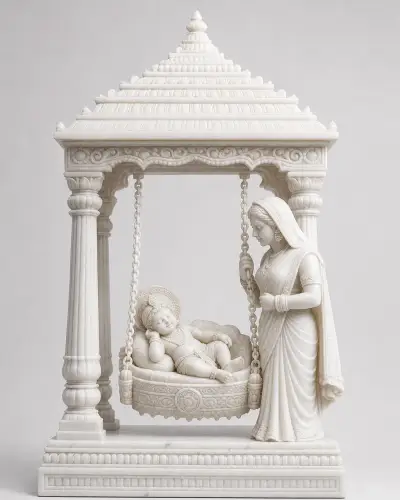
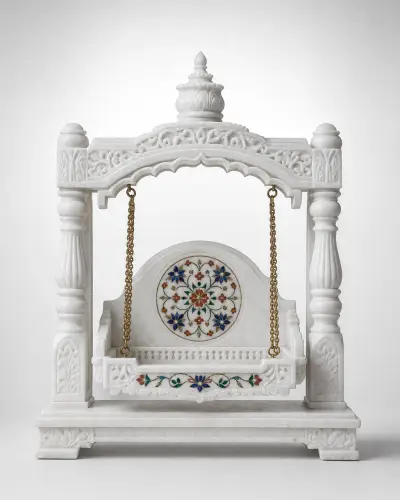
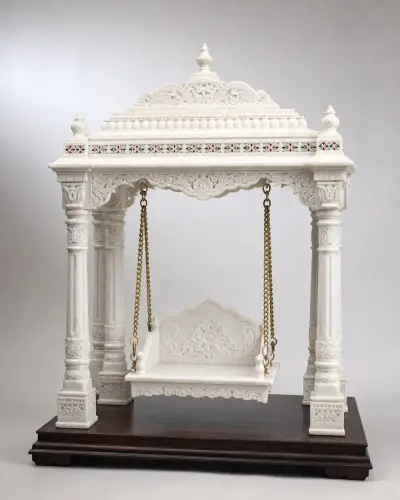
Makrana White Marble Jhula for Laddu Gopal with Pillared Pavilion, 18 in
Hand-carved Makrana marble jhula: a four-pillar pavilion with a kalash finial and a bare cradle hung on chains cut from the solid block.
Made to order. The pictures here are concept images. This is not a ready item. We get it made for you as per this design, as close as possible, in the size and stone you choose.
Want this design made for you?
Tell us the size, the stone and where it is going. We will send you a quote and a timeline.
Chat on WhatsAppWe'll respond within 5 minutes
About This Piece
The swing, and why the seat is empty
A jhula is the small swing a household keeps for its Laddu Gopal, the infant Krishna who is dressed, fed and put to rest as a member of the family rather than kept as a fixed image. This Makrana white marble jhula is made empty on purpose. The cradle is a bare carved platform with no infant, no figure and no murti worked into it, so the Laddu Gopal you already keep goes into the seat instead of one being carved permanently into the stone. The opening takes a murti of roughly five to eight inches, the sizes most homes own. Four pillars stand around it on a stepped plinth and carry a tiered roof with a kalash finial, so the swing reads as a small pavilion rather than a bare frame, and the murti sits inside a shelter rather than out in the open.
The stone
Makrana white marble comes out of the quarries in Nagaur district, Rajasthan, the same beds that supplied the Taj Mahal in the seventeenth century and that have been worked continuously for centuries before and since. It is a dense, closely grained calcite marble, and that density is what lets a fine chisel line hold without the edge crumbling, which matters on a piece carrying pierced work and thin chain links. The colour is natural white with faint grey hairline veining that runs differently through every block, so the jhula you receive will not repeat a photograph line for line. The surfaces take a soft satin polish rather than a mirror one: light settles on the stone instead of bouncing off it, which keeps the carving readable under the low lamps of a pooja room rather than flattening it into glare.
Chains cut from one block
The two chains carrying the cradle are not made and fitted. They are cut. The carver works them out of the same block as the crossbeam, link by link, freeing each loop from the stone around it without ever opening and closing a joint, and chain work of this kind is what a marble carver in Jaipur uses to show what he can do, because one wrong stroke ends the whole component and the piece starts again. The pierced floral apron under the cradle is opened out the same way, drilled first and then worked by hand until the pattern carries light through it. Nothing on this jhula is glued and nothing is bolted, so what looks like assembled hardware is one piece of marble with the waste taken away.
Sizing it for your mandir
At eighteen inches tall on a plinth about twelve inches across, this jhula is sized for a mandir shelf, a low wooden chowki or a console beside one, and it needs no wall fixing because the plinth carries the whole weight at roughly sixteen kilos. Leave a hand's width of clearance above the finial so the roof is not crowded by the shelf above, and stand it where the murti can be reached from the front for shringar and bhog, since the cradle is dressed far more often than it is looked at. Homes that keep the jhula out through Janmashtami and the Jhulan days usually give it the centre of the mandir for that week and return it to one side afterwards, which this footprint allows without rearranging everything else.
Making it yours
Every part of this is made to order, so the seat can be widened for a larger Laddu Gopal or tightened for a small one, and the overall height moved up or down from eighteen inches to suit your shelf. The apron and pillar carving can stay plain, take a deeper floral cut, or carry parchin kari stone inlay in the panels. If you would rather have brass chains and a cradle that moves, that is a different build and we make it that way too. Send us the height of your murti and a photograph of the shelf on WhatsApp, and we will come back with the proportions we would cut.
Specifications
Base
Stepped rectangular plinth with carved petal band, integral to the piece
Color
Natural White
Finish
Soft polish (satin)
Material
Makrana White Marble
Ideal For
Home mandir, Pooja room, Janmashtami
Set Or Pair
Single
Primary Size
18 inch tall × 12 inch wide × 9 inch deep, seat sized for a 5 to 8 inch murti
Weight In Kg
16
Depth In Inches
9
Width In Inches
12
Height In Inches
18
Region Or Tradition
Indian / Braj Vaishnav (Laddu Gopal jhulan seva tradition, Makrana marble)
Motif Or Iconography
Four-pillar pavilion with tiered roof and kalash finial, empty cradle on free-carved chains, pierced floral apron