Hand-Painted Marble Dust Matki Jhula for Laddu Gopal, 12 in
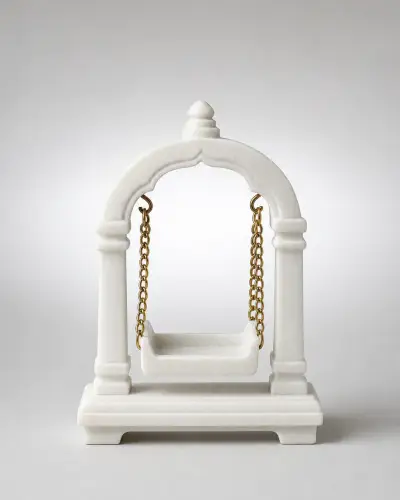
Hand-painted marble dust matki jhula on brass chains, a 12-inch swing with an empty seat, cut for your own Laddu Gopal murti.
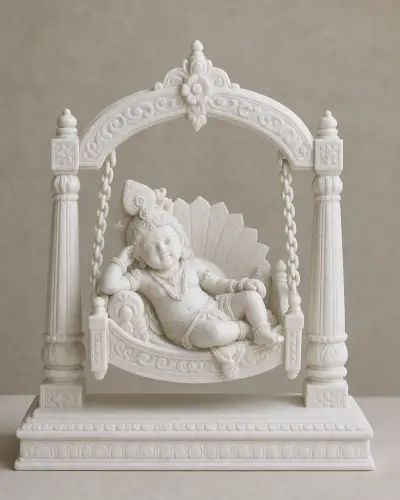
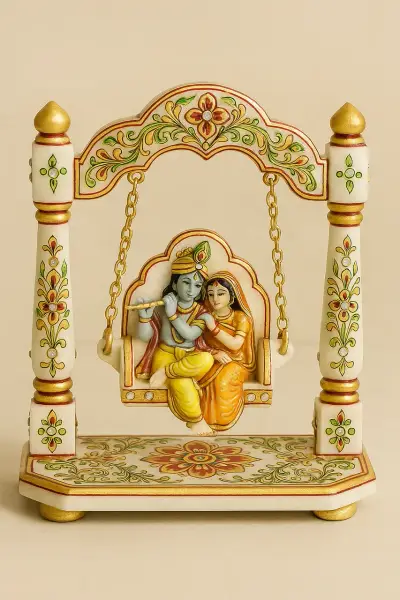
Made to order. The pictures here are concept images. This is not a ready item. We get it made for you as per this design, as close as possible, in the size and stone you choose.
Want this design made for you?
Tell us the size, the stone and where it is going. We will send you a quote and a timeline.
Chat on WhatsAppWe'll respond within 5 minutes
About This Piece
The swing, and why the seat is empty
A jhula is the small swing a Laddu Gopal is seated in at home, and this one arrives with its seat deliberately bare. The seat is shaped as a matki, the round-bellied pot of the Krishna stories, set mouth-upward so the hollow forms an open cradle. Nothing is carved into it. Nothing comes fixed inside. That is the whole point of the piece: most jhulas on the market are sold with a figure already worked into the seat, which leaves no room for the murti a family already keeps, bathes and dresses. Here the cavity is cut for a Laddu Gopal of roughly three to four inches, so your own murti goes straight in, lifts out for its bath and its clothes, and goes back.
Marble dust, brass and hand-painting
The frame is cast in marble dust composite, crushed marble bound with resin and then hand-finished. It is the budget-tier alternative to quarried stone in the Jaipur workshops, and it suits a small piece like this one: fine, even and vein-free, so it takes paint far more predictably than a veined block would. The two turned posts, the arched crossbar and the stepped base are all worked from it, then hand-painted in cobalt blue and gold. A floral band runs around the belly of the pot, scrollwork drops down the posts, and a peacock feather sits at the centre of the arch. The pot hangs from slim brass chains, sourced and fitted rather than made here, and the underside of the base is lined with felt.
Where it sits in the house
At 12 inches this is a shelf and mandir piece rather than a floor one. It works on the middle tier of a home mandir, with the swing at about eye level when you are seated, or on a console in a pooja room where the pot can be reached and set moving by hand. Around Janmashtami it becomes the centre of the arrangement: the murti bathed, dressed and lowered into the pot, with flowers and a diya set out on the base step around it. Leave a hand's width of clearance either side of the posts so the pot can swing without knocking them. The felt lining means it can be lifted down and carried to a thali without marking a wooden shelf.
Sizing it, and changing it
The piece stands 12 inches to the tips of the finials, and the seat is cut for a three- to four-inch murti, which is the size most families keep. If your Laddu Gopal is larger, the whole frame scales with it: seat opening, post spacing and chain drop all move together, so tell us the height of the murti rather than the height of the jhula and the proportions come out right. The painted palette is not fixed either. Cobalt and gold is the common Krishna palette, but the same frame is worked in green and gold, in maroon, or left plain white with only the gold banding. On the arch, a lotus or a bansuri can replace the peacock feather.
Specifications
Base
Stepped rectangular marble dust plinth, felt-lined underside
Color
White with blue and gold
Finish
Hand-painted (polychrome)
Palette
White marble dust with cobalt blue and gold hand-painting
Material
Marble Dust Composite
Ideal For
Home mandir, Pooja room, Janmashtami
Set Or Pair
Single
Primary Size
12 inches tall, seat cut for a 3-4 inch murti
Weight In Kg
4
Companion Elements
brass chains, felt base
Region Or Tradition
Indian / Rajasthani (Jaipur painted-marble craft, Braj Vaishnav jhula tradition)
Motif Or Iconography
Matki pot, peacock feather, floral scroll