Handcrafted Vietnam White Marble Khatu Shyam Ji Murli Form Murti, 12in
Sculptor-carved Vietnam white marble Khatu Shyam ji in the murli form. A 12-inch standing murti with flute at the lips on a lotus plinth.
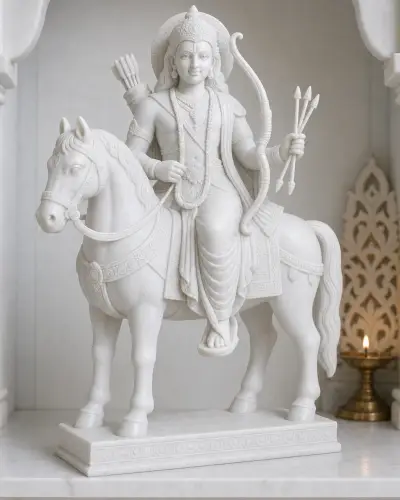
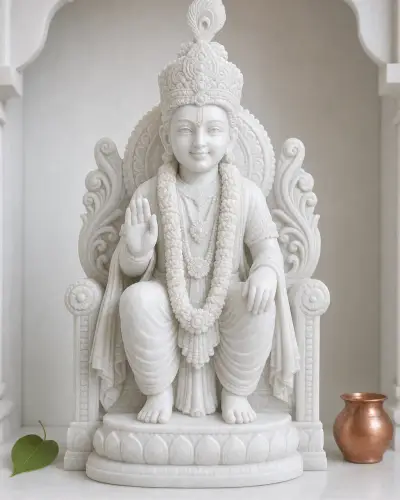
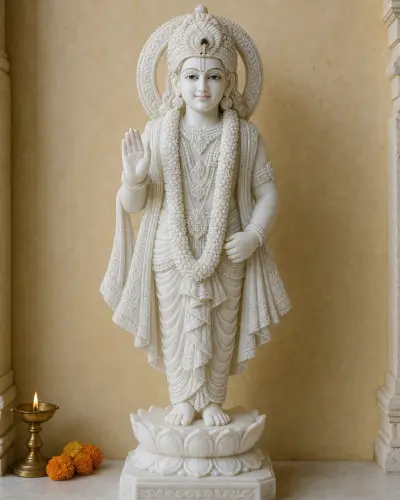
Made to order. The pictures here are concept images. This is not a ready item. We get it made for you as per this design, as close as possible, in the size and stone you choose.
Want this design made for you?
Tell us the size, the stone and where it is going. We will send you a quote and a timeline.
Chat on WhatsAppWe'll respond within 5 minutes
About This Piece
Why Shyam Baba is shown with a flute
Barbarika, the grandson of Bhima, gave his head to Krishna before the fighting began at Kurukshetra, and was granted in return that he would be worshipped through the Kali Yuga under Krishna's own name, Shyam. The shrine that grew around that boon stands at Khatu, in the Shekhawati belt of Rajasthan, and draws its largest crowds at the Phalgun mela each spring. Because the name given was Krishna's, one strand of the Khatu tradition shows Shyam Baba in Krishna's murli swaroop, and this 12-inch murti follows it: he stands in a gentle tribhanga bend on a lotus plinth, both hands raised to a transverse flute at the lips, a crowned mukut set with a single peacock plume, flower garlands falling past the knee, a dhoti with a patka at the waist. The face is young and beardless, as Barbarika was. That, with the plumed mukut and the tilak, is what holds the piece to Shyam Baba rather than to a general Krishna murti.
Cut in Vietnam white marble
The stone is Vietnam white marble from Thanh Hoa province, an export marble worked in Jaipur since the 2000s. It reads a cleaner, cooler white than Makrana (bright and neutral rather than faintly warm), with a fine crystalline grain and only hairline grey veining, so a small figure carries one unbroken tone from the mukut down to the plinth. It is finished to a soft satin polish, not a mirror. At this size the flowers of the garland are a few millimetres across and the filigree of the crown finer still; a satin surface holds light inside those cut lines rather than throwing it back as glare, which is what keeps carving this fine legible from across a room.
A 12-inch murti for the home mandir
The piece stands 12 inches tall, measures about 6 inches at its widest (the flute carries the outline out to one side), and is roughly 4.5 inches deep at the lotus plinth. It weighs around 4.5 kg, so an ordinary mandir shelf takes it without a bracket. Set about 32 inches off the floor, the face meets the eye of someone seated for aarti. Being a figure in the round rather than a wall panel, it wants enough shelf depth to clear the trailing uttariya behind, and a hand's width of open shelf on the flute side so nothing crowds the raised hands.
Made to your brief
This is a made-to-order design. Tell us the height your mandir allows, the stone you want it in (Makrana white marble, Vietnam white marble, black stone, Dholpur pink sandstone or cast marble dust), and whether the garland and the halo behind the head should be cut deeper or left plainer, and we settle the design with you before any stone is cut. It is then carved for you by the master sculptors we work with in and around Jaipur, and a commission at this size runs 8 to 12 weeks. Packing, paperwork and the delivery to your door are ours to handle. If a date matters, such as a Phalgun mela darshan or a griha pravesh, say so at the start, because a piece may already be carved with the sculptors we work with, and we can send you photographs of that one instead.
Specifications
Pose
Murli (flute) form — standing in a gentle tribhanga bend on a lotus plinth, two-armed, both hands raised to a transverse flute at the lips, crowned mukut with peacock plume, flower garlands to the knee, dhoti with patka
Color
Natural White
Finish
Soft polish (satin)
Material
Vietnam White Marble
Ideal For
home temple, pooja room, daily darshan, gifting
Weight In Kg
4.5
Depth In Inches
4.5
Width In Inches
6
Height In Inches
12
Region Or Tradition
Indian / Rajasthani (Khatu, Shekhawati — Shyam Baba tradition)