Handcrafted Makrana White Marble Khatu Shyam Ji Standing Darbar Murti, 24in
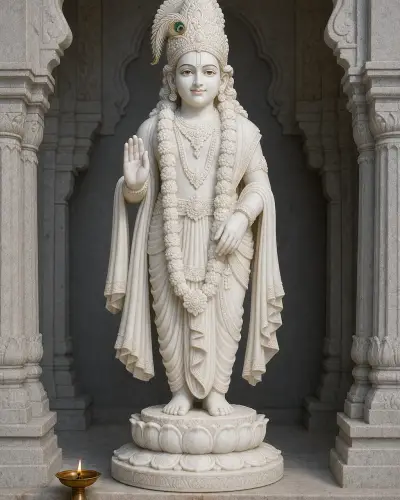
Hand-carved Makrana white marble Khatu Shyam Ji in the standing darbar form, a 24-inch home mandir murti crowned with a peacock plume.
Made to order. The pictures here are concept images. This is not a ready item. We get it made for you as per this design, as close as possible, in the size and stone you choose.
Want this design made for you?
Tell us the size, the stone and where it is going. We will send you a quote and a timeline.
Chat on WhatsAppWe'll respond within 5 minutes
About This Piece
Who Shyam Baba is
Khatu Shyam Ji is Barbarika: grandson of Bhima, son of Ghatotkacha, the warrior who carried three arrows and gave his head in daan before the Mahabharata was fought. Krishna blessed him to be worshipped through the Kaliyuga by Krishna's own name, Shyam, and the shrine grew at Khatu in Sikar district of Rajasthan, where the Falgun Mela on Shukla Ekadashi and Dwadashi draws lakhs of devotees walking in behind the triangular nishan flag. Devotees know him as Haare ka Sahara, the one who stands by those who have lost, and as Teen Baan Dhari, bearer of the three arrows. This murti carries the marks that identify him at a glance: a youthful beardless face, a slender vertical tilak, a crowned mukut with a peacock plume, and layered flower garlands to the chest. No flute appears anywhere on the piece, because that belongs to Krishna, not to Shyam Baba.
The standing darbar form
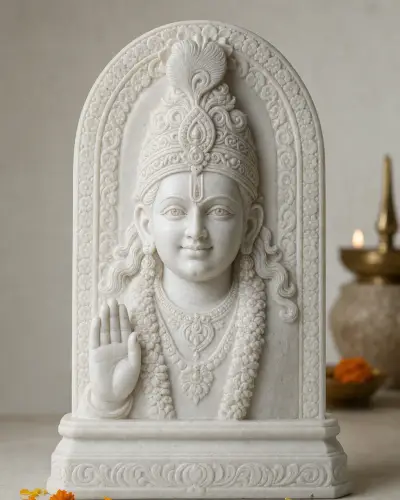
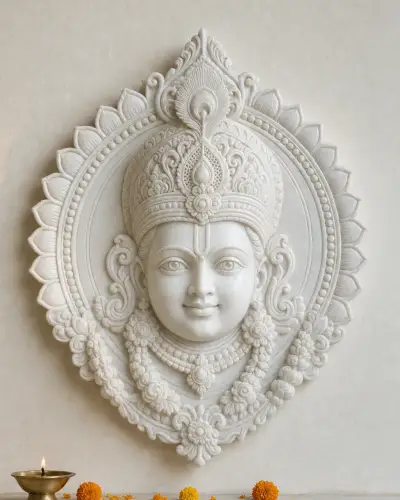
Most Khatu Shyam imagery a family already owns is the shish darshan, the face alone framed in an arch as it appears in the sanctum. The standing darbar form is the other tradition: the full figure, crowned and garlanded, standing in his court. Here he stands feet together on a carved lotus plinth set over a hexagonal base, the right hand raised palm-out in ashirwad and the left closed and resting at the hip. A carved halo behind the head lifts the face out of shadow. The dhoti falls in worked pleats with a patka sash at the waist and an ornamented uttariya crosses the shoulders, running down both sides; the drapery is where the carving does most of its work, since every fold has to hold its edge in stone. Two arms and no more, because Barbarika is a warrior youth, not a multi-armed deity.
The Makrana stone
Makrana marble comes out of Nagaur district, about 200 km west of Jaipur, and it is the stone the Taj Mahal was faced with. It is dense, low in porosity and calcite-rich, which is why it holds a carved edge for centuries instead of sugaring away. On this piece it reads as a bright natural white with the faintest warm undertone and only hairline grey veining. The surface is taken to a soft satin polish rather than a mirror gloss, so light settles into the drapery folds and the garland beads instead of skating off them, and the carving stays legible from across a room. It is carved for you by the master sculptors we work with in Jaipur: roughed from a single block, with the face, hands and drapery finished entirely by hand.
Sizing it for a home mandir
At 24 inches tall the murti measures roughly 7 inches across and 7 deep and weighs about 12 kg, the size most families settle on for a dedicated home mandir rather than a shelf. The face reads clearly from across a puja room during aarti, and two people can place it without equipment. Two things are worth checking before you fix this height: the mandir opening needs clear headroom above the mukut so the peacock plume is not crowded by the arch, and the chowki should raise the murti to roughly seated eye level, so darshan is level rather than downward. If your mandir is shallower than eight inches, say so and the same form can be worked to a slimmer footprint.
Commissioning yours
The design is open. This form can be commissioned in Makrana white marble as shown, in Vietnam white marble for a cooler and more even white, or in black stone if you want the garlands and drapery to read as light on dark; size, the plinth profile and the depth of the halo behind the head are yours to set. A murti in this darbar form may already be carved and standing with one of the sculptors we work with. We ask, and send you photographs of the actual piece, so there is no carving wait. If nothing matches, a fresh commission runs eight to twelve weeks from the approved brief. Tell us the date you are working toward and we will say which of the two you are looking at.
Specifications
Pose
Standing darbar form on a lotus plinth — right hand raised palm-out in ashirwad, left hand at the waist, crowned mukut with a peacock plume, layered flower garlands
Color
Natural White
Finish
Soft polish (satin)
Material
Makrana White Marble
Ideal For
home temple, temple
Weight In Kg
12
Depth In Inches
7
Width In Inches
7
Height In Inches
24
Region Or Tradition
Indian / Rajasthani (Khatu, Shekhawati — Shyam Baba tradition)