Handcrafted Makrana White Marble Khatu Shyam Ji Temple-Scale Murti, 36in
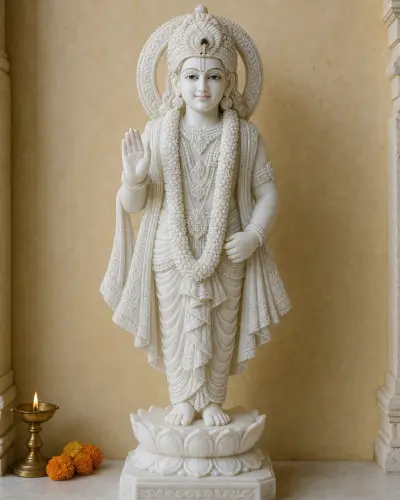
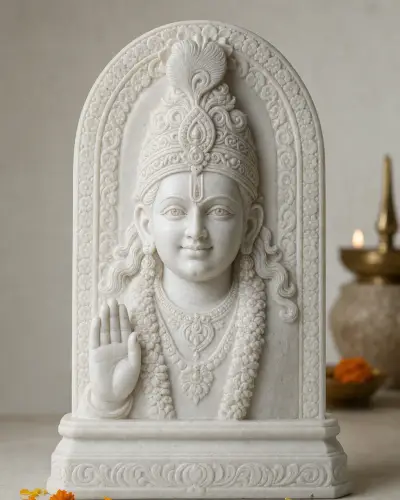
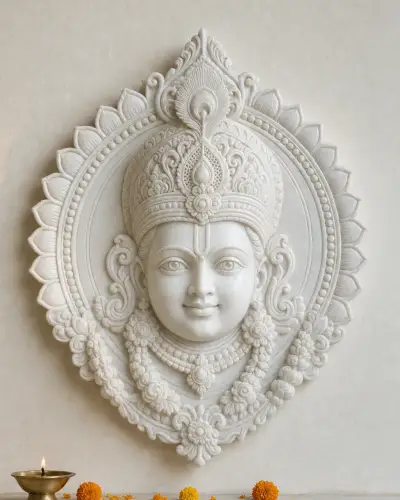
Sculptor-carved Makrana white marble Khatu Shyam Ji in standing darbar: a 36-inch temple-scale murti with a tall plumed mukut.
Made to order. The pictures here are concept images. This is not a ready item. We get it made for you as per this design, as close as possible, in the size and stone you choose.
Want this design made for you?
Tell us the size, the stone and where it is going. We will send you a quote and a timeline.
Chat on WhatsAppWe'll respond within 5 minutes
About This Piece
Shyam Baba in darbar, built at temple scale
Khatu Shyam Ji is Barbarika, grandson of Bhima, the young warrior who gave his head in daan before the Mahabharata began and was blessed by Krishna to be worshipped through Kaliyuga under Krishna's own name. That story belongs to a youth, and the murti keeps it: a beardless young face, a tall crowned mukut with a peacock plume set into the crest, deep layered flower garlands falling to the waist, and exactly two arms, the right raised palm-out in ashirwad and the left resting at the waist. At 36 inches on a broad stepped lotus plinth, this is the darbar form at the size a mandir sanctum or a satsang hall asks for, where the figure has to hold the room from the back of the hall rather than from a shelf an arm's length away.
Makrana white marble, and why the weight decides the plinth
The stone is Makrana white marble from Nagaur district in Rajasthan. It is the quarry that supplied the Taj Mahal, and still the stone most temple commissions in the state are carved in, because it takes fine detail without sugaring and stays bright through years of lamp smoke and abhishek. The soft satin polish is a deliberate choice over a mirror finish: it keeps depth in the crown jewellery, the garland petals and the pleats of the dhoti instead of flattening them under the hard downlights common in mandir halls. Solid marble at this size is heavy: roughly 105 kg, because weight follows volume rather than height. A 36-inch murti is about three and a half times the mass of a 24-inch one, not one and a half, so the plinth, the doorway and the lift route are worth settling early.
Placing a 36-inch murti in a mandir or community hall
A plinth of 12 to 18 inches brings the face close to the eye level of a standing devotee, which is the height a darshan queue is built around. Allow roughly 4 inches of clear space behind the shoulders for the uttariya, and open access on both sides. A murti of this scale is garlanded, dressed and bathed daily in an active mandir, and shoulder room matters far more here than it does for a shelf piece. The base measures about 15 inches across and 12 inches deep, so a sanctum niche or an alcove around 20 inches wide takes it without crowding the shringar.
Make it yours
This murti is carved to order by the master sculptors we work with in Jaipur, so the scale, the plinth profile and the depth of the shringar carving are all settled with you before work begins. The same darbar form is built at 24 and 48 inches, and in Vietnam white marble or black stone where a sanctum calls for a darker figure. A piece close to this one may already be carved, in which case there is no carving wait and photographs of the actual murti come to you; a fresh commission at this scale runs eight to twelve weeks. Tell us the date the pran pratishtha is planned for and we will tell you which of the two you are looking at.
Specifications
Pose
Standing temple-scale darbar form on a stepped lotus plinth, exactly two arms — the right raised palm-out in ashirwad, the left at the waist, a tall crowned mukut with a peacock plume and deep layered flower garlands
Color
Natural White
Finish
Soft polish (satin)
Material
Makrana White Marble
Ideal For
mandir sanctum, community hall, satsang hall, temple installation
Weight In Kg
105
Depth In Inches
12
Width In Inches
15
Height In Inches
36
Region Or Tradition
Indian / Rajasthani (Khatu, Shekhawati — Shyam Baba tradition)