Black Marble Sai Baba Before the Dhuni, 24 in
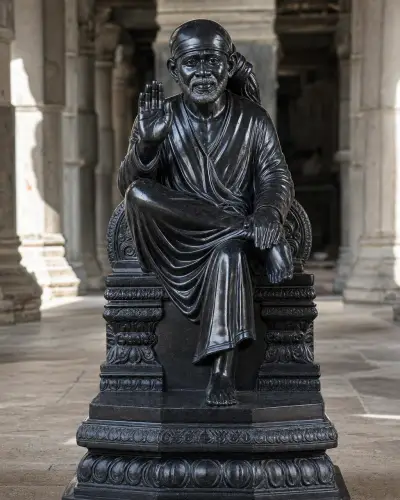
Master-carved black marble Sai Baba in the Dwarkamai dhuni posture: a 24-inch shrine piece with a mirror-polished, near-obsidian sheen.
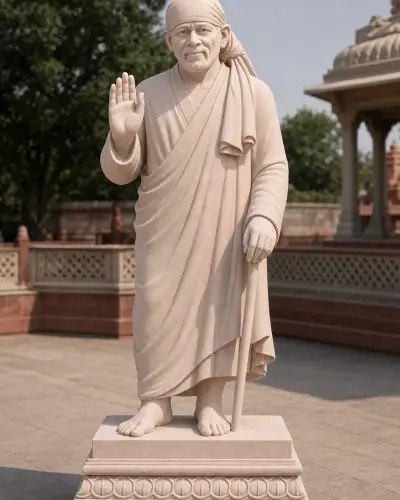
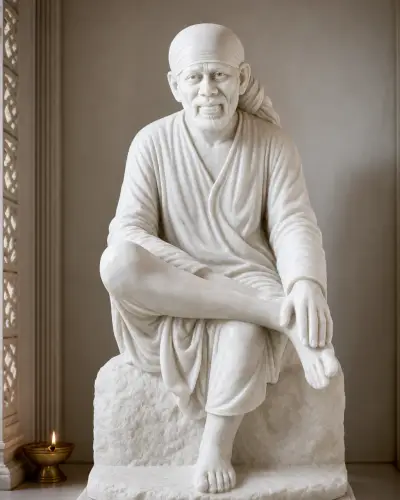
Made to order. The pictures here are concept images. This is not a ready item. We get it made for you as per this design, as close as possible, in the size and stone you choose.
Want this design made for you?
Tell us the size, the stone and where it is going. We will send you a quote and a timeline.
Chat on WhatsAppWe'll respond within 5 minutes
About This Piece
The black marble and one lamp flame
Black marble carries this figure differently from white stone. Quarried at Markapur in Andhra Pradesh, it is dense, close-grained and almost free of veining, and it takes a mirror polish deep enough that a single lamp flame travels across the folds of the kafni robe as one long, unbroken highlight. At 24 inches the figure is large enough to hold a shrine wall on its own, and the darkness of the stone does most of that work: the face and the hands read as the only lit surfaces in the room.
How the block is cut and polished
The carving is done for you by the master sculptors we work with in Jaipur, from a single block rather than assembled parts. Rough cutting establishes the seated mass and the balustrade rail together; the drapery of the sleeves and the fall of the robe over the plinth edge are cut next, and the face, the wrapped head cloth and the hands are finished entirely by hand, with no machine tooling touching them. Polishing runs through progressively finer grits until the black comes up to a true reflective gloss, with the recessed dhuni arch left slightly softer so the fire opening reads as depth rather than shine.
The Dwarkamai posture and the dhuni fire
The posture here is the Dwarkamai one, not a generic meditating ascetic. Sai Baba of Shirdi, who died in 1918, lived in a disused mosque he called Dwarkamai and kept a dhuni (a sacred fire) burning there; the ash from it, udi, is what he gave to those who came to him. This depiction follows the familiar Dwarkamai portrait: right forearm resting along a low carved rail, right leg crossed over the left, the body turned very slightly forward, the gaze outward and alert rather than withdrawn. The full-sleeved ankle-length kafni and the head cloth knotted over the left shoulder are the identifying marks, and the hearth is cut into the front face of the plinth.
Where a 24-inch murti sits, and other sizes
A 24-inch seated figure sits best at chest height, on a shrine ledge, a low chowki, or a dedicated console, so the gaze meets yours instead of looking down. Give it a plain, unbusy surface behind it; black stone loses its edge against a patterned wall. One warm light placed low and to the front, roughly where the dhuni would be, is worth more than overhead lighting, which flattens the polish. Allow about 12 inches of width and 11 inches of depth for the plinth.
We design each piece with you before anything is cut. The same posture works at 18 or 36 inches, in Makrana white or Vietnam white marble if you want a softer reading, and the dhuni arch can be left plain or given a deeper recess. Message us on WhatsApp with the space you have in mind and we will take it from brief to your door.
Specifications
Pose
Seated before the Dwarkamai dhuni — right forearm resting along a low carved balustrade rail, right leg crossed over the left
Color
Black
Finish
Mirror polish
Material
Black Marble
Ideal For
Home shrine statement piece, Sai devotee collector, Meditation corner
Weight In Kg
17
Depth In Inches
11
Width In Inches
12
Height In Inches
24
Region Or Tradition
Indian / Maharashtrian (Shirdi Sai tradition)