Black Marble Shrinathji Murti, 12 in
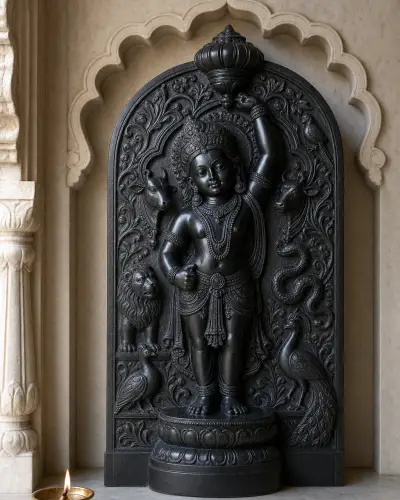
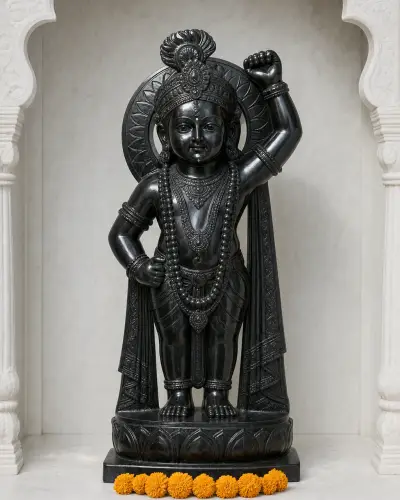
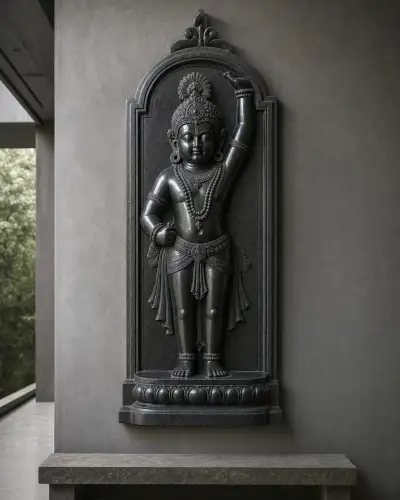
Master-carved jet-black marble Shrinathji on a plain arched stele, a 12-inch svarupa sized for the home mandir shelf.
Made to order. The pictures here are concept images. This is not a ready item. We get it made for you as per this design, as close as possible, in the size and stone you choose.
Want this design made for you?
Tell us the size, the stone and where it is going. We will send you a quote and a timeline.
Chat on WhatsAppWe'll respond within 5 minutes
About This Piece
The Nathdwara svarupa in black marble
Shrinathji stands here as he has stood at Nathdwara since the 1670s: the left arm lifted overhead, the right hand closed at the waist, both feet planted flat and frontal against a plain arched stele. This is the svarupa rendered in jet-black stone. The near-black darkness the Nathdwara image is known for is carried by a dense black marble whose fine crystalline grain takes a deep mirror polish. Indian black marble of this grade comes out of the Markapur belt in Andhra Pradesh, and it offers exactly what a murti like this needs: no veining to argue with the carving, and a surface that reads as one unbroken darkness under a lamp.
Carving the murti, and the fixed svarupa
The murti is carved for you by the master sculptors we work with in Jaipur, from a single block: stele, arch and figure together, never assembled from parts. Roughing out sets the arch and the depth of the relief; the figure is then brought forward in stages until the raised arm separates cleanly from the ground behind it. The face, the fingers, the strand-work of the top-knot and the beaded ornament are cut by hand at the end, with no machine finishing anywhere on them. Polishing then runs through progressively finer grits until the black closes up and begins to hold reflections.
Every element of the form is fixed by tradition rather than by taste. The raised left arm recalls the lifting of Govardhan; the right fist at the waist, thumb protruding, sits beside the lotus stalks tucked into the crook of the arm. The U-shaped urdhva pundra tilak, the top-knot, the half-lowered eyes and the deliberately child-like proportions (round face, soft cheeks, the body of a boy of about seven) are what make a svarupa recognisably Shrinathji rather than a general Bal Krishna. The stele is left plain so nothing competes with that silhouette.
Twelve inches in a home mandir
Twelve inches is the size most home mandirs are actually built around: tall enough to be the focal murti on a shelf, small enough to leave room for the thali, the diyas and the daily shringar. Because the form is a relief on its own stele, it sits flush against a back wall and needs only about three inches of depth. Black stone wants light rather than more darkness. One warm lamp from the front left will pick out the arm, the necklaces and the pleats of the lower garment, while an unlit niche flattens it.
Other sizes and a white marble option
If you want the same svarupa at 9 or 18 inches, or in Makrana white marble for a lighter mandir, we design the piece with you, brief the sculptor, and follow it through to your door. A polished base with the family name engraved along the front edge is a common addition when the murti is going out as a griha pravesh gift.
Specifications
Pose
Standing bas-relief svarupa on a plain arched stele — left arm raised aloft with the cupped hand at the arch, right hand closed in a fist at the waist with the thumb protruding, feet flat and frontal, lotus stalks in the crook of the right arm, U-shaped tilak, hair in a top-knot, eyes half-lowered, child-like proportions
Color
Jet Black
Finish
Mirror polish
Material
Black Marble
Ideal For
Home mandir, Pooja room, Daily darshan
Weight In Kg
6
Depth In Inches
3
Width In Inches
6
Height In Inches
12
Region Or Tradition
Indian / Rajasthani (Nathdwara, Pushtimarg tradition)