Dholpur Pink Sandstone Girijatmaj of Lenyadri in a Cave-Arch Stele, Natural Cleft Finish, 18 in
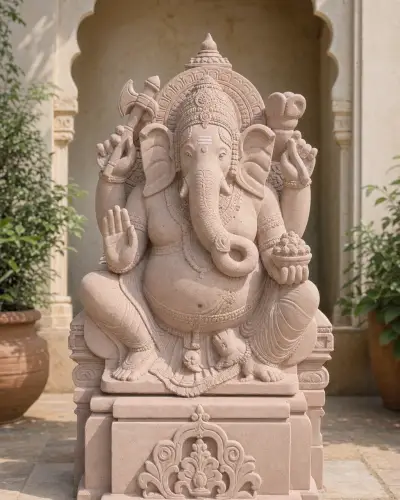
The Lenyadri cave form of Ganesha, cut as an 18-inch relief in a Dholpur pink sandstone stele with the split face left rough.
Made to order. The pictures here are concept images. This is not a ready item. We get it made for you as per this design, as close as possible, in the size and stone you choose.
Want this design made for you?
Tell us the size, the stone and where it is going. We will send you a quote and a timeline.
Chat on WhatsAppWe'll respond within 5 minutes
About This Piece
The Lenyadri cave form
Girijatmaj is the sixth halt on the Ashtavinayak circuit, and the only one of the eight that sits inside a hill rather than in a village temple. The shrine occupies a rock-cut cave above Junnar in Pune district, reached by a climb of roughly 283 steps, and its hall was hollowed out of a single mass of rock with no pillars holding up the roof. The murti there is not an installed image standing on a pedestal. It was worked directly into the stone of the cave, so the form rises out of the wall behind it.
The name means son of Girija, another name for Parvati, who is said to have kept penance in these caves to receive Ganesha as her child. That story is the reason many devotees make the climb: this is the Ashtavinayak stop associated with a mother's wish, and families often visit it for a child or for a child's wellbeing.
Why this piece is a stele rather than a figure
Because the Lenyadri image belongs to its wall, a faithful piece for the home has to keep that back slab. This one is a relief: Ganesha is cut in high relief inside an arched niche, with the shoulders, the knees and the bowl of modaks standing well proud of the ground, while the arch and the surround stay part of the same block. Nothing is joined on and nothing is free-standing.
That construction has a practical side. At 18 inches tall the panel is only about 6 inches deep, so it sits flat against a wall or slides into a shallow niche where a figure in the round would need a full shelf. It also rises from its own moulded base, so it can be set straight onto a mandir platform without a separate stand underneath it.
Reading the iconography
Four arms, and each one carries something the Ashtavinayak tradition keeps consistent. The upper right holds the parashu, the axe that cuts through obstacles; the upper left holds a cluster of modaks; the lower right is open in abhaya, the gesture of reassurance; the lower left cups a bowl of modaks. The trunk turns to Ganesha's own left, which puts the curl on your right as you face him. This is the direction most household murtis follow, and the one families ask for when a piece is meant for daily puja rather than a specific vow.
Below the right knee sits the mushak, small and attentive, its tail curled along the plinth. The single broken tusk is carved as it should be, the right one cut short and the left one whole. The arch behind the head is worked as a beaded torana, a detail borrowed from cave-temple doorways.
Dholpur pink sandstone with a split face
Dholpur sandstone comes from the quarries around Dholpur in eastern Rajasthan, the same beds that supplied Agra Fort and a good deal of Mughal Delhi. The pink variety reads as a warm pale blush that shifts toward tan in weaker light, with a fine even grain and small iron-oxide freckles scattered through it. It is a matte stone by nature; sandstone will not take a mirror polish, and it is not meant to.
The finish here is deliberate. The figure and the arch are worked smooth and sanded back to a soft matte, while the outer edge of the block is left at its natural cleft: the rough split face the quarried stone shows when it breaks along its bedding plane. So the panel carries both surfaces at once, the worked and the unworked, which is close to how the cave shrine itself reads.
Sizing and ordering yours
At 18 inches the panel stands roughly 11 inches across and 6 inches deep, and it weighs about 26 kilos. A relief in solid sandstone carries considerably more stone than a figure of the same height, so plan for a shelf or platform that can take the load. It suits a home mandir wall, an entrance niche, or a sheltered garden pavilion where the sandstone can weather gently over the years.
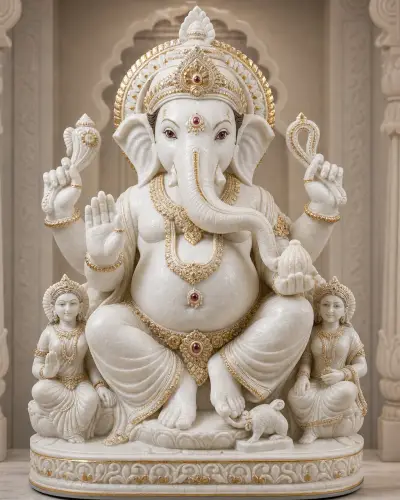
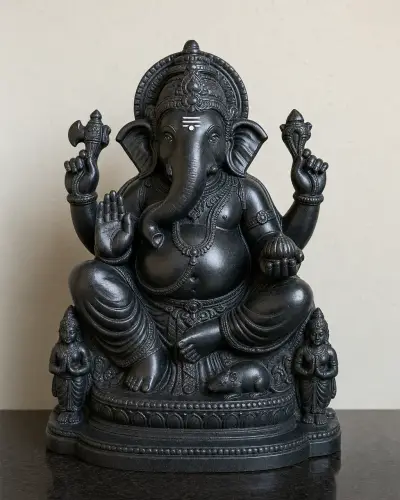
Every piece is made to order. We work through the design with you (the height, whether the cleft edge stays rough or is trimmed square, how deep the relief is cut), then brief the sculptor family who will carve it and follow it through from the first drawing to delivery at your door. Dholpur pink is the stone shown here; the same panel can be worked in Makrana white marble, Vietnam white marble, black stone, or cast marble dust.
Specifications
Pose
Girijatmaj Ganpati of Lenyadri carved as a seated four-armed relief inside an arched stele, the figure emerging from the back slab as it does in the cave shrine. His trunk curls to his own left, appearing on the viewer's right. Potbelly, a single broken right tusk, a modak in hand, the mushak at the base. The surrounding sandstone is left at its natural split face.
Color
Pink
Finish
Matte with natural grain
Material
Dholpur Pink Sandstone
Ideal For
Home mandir, Entrance niche, Garden pavilion
Weight In Kg
26
Depth In Inches
6
Width In Inches
11
Height In Inches
18
Region Or Tradition
Indian / Maharashtrian (Ashtavinayak, Lenyadri cave tradition)