Makrana White Marble Seated Jalaram Bapa Blessing Murti 18in
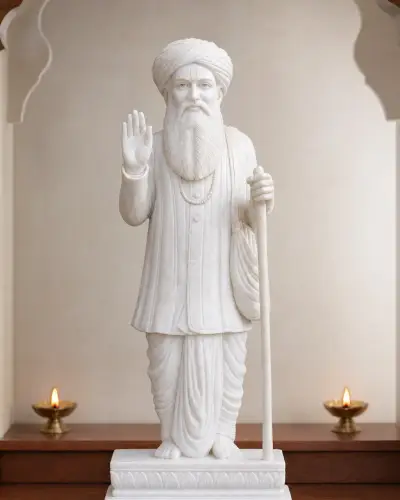
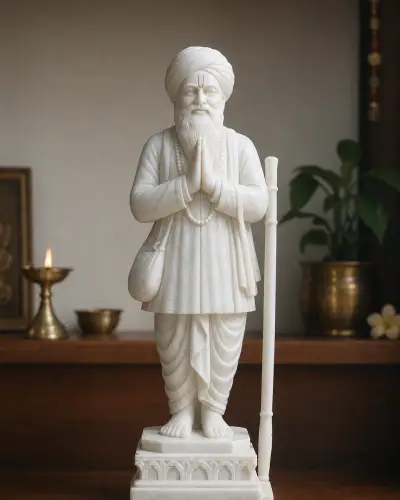
Hand-carved Makrana white marble Jalaram Bapa, seated in ashirwad on a low chowki with jholi and danda beside him. An 18-inch home mandir murti.
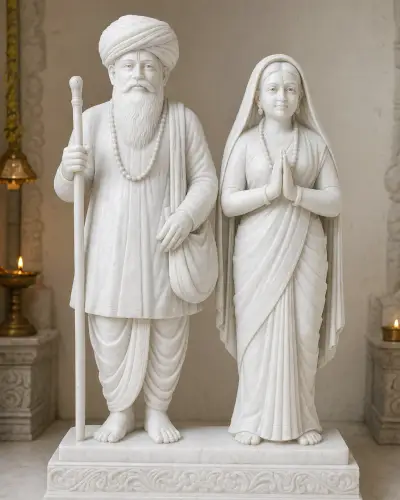
Made to order. The pictures here are concept images. This is not a ready item. We get it made for you as per this design, as close as possible, in the size and stone you choose.
Want this design made for you?
Tell us the size, the stone and where it is going. We will send you a quote and a timeline.
Chat on WhatsAppWe'll respond within 5 minutes
About This Piece
The stone
This Jalaram Bapa murti is carved from Makrana white marble, quarried at Makrana in the Nagaur district of Rajasthan, the same stone bed that supplied the Taj Mahal and that Rajasthani temple builders have drawn on for centuries. Makrana is a dense, fine-grained calcite marble: the surface reads a bright natural white with the faintest warm undertone, carrying occasional grey hairline veins no wider than a pencil line. It holds detail without crumbling at the edges, which matters on a figure like this one, where the beard, the folds of the kediyu and the toes on the plinth all need to keep a crisp line. The piece is given a soft satin polish rather than a mirror gloss, so the stone glows under a lamp instead of throwing hard reflections back at anyone standing in front of it.
Jalaram Bapa of Virpur
Jalaram Bapa was born in 1799 at Virpur, in what is now the Rajkot district of Saurashtra, Gujarat, and is remembered above all for the Sadavrat he kept there: a kitchen that fed any traveller who arrived, without asking their caste or their means. He took initiation from Bhoja Bhagat of Fatehpur, and his wife Virbai Ma is honoured alongside him in Gujarati households for having run that kitchen with him. Devotees mark Jalaram Jayanti on Kartik Sud 7, and the shrine at Virpur is still known for declining money offerings from the pilgrims who come to it. A murti of Bapa in a Gujarati home is usually a household piece rather than a temple one. It is kept on the mandir shelf, garlanded on Thursdays, and treated as the presence of a householder-saint rather than a remote figure.
The form
Bapa is shown seated on a low chowki, his right hand raised palm-out in ashirwad and his left resting on his knee, with both feet placed forward on the plinth so that charan darshan is possible. Four things fix the identity, and the sculptor holds all four: the wound Kathiawadi turban, the long full beard falling to the chest, the white dhoti worn under a long-sleeved kediyu that keeps the upper body covered, and the jholi and danda (the cloth alms-bag and the staff that stand for the Sadavrat itself). A Vaishnav U-shaped tilak marks the forehead and a tulsi kanthi sits at the neck. These are the details that separate Bapa from the other bearded sants a marble figure can drift towards, and they are carved rather than painted, so they survive a wash and a wipe-down.
Sizing it for a home mandir
At 18 inches tall, roughly 9 inches across and 8 inches deep, this Jalaram Bapa murti weighs in the region of 13 kg. That is a scale meant for a home mandir rather than a hall: it sits on a mandir shelf or on a chowki of its own, and when it stands at chest height the raised hand comes close to the eye line of someone standing in front of it, which is how a blessing figure is meant to be met. Allow a little more depth than the statue's own 8 inches, so the danda and the jholi at his side are not pressed against a back wall. The plinth is flat and finished on all four sides, so the murti can sit against a wall or stand free in an alcove without an awkward face.
Making it yours
Every piece here is made to order, so this specification is a starting point rather than a fixed catalogue entry. The murti can be carved larger or smaller than 18 inches, in Vietnam white marble, black stone or Dholpur pink sandstone instead of Makrana, or in cast marble dust where the budget calls for it. A matching Virbai Ma murti can be carved as a companion piece for households that keep the two together, and the plinth face can carry an engraved family name or a date. Tell us what you have in mind and where it will sit. We design it with you, brief the sculptor who will carve it, and follow the piece through to your door.
Specifications
Pose
Seated in blessing (ashirwad) on a low carved chowki, jholi and danda at his side
Color
White
Finish
Soft polish (satin)
Material
Makrana White Marble
Ideal For
Pooja room, Home mandir
Weight In Kg
13
Depth In Inches
8
Width In Inches
9
Height In Inches
18
Region Or Tradition
Indian / Gujarati (Virpur, Saurashtra sant tradition)