Makrana White Marble Jalaram Bapa with Sadavrat Dog 16in
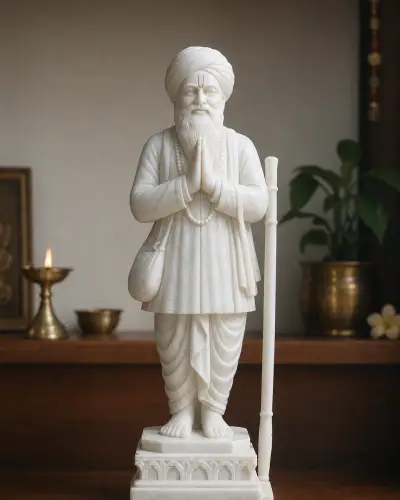
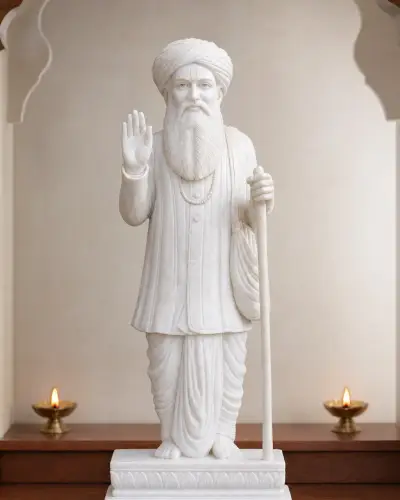
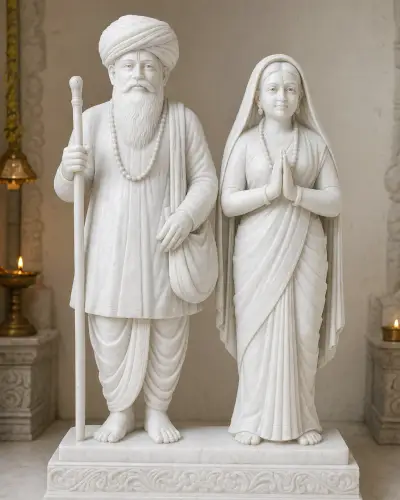
Sculptor-carved Makrana white marble Jalaram Bapa with jholi, danda and the sadavrat dog at his feet, made as a 16-inch pooja room murti.
Made to order. The pictures here are concept images. This is not a ready item. We get it made for you as per this design, as close as possible, in the size and stone you choose.
Want this design made for you?
Tell us the size, the stone and where it is going. We will send you a quote and a timeline.
Chat on WhatsAppWe'll respond within 5 minutes
About This Piece
The stone this Jalaram Bapa is carved from
Makrana white marble comes out of the quarries at Makrana in Nagaur district, Rajasthan, the same beds that supplied the Taj Mahal and the stone Rajasthani carvers have worked for centuries. It is a dense, fine-grained calcite marble: bright neutral white with the faintest cream undertone, threaded with grey hairline veins no wider than a pencil line. Held to a soft satin polish rather than a mirror gloss, the surface keeps a quiet glow that suits a saint murti better than a hard shine. Light sinks a little way into the stone and comes back off the folds of the dhoti and the edge of the beard. Makrana also holds up in a pooja room, where lamp oil, camphor smoke and daily abhishek slowly dull softer stones.
Who Jalaram Bapa of Virpur was
Jalaram Bapa was born in 1799 at Virpur, a village in the Rajkot district of Saurashtra, and lived there until 1881. A Vaishnav of the Lohana community and a disciple of Bhoja Bhagat of Fatehpur, he is remembered above all for the sadavrat he kept at his own house, an open kitchen where anyone who arrived (sadhu or traveller or neighbour) was fed without being asked who they were. In the devotional account a wandering sadhu left him a jholi, the cloth alms bag, and a danda, the wooden staff, and both became the attributes he is shown holding. The dog at his feet belongs to the same story of a household that turned nobody away. Virpur is still a pilgrimage stop for Gujarati families, especially around Jalaram Jayanti in Kartik.
What this Jalaram Bapa murti shows
The saint stands upright on a moulded plinth cut from the same block of Makrana marble, the jholi held forward in one hand and the danda upright in the other. He wears a wound Kathiawadi turban, a long-sleeved kediyu over a white dhoti, and a tulsi kanthi at the throat, with the U-shaped Vaishnav tilak cut into the forehead. The long white beard reaching his chest is worked as combed strands rather than one mass. That, and the hands, are where the sculptor's chisel work reads closest. The sadavrat dog sits alongside on the shared plinth, kept small in scale so the saint stays the centre of the piece. These are the details that separate a Jalaram Bapa murti from a Sai Baba one: turban rather than knotted head cloth, kediyu rather than kafni, a long beard rather than a short one.
Sizing a 16-inch murti for your mandir
At 16 inches tall the piece measures roughly 7 inches across and 5 inches deep and weighs about 9 kilograms with its plinth. That is shelf scale, not floor scale: it sits well on the middle tier of a home mandir, on a temple-room chowki, or on an office console where a full-height murti would crowd the wall. Leave a hand's width of clear space either side so the jholi and the danda read cleanly, and set the plinth at roughly seated eye level for darshan. Gujarati households often keep Jalaram Bapa beside Shri Ram or a Lakshmi-Narayan pair, so allow room to one side if this murti is joining an existing group rather than standing on its own.
Making this Jalaram Bapa murti yours
Everything here is made to order, so size is the easiest thing to change: the same composition works from a 10-inch shelf murti up to a 36-inch piece for a larger temple room. We can also brief the sculptor for black stone instead of white, a mirror polish rather than the satin one shown, a taller plinth carrying an inscription for a griha pravesh or Jalaram Jayanti gift, or the dog left out if you want the saint standing alone. Send us a picture of where it will stand and we will tell you what size reads right.
Specifications
Pose
Standing with the jholi held forward in one hand and the wooden danda in the other, a small seated sadavrat dog at his feet on the shared plinth, in a wound Kathiawadi turban, long-sleeved kediyu and white dhoti, with a Vaishnav U-shaped tilak and a tulsi kanthi
Color
White
Finish
Soft polish (satin)
Material
Makrana White Marble
Ideal For
Pooja room, Home mandir, Devotional gift
Weight In Kg
9
Depth In Inches
5
Width In Inches
7
Height In Inches
16
Region Or Tradition
Indian / Gujarati (Virpur, Kathiawad Vaishnav tradition)