Makrana White Marble Lalbaugcha Raja Ganpati on Lion Throne, 18 in
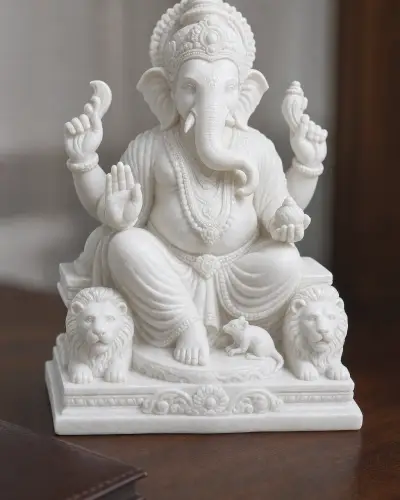
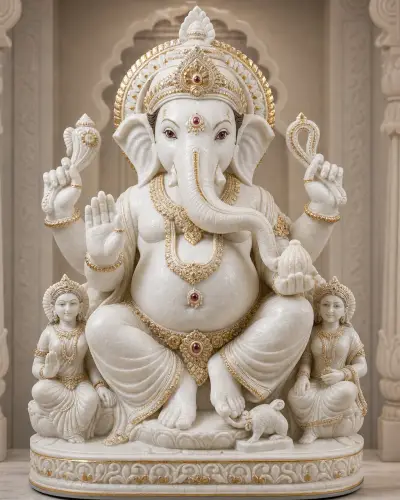
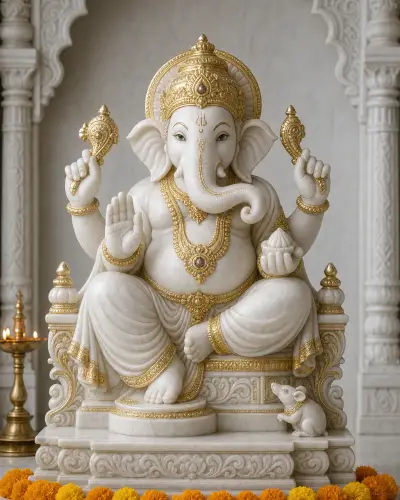
Sculptor-carved Makrana white marble Lalbaugcha Raja on a lion-flanked simhasan: an 18-inch home mandir centrepiece with a tall regal mukut.
Made to order. The pictures here are concept images. This is not a ready item. We get it made for you as per this design, as close as possible, in the size and stone you choose.
Want this design made for you?
Tell us the size, the stone and where it is going. We will send you a quote and a timeline.
Chat on WhatsAppWe'll respond within 5 minutes
About This Piece
The lion throne, and why Makrana takes fine detail
The defining mark of a Lalbaugcha Raja murti is the throne: a simhasan flanked by two carved lions, their manes chiselled in tight overlapping rows, holding the seated Ganpati at the height of a household shrine. This one is cut from Makrana white marble, quarried in the Nagaur district of Rajasthan, the same compact, faintly warm stone that clads the Taj Mahal and has been worked by Rajasthani carvers for centuries. Makrana takes fine detail without crumbling at the edges, which is what keeps the jewellery, the layered mukut and the lions' faces readable at 18 inches rather than soft and approximate.
How the Makrana Ganpati is carved and polished
Work begins with a single block, roughed down by chisel and drill point before the figure is separated from the throne mass. The independent master sculptors TMW commissions in Jaipur cut the ornament last (the necklaces, the jewelled belt, the fall of the shawl over the knee), and the face, hands and drapery are always hand-finished, never left to a machine pass. Polishing runs through progressive grades to a soft satin rather than a mirror, so light settles into the stone instead of bouncing off it and flattening the carving.
Navasacha Ganpati, and why Mumbai queues for him
Lalbaugcha Raja belongs to Mumbai. The Lalbaug Sarvajanik Ganeshotsav Mandal has installed its Ganpati since 1934, and the idol is known across Maharashtra as Navasacha Ganpati, the Ganpati of the vow, drawing queues that run for hours through Ganesh Chaturthi. The form is deliberately regal: a tall ornate mukut, heavy carved ornaments, and four arms, with the lower right raised in abhaya and a modak held in the lower left. The trunk curls to the deity's left, the right tusk is broken in the canonical way, and the mushak sits alert at the plinth.
Living with an 18-inch Raja, and what can change
At 18 inches the murti is scaled for a home mandir rather than a hall. Set on a shelf or a low chowki it brings the Raja's gaze close to a seated devotee's eye level, which is the whole point of the throne form. Allow roughly a foot of clear width for the lions and the plinth, and leave the front open for a diya; the satin surface holds a flame's reflection softly instead of glaring. Because marble is meant for permanent installation, the piece stays in the mandir through the year and is simply re-decorated at Chaturthi rather than immersed.
Most elements here can move: height from a 9-inch tabletop murti up to a 4-foot showpiece, the same form in Vietnam white or black marble, a mirror polish in place of satin, gold-leaf or hand-painted detailing on the mukut and ornaments, or a family name engraved on the plinth for a housewarming. Send us your mandir dimensions on WhatsApp and we will work back from there.
Specifications
Pose
Seated four-armed Lalbaugcha Raja Ganpati on a lion-flanked simhasan throne, tall ornate mukut, trunk curled left, single broken right tusk, modak in the lower left hand and right hand raised in abhaya blessing, heavy carved necklaces and jewelled belt, mushak at the base
Color
Natural White
Finish
Soft polish (satin)
Material
Makrana White Marble
Ideal For
Home mandir centrepiece, Ganesh Chaturthi sthapana, Housewarming gift
Weight In Kg
24
Depth In Inches
8
Width In Inches
9
Height In Inches
18
Region Or Tradition
Indian / Maharashtrian (Mumbai Lalbaug pandal tradition)