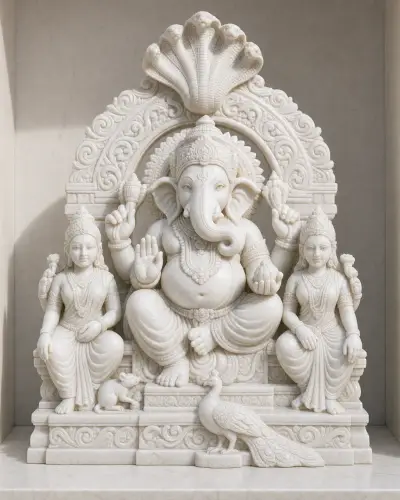
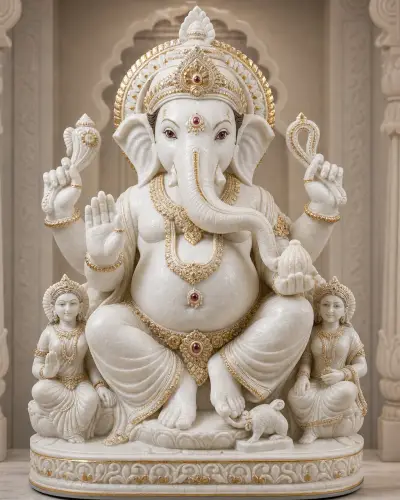
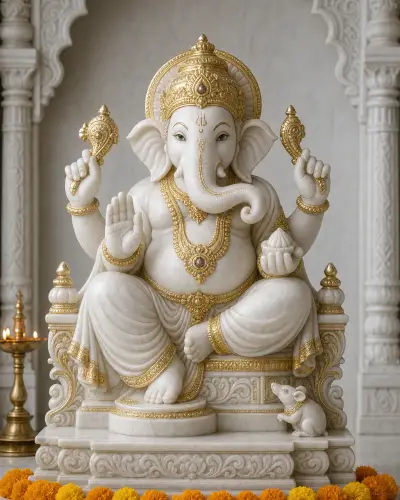
Makrana White Marble Mahaganapati of Ranjangaon on Singhasan, Multi-Armed, 24 in
Master-carved Makrana white marble Mahaganapati of Ranjangaon. A 24-inch home mandir murti with Riddhi and Siddhi at his sides.
Made to order. The pictures here are concept images. This is not a ready item. We get it made for you as per this design, as close as possible, in the size and stone you choose.
Want this design made for you?
Tell us the size, the stone and where it is going. We will send you a quote and a timeline.
Chat on WhatsAppWe'll respond within 5 minutes
About This Piece
The eighth swaroop of the Ashtavinayak yatra
Mahaganapati of Ranjangaon is where the Ashtavinayak circuit closes. The temple stands at Ranjangaon in Shirur taluka, Pune district, and by tradition it is the last of the eight swaroops a pilgrim reaches after Morgaon, Siddhatek, Pali, Mahad, Theur, Lenyadri and Ozar. The name carries a story with it: Shiva is said to have worshipped Ganesha on this spot before setting out against the demon Tripurasura, and the deity here is remembered as Mahaganapati, the great form. The sanctum as it stands today was built in the Peshwa period and faces east, so that at certain times of the year the morning sun falls directly on the murti. The image that receives daily worship sits above an older one, called Mahotkat, which tradition holds is sealed in a vault beneath the floor.
The Makrana stone and its satin finish
Makrana white marble comes out of the quarries of Nagaur district in Rajasthan, beds that have been worked for centuries and that supplied the Taj Mahal. It is a bright, neutral white with a fine crystalline grain and only faint grey hairline veining, and it is dense enough to hold an undercut without chipping. That is exactly what a piece like this asks of a stone, with jewellery, a throne back and two attendant figures all cut at small scale. This murti is finished to a soft satin polish rather than a mirror, and the difference matters in a mandir: a satin surface gathers lamp flame and morning light in a slow, even glow across the belly and the throne, where a mirror finish throws hard highlights that flatten the carving.
Reading the form
Mahaganapati is described in the Ganesha tradition as the expansive, multi-armed form of the deity (eight arms in some accounts, ten in others, more in a few), seated in state with Riddhi and Siddhi. This murti follows that description without settling on a fixed count. He sits cross-legged on a carved singhasan, broad-browed and potbellied, his right tusk broken, a modak held in the front hand and the mushak turned up towards him at the base. The trunk curls to his own left, which reads across to your right as you stand in front of him. This is the vamamukhi form kept for daily household worship. Riddhi and Siddhi are seated one on either side of the throne, each carved with her own crown, jewellery and draped sari.
Sizing it for your mandir
At 24 inches the murti stands two feet tall and about twenty inches across at the throne, so it wants a shelf or platform of at least 24 inches with a foot of depth. The stepped plinth is part of the carving and should sit fully supported rather than overhanging. At roughly 44 kg this is a piece that stays where it is installed instead of moving between rooms: a masonry ledge or a solid wooden platform carries it comfortably, a light glass shelf does not. Households usually keep a Ganesha murti on the east or north-east side of the mandir, facing into the room. The scale suits a dedicated pooja room or a family mandir rather than a narrow apartment niche.
Other sizes, other stones
The same Mahaganapati can be made smaller for a compact mandir or larger for a temple hall. Tell us the shelf or the alcove you have in mind and we will size the piece to it. It can also be carved in Vietnam white marble, in black stone or in Dholpur pink sandstone, and cast in marble dust where the budget calls for it. We design it with you, brief the master sculptors we work with in Jaipur, and follow the piece through to your door.
Specifications
Pose
Seated cross-legged on a carved singhasan throne in his multi-armed cosmic form, broad forehead and potbelly, a single broken right tusk, a modak in the front hand and the mushak at the base, with Riddhi and Siddhi seated one on either side; trunk curled to his own left
Color
White
Finish
Soft polish (satin)
Material
Makrana White Marble
Ideal For
Home mandir, Family temple, Housewarming
Weight In Kg
44
Depth In Inches
12
Width In Inches
20
Height In Inches
24
Region Or Tradition
Indian / Maharashtrian (Ashtavinayak, Ranjangaon tradition)