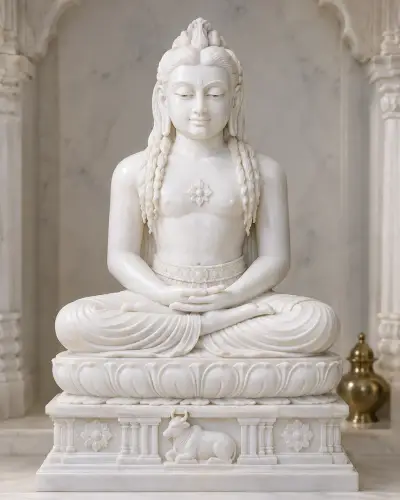
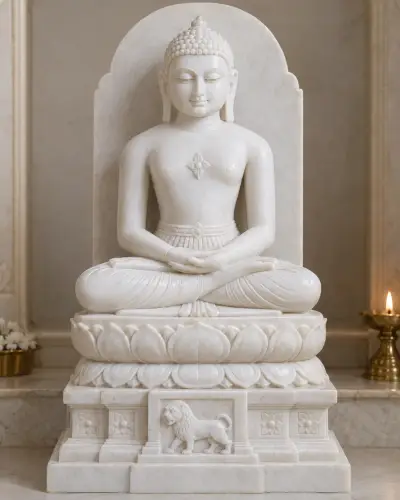
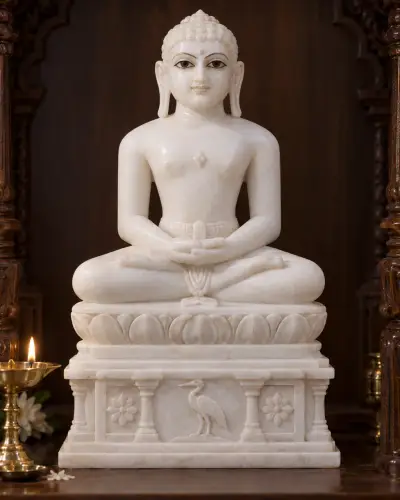
Makrana White Marble Mallinath Murti, 15in
Hand-carved Makrana white marble Mallinath in padmasana. A 15-inch home derasar murti, named by the kalash on its pedestal.
Made to order. The pictures here are concept images. This is not a ready item. We get it made for you as per this design, as close as possible, in the size and stone you choose.
Want this design made for you?
Tell us the size, the stone and where it is going. We will send you a quote and a timeline.
Chat on WhatsAppWe'll respond within 5 minutes
About This Piece
The nineteenth Tirthankar
Mallinath is the nineteenth of the twenty-four Tirthankars, born at Mithila and remembered in the Shvetambar tradition for something no other Jina shares: the Kalpa Sutra holds that Malli took birth as a woman, and that a woman attained kevalgyan and taught the assembly. The Digambar tradition reads the same life differently, and murtis in both traditions are carved to the same fixed form, because a Tirthankar image is not a portrait and the body is the same body for all twenty-four. What tells you which Jina is in front of you is the lanchhana cut into the pedestal. Here it is the kalash, the water pot, carved in relief on the front face of the lotus base directly below the stacked palms. Look for it first: everything else on this murti (the srivatsa, the kandora, the lowered gaze) belongs to all twenty-four equally.
Why Makrana marble
The block comes from Makrana in Rajasthan's Nagaur district, roughly 350 kilometres from Jaipur, where the murti is carved. Jain temple-builders have used this stone for the better part of a thousand years (Dilwara on Mount Abu and the Chaumukha temple at Ranakpur are both worked in it), and the reason is how the stone behaves rather than where it comes from. Makrana is calcite-dense and close to non-porous, so a fine edge like the rim of a kalash or the beading of a kandora comes out crisp and stays crisp. It does not drink in milk, ghee or kesar, which matters on a murti that will be bathed, and it holds a satin polish for decades without yellowing. Light enters the surface a millimetre or two before it returns, which is what gives the face a quiet glow under a diya instead of a flat white.
Carved to Shvetambar convention
We design the murti with you, brief it in detail, and stay with it until it is installed; the carving itself is done by the master sculptors we work with in Jaipur, for whom Tirthankar murtis are routine work. The block is squared, roughed down to the seated silhouette, and the stepped lotus pedestal blocked in before any detail is cut. Then the hand work: palms laid flat in the lap, right over left, in dhyana; the srivatsa on the chest; the kandora waistband above pleated kachota; deep-cut earlobes; and the open eyes of the Shvetambar chakshus convention, so the devotee stands before a Jina who is present rather than withdrawn. The gaze is set to the nose-tip, in nasagradrishti. None of this is interpretation. A Tirthankar murti is iconographically fixed, and one that departs from it cannot be installed.
A 15-inch murti in a home derasar
Fifteen inches is a domestic scale, the height that works as the mulnayak of a ghar derasar, or alongside a larger Jina on the upper tier of a pooja room shrine. Seated, it is read from a foot or two away at about the eye level of someone sitting down, which is the distance at which the kalash and the srivatsa stay legible. Allow around eighteen inches of clear width and a foot of depth so the pedestal is not crowded and a thali fits in front of it. A plain pale wall or a simple wooden ghar-mandir behind the murti suits the stone; a patterned backdrop competes with the carving and flattens it. Keep the murti raised, on a chowki, a singhasan or a shelf, and never at floor level.
Commissioning yours
The same murti can be made taller for a community derasar, given a full parikar with a toran arch and attendant figures, set on a stepped singhasan, or cut in Vietnam white marble if you want a cooler, whiter stone. Gold-leaf work on the pedestal mouldings is possible where a derasar is finished that way. Tell us the height of your shrine and the date you would like to install by: a murti at this scale takes eight to twelve weeks from the day the drawing is approved, plus crating and transit. Message us on WhatsApp with your shrine dimensions and we will come back with a drawing.
Specifications
Pose
Seated padmasana on a stepped lotus pedestal, hands stacked flat in the lap right over left in dhyana, srivatsa on the chest, kandora waistband with kachota pleats, open chakshus eyes with the gaze to the nose-tip, kalash (water-pot) lanchhana carved on the pedestal
Color
White
Finish
Soft polish (satin)
Material
Makrana White Marble
Ideal For
Home derasar, Derasar, Pooja room
Weight In Kg
19
Depth In Inches
7
Width In Inches
9
Height In Inches
15
Region Or Tradition
Indian / Jain (Shvetambar Murtipujak derasar tradition)