Makrana White Marble Neem Karoli Baba Blanket Darshan Murti 18in
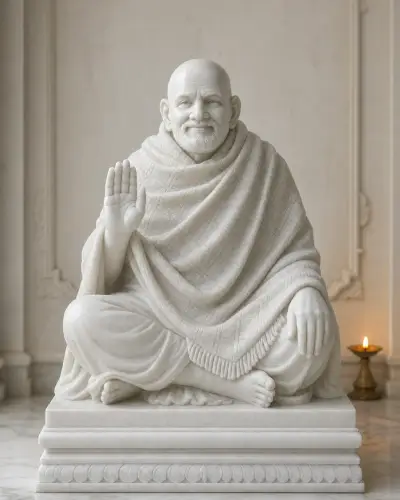
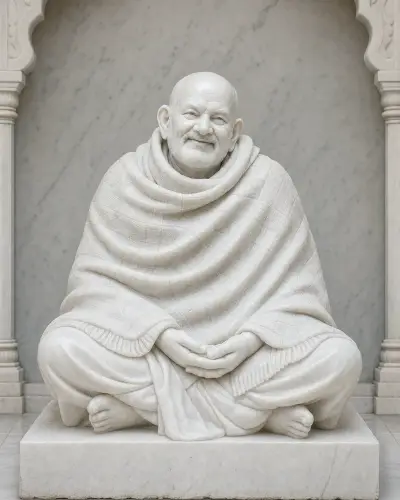
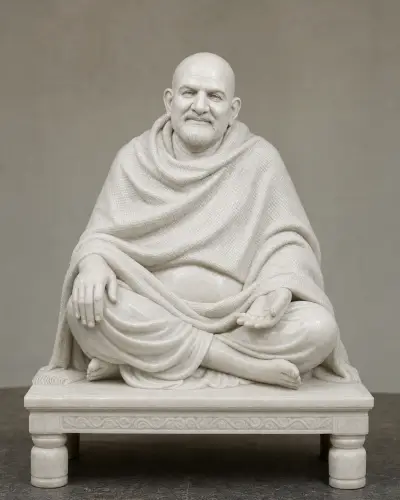
Hand-carved Makrana white marble Neem Karoli Baba in blanket darshan, an 18-inch pooja-room murti with the plaid weave worked into the stone.
Made to order. The pictures here are concept images. This is not a ready item. We get it made for you as per this design, as close as possible, in the size and stone you choose.
Want this design made for you?
Tell us the size, the stone and where it is going. We will send you a quote and a timeline.
Chat on WhatsAppWe'll respond within 5 minutes
About This Piece
The blanket darshan
Neem Karoli Baba is remembered less for a pose than for a wrapping. Devotees who reached Kainchi Dham through the 1960s and 70s describe the same figure again and again: a stout, elderly man sitting cross-legged on a wooden takht, a chequered plaid blanket pulled up over his head and gathered around his shoulders, hands tucked away inside it, saying little and laughing often. This murti holds exactly that. He sits in sukhasana, bare-headed under the blanket's hood so only the face shows: the short grey-white beard, the heavy build, the faintly amused expression so many accounts return to. There is no turban, no kafni robe, no ushnisha; the silhouette is Maharaj-ji's and nobody else's. The blanket's check is cut in shallow low relief, so the weave reads in the stone itself rather than being painted on afterwards.
Makrana white marble, and why it suits this form
The stone is Makrana white marble, quarried in Nagaur district about 350 kilometres from the Jaipur benches where this piece is cut. It is the same calcite-rich white that has gone into Rajasthani shrines for centuries and into the Taj Mahal's facing. It is dense and fine-grained, which is what a piece like this needs: the drapery is the whole sculpture, and a coarse stone would blur the edge where one fold laps over another. Makrana takes a soft satin polish that stays luminous under a diya without turning glassy, and light travels a short way into the surface before coming back, so the marble glows instead of sitting flat. Left unlacquered it holds its colour for generations, and a wipe with a dry cloth is the whole maintenance story. The base is finished with a lightly bush-hammered face so the murti sits steady on a wooden shelf.
How the piece is carved
Work starts with a block chosen for its vein pattern, so no grey line runs across the face. The rough form comes down with a saw and a pneumatic point; from there the carver moves to hand chisels for the seated mass, the crossed legs, the fall of the blanket and the fringe at the hanging end. The face is entirely hand work, and so is the chequered relief: the crossing lines are scribed and cut with fine chisels and rifflers, which is why the weave shifts slightly in depth across the drape instead of repeating like a printed pattern. Polishing runs through progressively finer abrasives and stops at satin rather than mirror, so the tool rhythm stays readable up close. Nothing on the face, the hands or the drapery is machine-finished, and small left-to-right asymmetries are left alone.
Sizing it for a pooja room
At 18 inches tall and roughly 9 inches across, this is a home-mandir size rather than a temple one. It reads correctly on a standard pooja shelf, inside a marble mandir with a 24-inch inner opening, or on a low chowki set against a wall. Leave a hand's width of clear space on either side. The silhouette is broad at the shoulders and needs the air around it to read as a wrapped figure rather than a block. At about 13 kilograms it is a two-person lift into position but sits happily on any shelf already carrying a brass thali. Most devotees keep Maharaj-ji facing into the room rather than into a corner, since the whole point of this form is darshan: the face is the only part of him the blanket leaves showing.
Making it yours
Every piece is carved to order, so this one can change. Common requests are a larger 24 or 30 inch version for a dedicated mandir room, a hand-painted polychrome finish with the blanket in its familiar red-and-black check, or a name and date cut into the base for a gruha pravesh or a memorial gift. Carving usually runs eight to twelve weeks depending on the queue. Message us on WhatsApp with your shelf dimensions and we will tell you what will sit well.
Specifications
Pose
Seated cross-legged in sukhasana with a chequered plaid blanket drawn up over the head and around the shoulders, both hands enclosed within it, bald and bare-headed, short grey-white beard, heavy-set build, the blanket's check worked in shallow low relief
Color
White
Finish
Soft polish (satin)
Material
Makrana White Marble
Ideal For
Pooja room, Home mandir, Meditation room
Weight In Kg
13
Depth In Inches
8
Width In Inches
9
Height In Inches
18
Region Or Tradition
Indian / Kumaoni (Kainchi Dham, Uttarakhand; Neem Karoli Baba tradition)