Makrana White Marble Neem Karoli Baba with Hanuman 60in
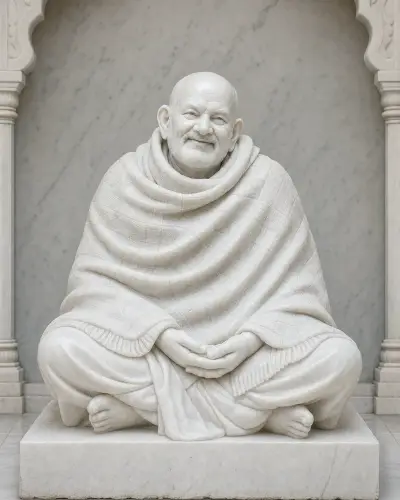
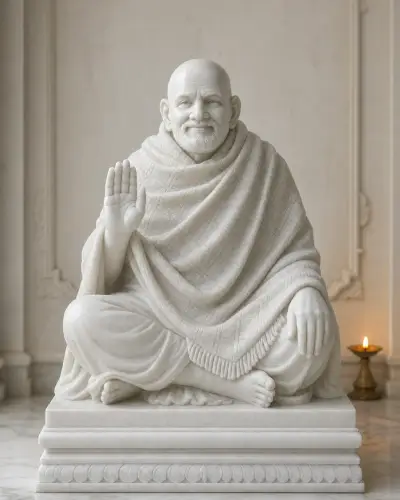
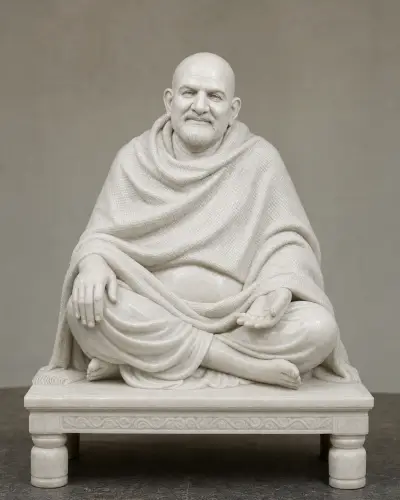
Master-carved Makrana white marble Neem Karoli Baba in sukhasana with Hanuman standing behind. A 60-inch ashram darshan centrepiece.
Made to order. The pictures here are concept images. This is not a ready item. We get it made for you as per this design, as close as possible, in the size and stone you choose.
Want this design made for you?
Tell us the size, the stone and where it is going. We will send you a quote and a timeline.
Chat on WhatsAppWe'll respond within 5 minutes
About This Piece
The stone
Makrana White Marble comes out of the quarries at Makrana in Rajasthan's Nagaur district, about 350 kilometres from our Jaipur workshop. It is the same calcite-rich stone the Taj Mahal, the Victoria Memorial and most of the Birla temples are built from. It is a brilliant neutral white with only the faintest warm undertone, a fine sugary crystalline grain, and occasional grey hairline veins that read as a signature rather than a flaw. Because the calcite is dense and the porosity low, Makrana holds a carved edge for generations and weathers an open courtyard far better than softer white marbles. The murti is finished to a soft satin polish rather than a mirror: at five feet, satin scatters light gently and keeps Maharaj-ji's face readable from across a courtyard instead of throwing glare back at whoever is standing in front of it.
Maharaj-ji and Hanuman
Neem Karoli Baba is carved the way devotees picture him at Kainchi Dham: seated cross-legged in sukhasana, bald and bare-headed, a short trimmed grey-white beard, heavy-set and settled, with the warm, faintly amused expression that runs through every photograph of him. His chequered plaid blanket is drawn over both shoulders and around the torso over a white dhoti, worked as thick folded drapery with a fringed edge, the check pattern cut in shallow low relief so the weave reads in the stone itself. Behind him and slightly to one side, on the same shared plinth, Hanuman stands with palms folded at the chest and the gada resting upright at his side. The pairing is not decorative: the principal shrine at Kainchi Dham is a Hanuman temple, and most devotees come to Maharaj-ji through Hanuman.
How the piece is carved
Work begins with a single Makrana block chosen for even colour, since a five-foot two-figure group cannot hide a colour break. The sculptor roughs out the mass, establishes the seated silhouette and the standing figure behind it, then moves to detail: the blanket folds, the fringe, the fingers of Hanuman's folded palms, the lotus-petal courses on the plinth. Faces, hands and drapery are finished entirely by hand; nothing on those surfaces is machine-worked. Polishing runs in stages, each grade taking the surface further until the satin sheen appears without the grain disappearing under it. The check pattern is the slowest part of the carving, because a relief that shallow has to stay perfectly even across a curved, folded surface.
Placing a five-foot murti
At 60 inches tall, roughly 34 inches across and 30 deep, this is an institutional-scale piece. It weighs around 480 kilograms with its plinth, so it wants a load-bearing floor or a poured pad rather than a wooden platform. Leave a clear wall, hedge or boundary at least seven feet high behind it so the standing Hanuman has room above the seated figure, and keep space in front for a queue to form and for pradakshina if the courtyard allows it. Ashrams usually orient the murti so devotees approach from the east or north. Outdoors the satin finish takes rain and sun without sealing; indoors in a hall, one warm downlight from the front left follows the same light the carving was shaped under.
Commissioning one
Every piece leaves the workshop made to order, and a five-foot two-figure group of this kind takes eight to twelve weeks from confirmed drawing to crated dispatch. The composition can move with you: a 30 or 36 inch version for a home mandir, the right hand raised in ashirwad rather than resting, a hand-painted polychrome finish if your shrine is used to painted murtis, or the ashram's name and a dedication date inscribed into the plinth. Send us the height of your courtyard or hall and a photograph of where it will sit, and we will come back with a drawing and a quotation.
Specifications
Pose
Seated cross-legged in sukhasana on a shared plinth, wrapped in a chequered plaid blanket drawn over both shoulders over a white dhoti, with a standing Hanuman carved behind and slightly to one side, palms folded at the chest and a gada resting upright at his side
Color
White
Finish
Soft polish (satin)
Material
Makrana White Marble
Ideal For
Ashram, Temple, Institution
Weight In Kg
480
Depth In Inches
30
Width In Inches
34
Height In Inches
60
Region Or Tradition
Indian / Kumaoni (Kainchi Dham, Neem Karoli Baba tradition)