Makrana White Marble Saraswati Relief on an Arched Stele, 24in
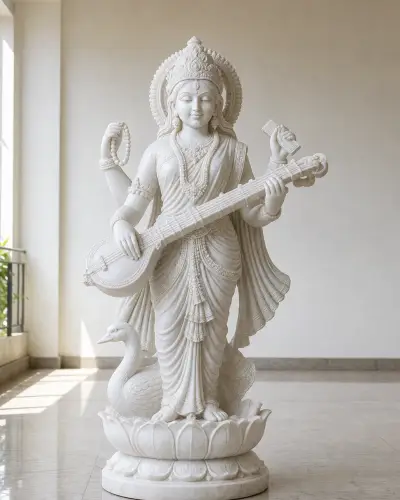
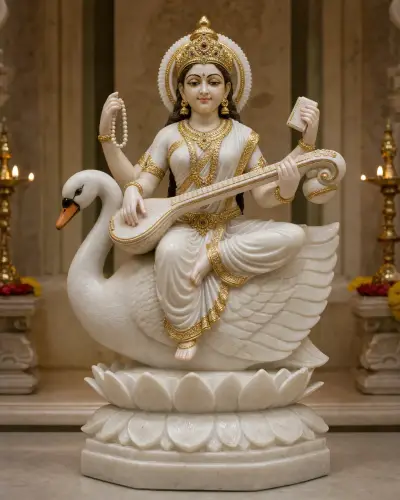
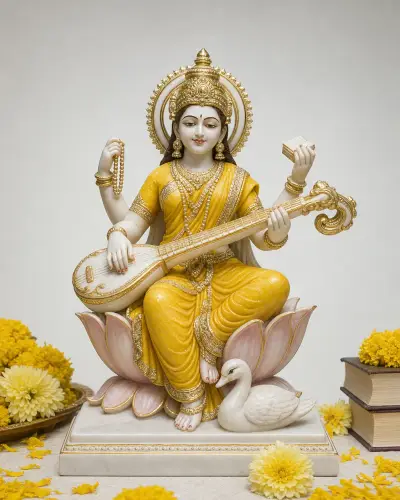
A 24-inch Makrana white marble Saraswati carved in high relief on an arched stele, playing the veena above her swan, made for a wall niche.
Made to order. The pictures here are concept images. This is not a ready item. We get it made for you as per this design, as close as possible, in the size and stone you choose.
Want this design made for you?
Tell us the size, the stone and where it is going. We will send you a quote and a timeline.
Chat on WhatsAppWe'll respond within 5 minutes
About This Piece
Saraswati carved in high relief
Not every Saraswati is meant to stand free in the middle of a room. This 24-inch piece is a relief: the goddess is carved out of the face of an arched stele, rising from the stone in deep high relief so that her face, her arms and the veena stand well forward while her back stays joined to the slab behind her. It is the form you see set into the walls of old temples, and it is made to sit in a wall niche, where the arch of the stele echoes the arch of the recess around it and the whole composition reads at once from across a hall.
Four arms, two on each side
She sits on an open lotus with one leg folded and one foot resting forward, and her swan, the hamsa, sits in the front of the base below her. She is four-armed, with two arms on each side of her body. The front pair play a veena held across her lap, one hand at the strings over the gourd and one along the neck below the carved scroll. Her back right hand holds an akshamala, the rosary of japa and steady practice, and her back left hand holds a palm-leaf book, the sign of learning. She wears a draped sari over a fitted choli with the pallu across her torso, a tall crown, earrings, layered necklaces, armlets and bangles, and a sunburst halo opens behind her head. Her face is youthful and calm, eyes softly lowered, with a small tilak and a gentle smile.
The arch and its border
The stele itself is part of the carving, not a plain backing. A border of curling creeper and small flowers runs up both sides and over the top of the arch, a lotus finial crowns it, and a band of lotus petals runs along the stepped plinth at the foot. Because everything is cut from one block of Makrana white marble, the border, the figure and the base share the same fine, crystalline grain and the same bright natural white with a faint warm undertone. Nothing is painted. The surface is brought to a soft satin polish, which lets light pick out the depth of the relief, the strings of the veena and the feathers of the swan without the glare of a mirror finish.
Where it belongs
A relief like this suits places where wall space is easier to find than floor space: the prayer hall or assembly hall of a school, the entrance of a library or music academy, a temple wall beside the main shrine, or a niche in a family pooja room. At 24 inches tall, about 16 inches wide and 6 inches deep, it fits a standard recessed niche and weighs around 35 kg, so it should be set on a solid ledge or fixed into the wall by a mason rather than hung. Keep the base of the niche above floor level, as it should be for any murti, and wipe away kumkum, haldi and flower marks soon after puja on Vasant Panchami, since marble is a natural, slightly porous stone.
Made to your measurements
Because a relief is usually fitted into a space that already exists, the height, width and the shape of the arch can all be adjusted to your niche. The same composition can also be carved with the name of a school, temple or donor along the plinth. Send us the inside dimensions of the niche on WhatsApp and we will help you settle the size before carving begins.
Specifications
Pose
Seated on a lotus in deep high relief against an arched stele, four-armed, playing the veena with akshamala and palm-leaf book, swan at her feet
Color
White
Finish
Soft polish (satin)
Material
Makrana White Marble
Ideal For
Wall niche, School prayer hall, Temple wall
Weight In Kg
35
Depth In Inches
6
Width In Inches
16
Height In Inches
24
Region Or Tradition
Indian (pan-Indian Saraswati worship, Vasant Panchami)