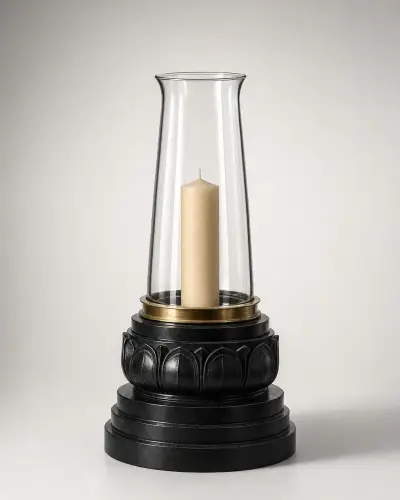
Black Granite Lotus-Seat Chowki, 6in
Hand-polished black granite chowki: a 6-inch lotus-petal seat on four turned feet, made to raise a murti in a home pooja room.
Made to order. The pictures here are concept images. This is not a ready item. We get it made for you as per this design, as close as possible, in the size and stone you choose.
Want this design made for you?
Tell us the size, the stone and where it is going. We will send you a quote and a timeline.
Chat on WhatsAppWe'll respond within 5 minutes
About This Piece
What a chowki is for
A chowki is the low seat that lifts a murti clear of the floor or the shelf it stands on, the household version of the stone singhasan inside a temple. In most Indian homes nothing in the pooja room is meant to rest directly on the ground, and this is the piece that answers that. The form here is a 6-inch square with a lotus-petal medallion cut into the top face, a moulded band carrying a petal frieze around the edge, and four short turned feet that raise it about an inch. The top is left completely open, so a small Ganesh, a Laddu Gopal, a Shiva lingam or a framed photograph can all take the same seat. The raised feet also let abhishek water run off the sides instead of collecting underneath.
The stone
Black granite is an igneous rock rather than a marble. It is considerably harder, effectively non-porous, and far less troubled by water, oil and lamp soot than white marble is. On a chowki, which lives under abhishek water and beside a lit diya, that is the property that earns it the job. The stone is quarried in southern India, where it has been the temple material for centuries: the Chola-period shrines of Tamil Nadu and most South Indian processional murtis are cut from the same family of rock. Worked to a soft satin polish rather than a mirror, it reads as an even, deep black with a very fine crystalline grain that shows only where the carving turns and catches the light. It takes a wipe with a damp cloth and looks the same years later.
The carving
Every line on this chowki is cut by hand. The lotus is a shallow relief of eight petals around a seed boss, the outlines run in with a fine point so the flower stays legible in the low light of a mandir. Below it the edge band carries a repeating petal frieze, and the four feet are turned to a round profile and then carved with a leaf sheath so they answer the top. Black granite is slow, unforgiving work: it will not be hurried the way marble can be, and a slipped chisel cannot be filled afterwards. The piece is carved for you by the master sculptors we work with in Jaipur, and the flat top is trued and polished last so a murti sits level on it.
Sizing it for your mandir
Six inches across suits a murti of roughly four to nine inches, such as a Laddu Gopal, a small Ganesh, a Balaji, or a lingam with its yoni base. Standing about two and a half inches tall and weighing close to two kilos, it stays put without being awkward to lift down for cleaning. In a home mandir it usually goes centrally on the main shelf, with the murti's own base set inside the lotus medallion so the petals read as a border around it. Black against a white marble mandir is a deliberate contrast; against a wooden one it reads quieter. If your murti is wider than six inches at the base, take the next size up rather than let the base overhang the edge band.
Making it yours
The lotus can be left off for a plain polished top, the square can be turned round, and the same chowki can be cut in Makrana white marble, Vietnam white marble or Dholpur pink sandstone. Sizes step up in two-inch increments. Tell us the murti it has to carry and we will size it to that piece.
Specifications
Color
Black
Finish
Soft polish (satin)
Material
Black Granite
Ideal For
pooja room, home mandir, gifting
Set Or Pair
Single
Primary Size
6 inch square top, about 2.5 inches tall
Weight In Kg
2
Region Or Tradition
Indian / South Indian (Dravidian temple tradition)
Motif Or Iconography
Lotus petal