Black Marble Girijatmaj of Lenyadri in a Rock-Cut Cave Arch, 30 in
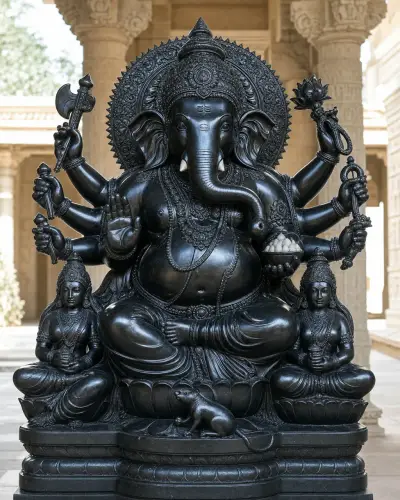
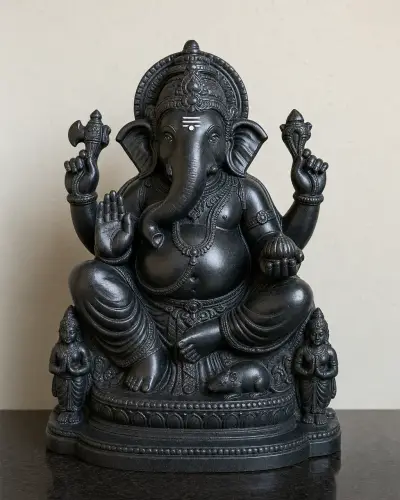
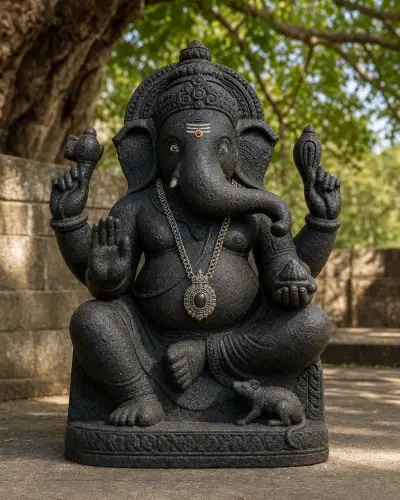
The sixth Ashtavinayak swaroop, Girijatmaj of Lenyadri, as a seated relief in an arched black marble stele, 30 inches, honed matte.
Made to order. The pictures here are concept images. This is not a ready item. We get it made for you as per this design, as close as possible, in the size and stone you choose.
Want this design made for you?
Tell us the size, the stone and where it is going. We will send you a quote and a timeline.
Chat on WhatsAppWe'll respond within 5 minutes
About This Piece
The swaroop of Lenyadri
Girijatmaj is the sixth of the eight Ashtavinayak swaroops, and the only one of them whose shrine was never built. Cave seven in the Lenyadri group, cut into a hillside above the Kukadi river in Pune district, began as a Buddhist vihara centuries before it became a Ganpati sthan, and the murti sits in the wall of the hall itself, carved out of the living rock rather than installed in front of it. Pilgrims reach it by a long flight of cut-stone steps, and the hall spans its whole width without a single pillar holding up the roof. The name means son of Girija, Parvati, who is said to have kept her penance in these caves. That relationship between image and rock is what this piece is built around: the Ganpati is worked as a seated relief inside an arched stele, emerging from the back slab, so the stone reads as one continuous mass from finial to plinth.
The stone and the finish
The block is a dense black stone of the kind quarried around Markapur in Andhra Pradesh: close-grained, uniform, with no veining to break across the surface. It is left honed rather than polished, so the piece keeps a dry matte skin that reads charcoal under a direct lamp and near-black in shadow. The choice is deliberate for this swaroop. A mirror polish turns a stele into an object that reflects the room back at you, and the whole point of Girijatmaj is a form that reads as rock. Honing also keeps the chisel record legible: the fine tool passes across the arch face, the softer sanding around the trunk and belly, the crisper cuts in the scrollwork band running along the plinth. Each piece is carved to order for you by the master sculptors we work with in Jaipur, and the face, hands and trunk are always finished by hand rather than by machine.
Reading the iconography
Four arms, a rounded belly, one broken tusk on the right, a modak held in the lower hand, and the mushak turned in at the base: those attributes are the standard ones, and they are the first things to check on any Ganpati murti. The detail particular to this form is the trunk: it curls to his own left, which places it on your right as you stand in front of the piece. The figure sits inside a plain arched frame topped by a small ribbed finial, the shape a niche takes when it is cut into rock rather than assembled from blocks. Nothing is applied to the ground behind him. There is no prabhavali, no inlay, no gilding and no painted detail. The arch is left bare so the eye stays on the modelling of the body and on the shallow depth of the carving, which is where a cave image gets its stillness.
Sizing it for your space
At 30 inches tall and roughly 19 inches across, this is a floor- or platform-standing murti rather than a shelf piece. The stele carries its own moulded plinth, so it wants a flat surface rated for about 85 kilograms, such as a stone or hardwood chowki, a built mandir platform, or a low masonry ledge. Depth stays modest at around 7 inches, which is what makes a relief practical where a figure in the round would not fit: it sits close against a wall in a mandir room, a landing alcove, or a meditation corner. Set a plain wall behind it and place a lamp to one side rather than straight on, since shallow carving shows its depth when the light crosses it. Sizes from 12 inches upward, the same swaroop in Makrana or Vietnam white marble, and a soft polish instead of a honed finish can all be worked to your brief.
Specifications
Pose
Seated four-armed relief within an arched stele, in the manner of the Lenyadri rock-cut cave shrine — the figure emerges from the back slab rather than standing free of it; trunk curled to his own left, single broken right tusk, modak in the lower hand, mushak at the base
Color
Jet Black
Finish
Matte (honed)
Material
Black Marble
Ideal For
Home mandir, Meditation room, Temple installation
Weight In Kg
85
Depth In Inches
7
Width In Inches
19
Height In Inches
30
Region Or Tradition
Indian / Maharashtrian (Ashtavinayak, Lenyadri tradition)