Black Marble Mahaganapati of Ranjangaon, Multi-Armed, Mirror Polish, 3 ft
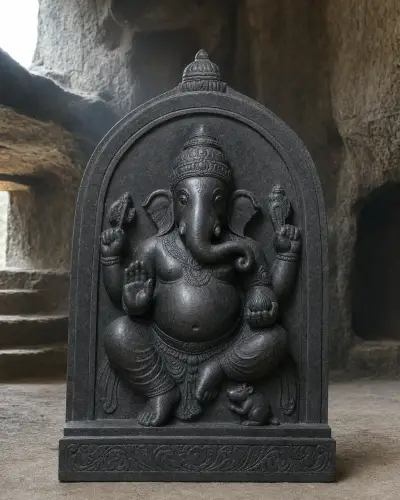
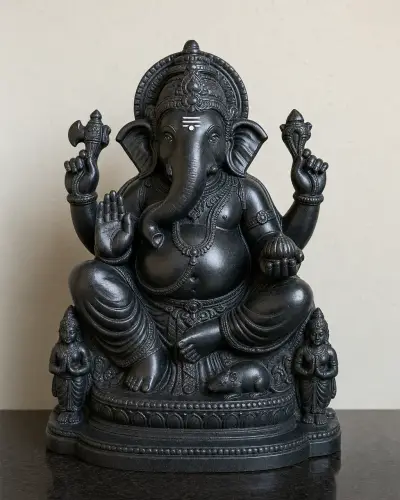
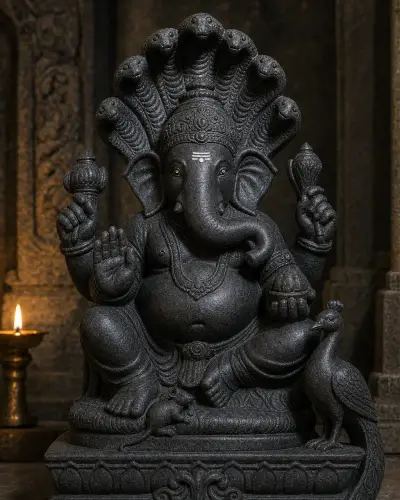
Master-carved black marble Mahaganapati of Ranjangaon: a 3ft temple-scale murti in mirror polish, with Riddhi and Siddhi seated beside him.
Made to order. The pictures here are concept images. This is not a ready item. We get it made for you as per this design, as close as possible, in the size and stone you choose.
Want this design made for you?
Tell us the size, the stone and where it is going. We will send you a quote and a timeline.
Chat on WhatsAppWe'll respond within 5 minutes
About This Piece
The Ranjangaon swaroop
Mahaganapati is the eighth and last halt on the Ashtavinayak yatra, and the swaroop at Ranjangaon in Pune district has an arrangement of its own. He sits cross-legged, broad-browed and full-bellied, the trunk turning to his own left, with Riddhi and Siddhi seated one on either side. The arms fan out symmetrically around his shoulders holding weapons, a lotus and a bowl of modaks, the expansive form that Shiva is said to have invoked here before the campaign against Tripurasura. This murti keeps to that arrangement: the mushak curled at the base, a single broken tusk, a carved prabhavali arch rising behind the crown. The form is not reinterpreted anywhere, because a devotee searching for Mahaganapati has one specific murti in mind.
Black stone taken to a mirror polish
Black stone has been the sculptor's material for temple murtis across southern India for centuries, and it is one of very few stones that will hold a true mirror finish, the high-gloss reading that dense black stone reaches and softer white marbles never do. On a form this busy the polish earns its extra weeks of hand work: light travels the curve of the belly and along the fanned arms as one long unbroken highlight, so the murti reads clearly even in a dim garbhagriha. The colour is dense and opaque, with no veining and no brown or green drift. The fine carving (necklace beading, the folds of the dhoti, the mouse's whiskers) stays legible inside the shadows instead of sinking into them.
Why pilgrims come to Ranjangaon
The Ashtavinayak yatra is a circuit of eight self-manifested Ganpati shrines around Pune, and tradition places Ranjangaon at the end of it. This is the temple where Shiva is said to have worshipped Ganesha before setting out against the demon Tripurasura, which is where the name Mahaganapati and the epithet Tripurarivade come from. The east-facing temple is built so that the sun's rays reach the murti at certain times of the year, and pilgrims plan their darshan around it. Ordering this swaroop is usually a deliberate choice rather than a general one: families who have completed the yatra, Maharashtrian households raised on this form, and mandals that want the Ranjangaon Ganpati specifically rather than a generic seated one.
Sizing a 3-foot Mahaganapati for your mandir
At 36 inches tall and roughly 25 inches across, this is temple scale rather than shelf scale. The width comes from Riddhi and Siddhi flanking him, so the platform wants to be at least a foot wider than the murti, and the wall behind it clear of clutter. In dense black stone at this size the piece runs to a couple of hundred kilos, so the plinth and the route into the room are worth settling before the delivery date. Set it at chest height or higher, facing east or north, as is usual for a Ganpati in a home mandir. In a community mandap the mirror finish does most of the work; one warm lamp placed in front of it is enough.
Make it yours
Everything is made to order, so the Ranjangaon swaroop can be cut down to 18 inches for a home mandir or taken past four feet for a mandal, worked in Makrana white or Vietnam white marble instead of black stone, and finished in a softer satin polish if a mirror surface is too reflective for the room. We design the piece with you, brief the sculptor who carves it, and follow it through to your door. Send a photograph of the space and we will tell you what will actually sit well in it.
Specifications
Pose
Seated cross-legged in the multi-armed Mahaganapati form of Ranjangaon, the arms fanned symmetrically holding weapons, a lotus and a bowl of modaks; broad forehead, potbelly, a single broken tusk, the mushak at the base, and Riddhi and Siddhi seated one on either side. The trunk curls to his own left.
Color
Jet Black
Finish
Mirror polish
Material
Black Marble
Ideal For
Temple installation, Community mandir, Large home mandir
Weight In Kg
175
Depth In Inches
14
Width In Inches
25
Height In Inches
36
Region Or Tradition
Indian / Maharashtrian (Ashtavinayak, Ranjangaon tradition)