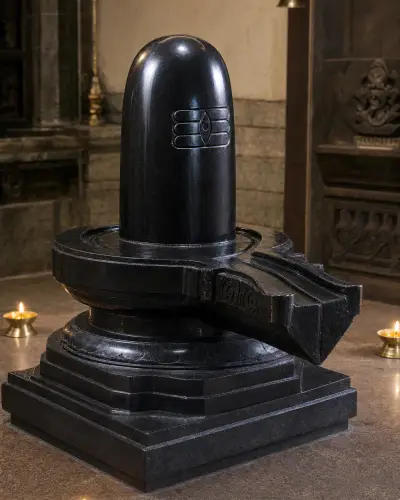
Handcrafted Black Marble Naga Shiva Lingam with Serpent Canopy, 24in
Master-carved black marble Naga Shiva Lingam, with a five-hooded serpent canopy over a mirror-polished shaft on a broad yoni base.
Made to order. The pictures here are concept images. This is not a ready item. We get it made for you as per this design, as close as possible, in the size and stone you choose.
Want this design made for you?
Tell us the size, the stone and where it is going. We will send you a quote and a timeline.
Chat on WhatsAppWe'll respond within 5 minutes
About This Piece
Why black marble for a lingam bathed daily
Black marble carries the deepest tonal weight of any stone in the Indian sculpture trade, and it is the traditional choice for a lingam meant to be bathed daily. The block for this piece comes from the black marble belt around Markapur in Andhra Pradesh, a stone quarried for temple flooring and idol work for generations. Its grain is fine and close, with almost no visible veining, which is why it holds a mirror polish where softer white marbles would cloud. Under sanctum light the shaft reads as one unbroken dark form; under a stream of abhisheka water it turns almost liquid.
How the Naga hoods and scales are cut
The master sculptors we work with in Jaipur begin at the yoni pitha, because the base sets the axis for everything above it. The circular drum and the projecting pranala spout are roughed out with hand chisels, then the lingam shaft is shaped, its curvature checked against a template at every stage. The Naga is the slowest part: each hood and every row of scales along the coils is cut with fine points and rifflers, never machine burrs. Polish then runs through progressive grades by hand, so the scale texture stays crisp while the shaft comes up to full gloss.
Vasuki's canopy and what the yoni base means
The serpent sheltering the lingam is one of the older motifs in Shaiva imagery. The Naga, usually identified as Vasuki, the serpent Shiva wears at his throat, raises a five-hooded canopy over the shaft and coils around its base as a guardian rather than a threat. Naga lingams of this kind stand in sanctums and beneath sacred trees across South India and the Deccan, often installed in clusters as Naga pratishtha. The yoni base with its outward spout completes the aniconic form: shaft and pitha are always read together, never separately.
Installing a 24-inch lingam, and other hood counts
At 24 inches this is a sanctum-scale lingam rather than an altar piece. It asks for a dedicated platform (a temple room, a pooja hall, or a garden shrine with a drain line) and clear space on the spout side, since the pranala is conventionally set so abhisheka water runs off toward the north. Decide that orientation before installation rather than after. Weight matters too: near 80 kg, the piece wants a masonry or solid-wood plinth and is far easier to position once, correctly, than to shift later.
Height, base diameter and the number of serpent hoods can all be changed. A seven-hooded Naga or a taller shaft are both regular requests, as is the same form in Makrana white marble for a lighter sanctum. Send us the platform dimensions you are working with and we will size the pitha to them.
Specifications
Pose
Naga Shiva Lingam — coiled five-hooded serpent canopy over the lingam shaft, on a yoni base with north-facing spout
Color
Black
Finish
Mirror polish
Material
Black Marble
Ideal For
Temple sanctum, Large home shrine, Rudrabhishek
Weight In Kg
80
Depth In Inches
18
Width In Inches
16
Height In Inches
24
Region Or Tradition
Indian / Deccan (Shaiva Naga-lingam tradition, Markapur black marble)