Handcrafted Black Marble Pala-Style Mahishasuramardini Durga Stele, 4ft
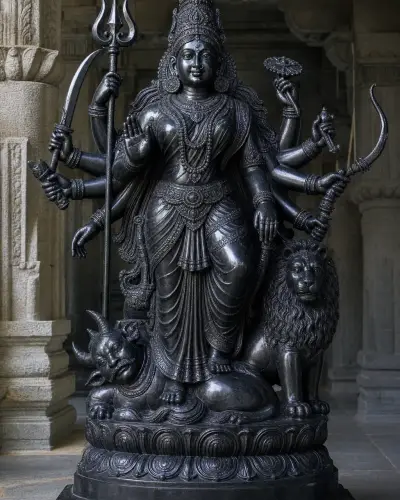
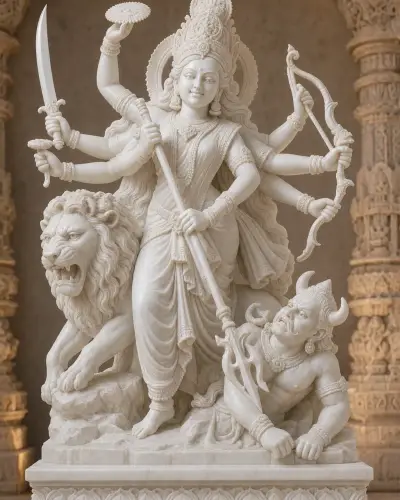
Master-carved black marble Durga stele in the Pala idiom, a 48-inch deep-relief Mahishasuramardini framed by an ornate prabhavali arch.
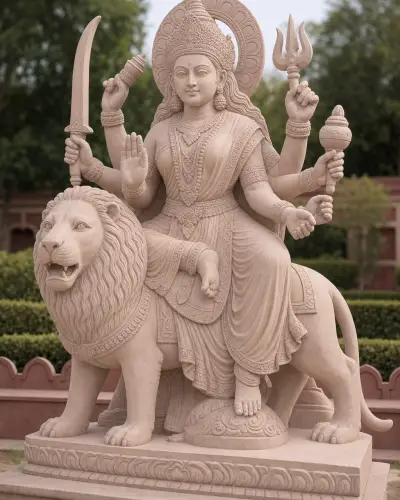
Made to order. The pictures here are concept images. This is not a ready item. We get it made for you as per this design, as close as possible, in the size and stone you choose.
Want this design made for you?
Tell us the size, the stone and where it is going. We will send you a quote and a timeline.
Chat on WhatsAppWe'll respond within 5 minutes
About This Piece
Why black stone suits a Pala-style stele
Black stone is the historically correct medium for this subject. Between the eighth and twelfth centuries, sculptors working under the Pala courts of Bihar and Bengal cut their Mahishasuramardini panels from the dark schist of the eastern hills, and the deep-relief stele (figure, mount and framing arch worked out of one slab) became the signature form of that school. This 48-inch piece follows the same idiom in black marble quarried at Markapur in Andhra Pradesh, a dense, close-grained stone that holds the mirror polish the undercut arch detail needs to read from across a room.
How the stele is cut from one slab
Carving begins with the slab, not the figure. The outline of the prabhavali is scribed first, then the ground is dropped back in stages so that Durga, her lion and the fallen asura emerge in descending planes of relief. Point and claw chisels do the rough removal; the crown tiers, the necklaces, the bowstring and the small attendant figures inside the arch are cut with fine flat chisels and rifflers. Faces, hands and drapery are finished entirely by hand; no machine pass touches them. Tilak Mandirwala commissions each piece to order from the independent master sculptors it has worked with in Jaipur for years.
The Mahishasuramardini pose and where the stele stands
Mahishasuramardini is Durga at the moment the buffalo demon falls. She stands in pratyalidhasana, the archer's lunge, one foot braced on the carcass and the other resting over her lion, with weapons distributed across her many arms (sword, shield, bow, noose), each one a gift from a different god. The face is the whole point of the tradition: composed, almost smiling, above a body in full combat. In Bengal the same iconography returns every autumn at Durga Puja, where the goddess and her retinue are set inside a single framing arch.
At four feet the stele is a floor or plinth piece rather than a shelf piece. Give it a plain wall, since the arch reads best with nothing competing behind it, and roughly eighteen inches of clearance on either side. A single raking light from above and to one side is what brings out the undercutting; flat frontal light flattens black stone into a silhouette. Collectors usually place it along an entrance hall or a gallery wall, while a Bengali household shrine can carry it as the central image with the lamp stands set low and forward.
Adjusting the height, the arch or the stone
Height, arch profile and the depth of the relief can all be adjusted, and the same composition can be cut in Makrana white marble or Vietnam white marble if the room needs a lighter piece. Message us with the wall dimension and the light you have, and we will work back from there.
Specifications
Pose
Pala-style Mahishasuramardini stele — pratyalidhasana with one leg braced on the slain buffalo demon and the other over her lion, multi-armed with sword, shield, bow and noose, triple-diadem crown, framed by a deeply carved prabhavali arch with attendant figures
Color
Black
Finish
Mirror polish
Material
Black Marble
Ideal For
Collector piece, Gallery display, Bengali household shrine
Weight In Kg
38
Depth In Inches
14
Width In Inches
26
Height In Inches
48
Region Or Tradition
Indian / Bengali (Pala-period eastern India)