Hand-Painted Makrana White Marble Neem Karoli Baba Ashirwad Murti 24in
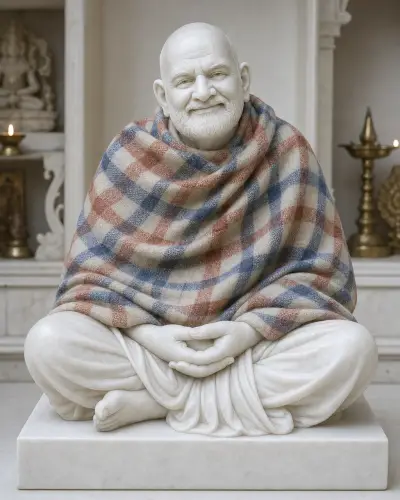
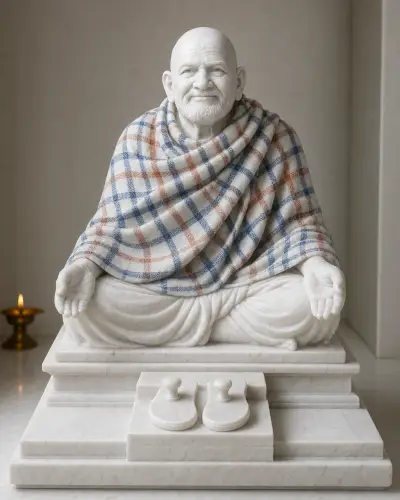
Studio-carved Makrana white marble Neem Karoli Baba in ashirwad. A 24-inch pooja-room murti with a hand-painted blue-and-rust plaid blanket.
Made to order. The pictures here are concept images. This is not a ready item. We get it made for you as per this design, as close as possible, in the size and stone you choose.
Want this design made for you?
Tell us the size, the stone and where it is going. We will send you a quote and a timeline.
Chat on WhatsAppWe'll respond within 5 minutes
About This Piece
The stone
Makrana white marble comes out of the quarries in Nagaur district, about a hundred kilometres north-west of Jaipur. It is the same seam the Taj Mahal was faced with, which is why it has stayed the default stone for Indian temple work for four centuries. It is almost pure calcite, dense and low in porosity, so it takes daily washing, oiling and garlanding without staining or going chalky along the edges. The colour is a bright neutral white with the faintest warm undertone, the grain fine and lightly sugary, carrying occasional grey hairlines no wider than a pencil mark. This murti is finished to a soft satin polish rather than a mirror shine, so light settles on the surface instead of bouncing off it, and the face, the raised palm and the fall of the blanket stay readable from across a pooja room.
The form
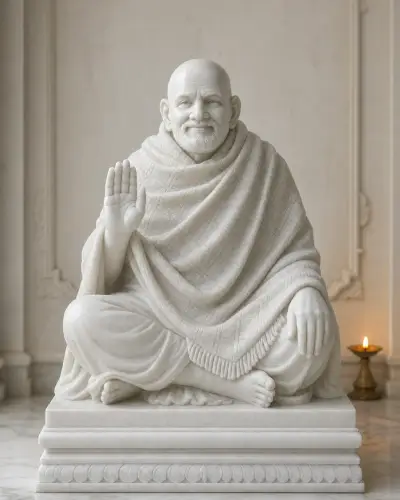
Neem Karoli Baba is shown here the way most of his devotees picture him: seated cross-legged in an easy sukhasana on a plain rectangular plinth, the right hand lifted palm-out in ashirwad, the left resting open on the knee, bare feet showing at the front. He is bald and bare-headed, with a short trimmed grey-white beard, heavy-set through the shoulders and the middle, the expression elderly and warm with a trace of amusement in it. The plaid blanket drawn over both shoulders and around the torso, worn over a white dhoti, is the recognition mark. Maharaj-ji is never carved in a monastic robe, never with a knotted head cloth, and never in the lotus posture. Getting the blanket right is most of the likeness.
The hand-painting
Only the blanket carries colour. It is painted after the carving and the polishing are finished, laid in as a woven check in blue, rust and navy, the weave suggested by how the tone shifts across each square rather than by any raised texture. Everything else (the plinth, the dhoti, the hands, the face) is left as bare marble, and that restraint is what keeps a painted murti from tipping into a doll. Polychrome work of this kind is done by hand on finished stone, so no two pieces match exactly and the check will read a little differently on yours. A plain unpainted version in white marble, or a different colourway for the blanket, is a decision to make before carving starts rather than after.
Sizing it for your pooja room
At 24 inches seated the murti measures roughly 12 inches across and 11 inches front to back, and weighs about 17 kg, heavy enough to want a solid shelf, a stone chowki or a low wooden platform rather than a hollow-topped mandir. It reads well as the main figure in a home mandir with a couple of feet of clear wall behind it, and the raised blessing hand sits close to eye level for someone seated on the floor. Every piece is made to order in Jaipur by the master sculptors we work with, and a statue of this size runs eight to twelve weeks from approved drawing to crated dispatch. Sizes between 12 and 48 inches, and an inscribed plinth for a temple donation or a family gifting, are all straightforward to arrange.
Specifications
Pose
Seated cross-legged in relaxed sukhasana on a plain rectangular plinth, the right hand raised palm-out in ashirwad, the left resting on the knee, bare feet at the front, wrapped in a hand-painted chequered plaid blanket over a white dhoti
Color
Polychrome (hand-painted)
Finish
Hand-painted (polychrome)
Material
Makrana White Marble
Ideal For
Pooja room, Home mandir, Devotional gift
Weight In Kg
17
Depth In Inches
11
Width In Inches
12
Height In Inches
24
Region Or Tradition
Indian / Kumaoni (Kainchi Dham, Hanuman bhakti tradition)