Hand-Painted Makrana White Marble Neem Karoli Baba with Charan Padukas 21in
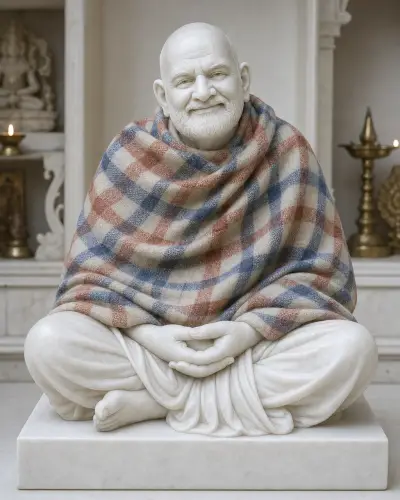
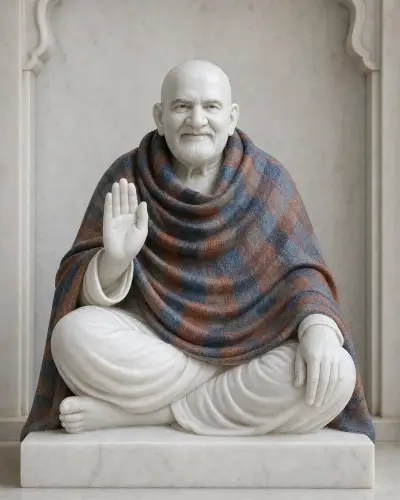
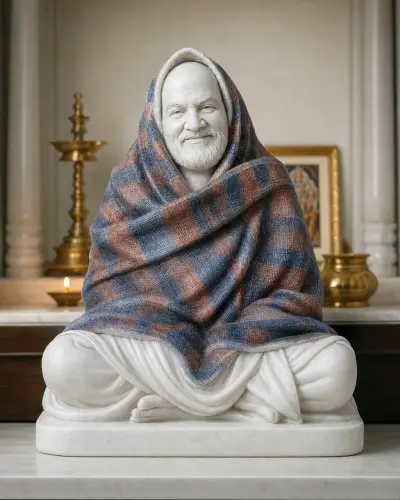
Hand-carved Makrana white marble Neem Karoli Baba in sukhasana: a 21-inch pooja room murti with painted plaid blanket and charan padukas.
Made to order. The pictures here are concept images. This is not a ready item. We get it made for you as per this design, as close as possible, in the size and stone you choose.
Want this design made for you?
Tell us the size, the stone and where it is going. We will send you a quote and a timeline.
Chat on WhatsAppWe'll respond within 5 minutes
About This Piece
The stone, and the one place colour appears
Makrana white marble comes out of the quarries in Nagaur district, Rajasthan, the same calcite belt that supplied the Taj Mahal four centuries ago. It is a brilliant neutral white with only the faintest warm undertone, fine and compact in the grain, carrying the occasional grey hairline vein and little else. On this 21-inch Neem Karoli Baba murti the stone is left bare almost everywhere: the face and open hands, the white dhoti, the stepped plinth and the pair of charan padukas resting below are all plain marble, taken to a soft satin polish that holds light without turning glassy. Colour appears in exactly one place. The blanket wrapped over both shoulders is hand-painted as a woven check in blue, rust and navy, so the plaid reads from across a room while the rest of the piece stays stone.
Why the padukas sit on the step
Neem Karoli Baba (Maharaj-ji to the people who came to him at Kainchi Dham) is remembered less for a formal posture than for a presence: bald and bare-headed, a short grey-white beard, wrapped in a plaid blanket in nearly every photograph of him. The murti keeps that exactly. He sits cross-legged in sukhasana, heavy-set and settled, both hands open on the knees, the face elderly and faintly amused. On the step below him rests a carved pair of charan padukas. In this tradition devotees garland and touch the sandals rather than the figure, so cutting a paduka set into the same block gives the piece a place for that daily gesture instead of leaving it something only to look at.
How it is carved and painted in Jaipur
Every piece is made to order by the Jaipur carvers we work with. The block is rough-cut to the seated mass first, then the plinth steps and the padukas are squared up before any figure work begins, because they set the proportions everything else hangs off. The face, the beard, the open hands and the folds of the blanket are cut by hand with chisel and drill point, with no machine finishing on those surfaces, and then carried through progressive hand polishing to a satin sheen. Painting comes last, laid in over finished stone line by line so the check sits down into the carved folds and follows them rather than floating flat across the drape. A 21-inch murti of this kind runs roughly eight to twelve weeks from the day the order is confirmed.
Sizing it for your pooja room
At 21 inches the murti reads as a full centrepiece on a mandir shelf or a low wooden chowki. It is large enough that the painted check and the carved padukas both keep their detail, and small enough that a standard home mandir takes it without rebuilding the platform. Allow about 11 inches of width and 9 of depth, and leave clear space in front so the padukas stay within reach. It weighs around 15 kg, so a solid shelf or a stone platform is worth having rather than a hollow cabinet top. If you would like it larger, smaller, in plain unpainted white marble, or with a different blanket palette, send us the size and we will work it out with you.
Specifications
Pose
Seated cross-legged in sukhasana on a stepped plinth, both hands open on the knees, wrapped in a chequered plaid blanket over a white dhoti, with a carved pair of charan padukas resting on the step below
Color
Polychrome (hand-painted)
Finish
Hand-painted (polychrome)
Material
Makrana White Marble
Ideal For
Pooja room, Home mandir, Devotional gift
Weight In Kg
15
Depth In Inches
9
Width In Inches
11
Height In Inches
21
Region Or Tradition
Indian / Kumaoni (Kainchi Dham, Neem Karoli Baba Hanuman-bhakti tradition)