Hand-Painted Makrana White Marble Kainchi Dham Neem Karoli Baba Darshan Murti 36in
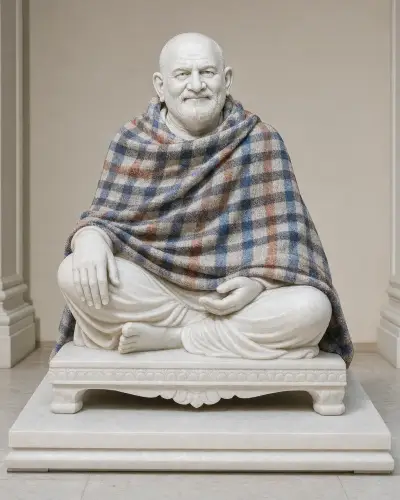
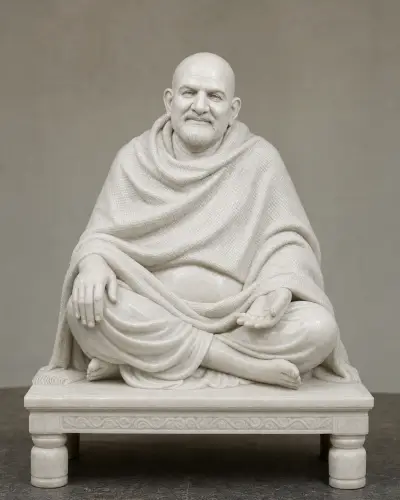
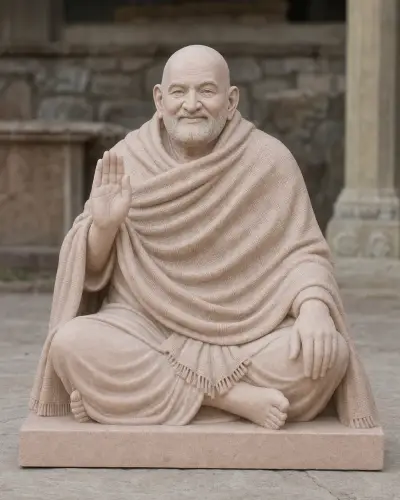
Hand-painted Makrana white marble Neem Karoli Baba in the Kainchi Dham darshan form, a 36-inch temple murti with a tartan-check blanket.
Made to order. The pictures here are concept images. This is not a ready item. We get it made for you as per this design, as close as possible, in the size and stone you choose.
Want this design made for you?
Tell us the size, the stone and where it is going. We will send you a quote and a timeline.
Chat on WhatsAppWe'll respond within 5 minutes
About This Piece
The stone
Makrana white marble comes out of the Nagaur district of Rajasthan, from quarries that have been worked continuously for close to a thousand years, the same beds that supplied the Taj Mahal and the Dilwara temples. It is a dense, compact stone with a fine crystalline grain and only faint grey hairline veining, which is why it holds a carved eyelid or a fold of cloth without crumbling at the edge. On this murti the stone is finished to a soft satin polish: light settles on it rather than bouncing off it, so the face reads clearly under a sanctum lamp instead of flaring. The plinth, the dhoti, the hands and the face are left in bare white marble, unpainted, so the material stays visible as the material it is.
Who this murti shows
Neem Karoli Baba, Maharajji to the people who knew him, was a Hanuman devotee of the Kumaon hills who left his body in 1973, and whose murti was installed at Kainchi Dham on 15 June 1976. The likeness here follows that sanctum form: a bare, bald head with no turban and no head cloth, a short trimmed grey beard and moustache, and the chequered plaid blanket drawn over both shoulders that earned him the name Blanket Baba. He sits cross-legged in sukhasana, heavy-set and easy, the right hand raised palm-out in ashirwad and the left open on the knee. Heavy flower garlands hang at the neck, carved into the stone rather than added later.
Why the blanket is painted
Colour on this piece is deliberate and confined. The blanket is hand-painted after carving as a woven tartan check in blue, rust and navy; everything else (face, hands, dhoti, garland, plinth) stays bare Makrana marble. That division is not decoration for its own sake. The check is the mark that identifies Maharajji instantly, and painting it lets the identity carry the length of a darshan hall in a way carved texture alone cannot. Keeping the skin and the drapery in white stone keeps the murti reading as stone rather than as a painted figure. A plain, fully unpainted version of the same seated form can be carved instead if you prefer it, in this stone or another.
Sizing it for your space
At 36 inches, three feet seated, this is a sanctum-scale murti rather than a shelf piece. It measures roughly 18 inches across and 16 inches deep and weighs about 25 kg, so it wants a built plinth, a masonry platform or a solid wooden takhat rather than a bracket or a light console. It suits a temple sanctum niche, an ashram darshan hall, or a large home mandir with a dedicated alcove; allow clear space above the raised hand so the blessing gesture is not crowded by the arch. The piece is carved to order by the master sculptors in Jaipur we commission, and a commission at this size runs eight to twelve weeks from confirmed drawing to dispatch. Other heights, a plain white finish, or a carved takhat-style base can be quoted on the same form.
Specifications
Pose
Seated cross-legged in sukhasana on a low carved singhasan plinth, the right hand raised palm-out in ashirwad and the left open on the knee, bald and bare-headed with a short trimmed grey beard and moustache, wrapped in a chequered plaid blanket over a white dhoti, heavy flower garlands at the neck
Color
Polychrome (hand-painted)
Finish
Hand-painted (polychrome)
Material
Makrana White Marble
Ideal For
Temple, Ashram, Home mandir
Weight In Kg
25
Depth In Inches
16
Width In Inches
18
Height In Inches
36
Region Or Tradition
Indian / Kumaoni (Kainchi Dham, Neem Karoli Baba tradition)