Hand-Painted Makrana White Marble Neem Karoli Baba on Takhat 30in
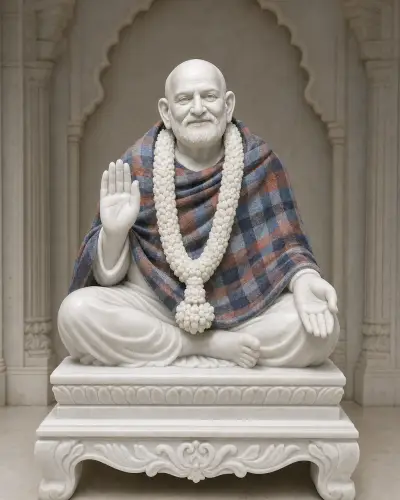
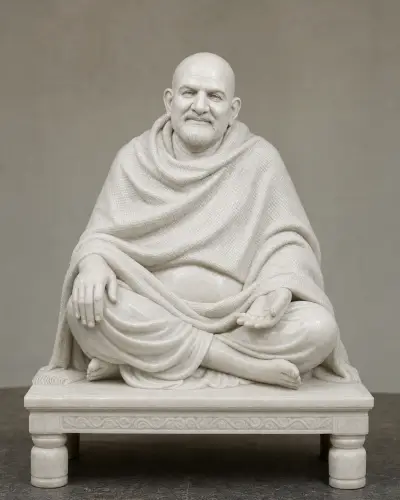
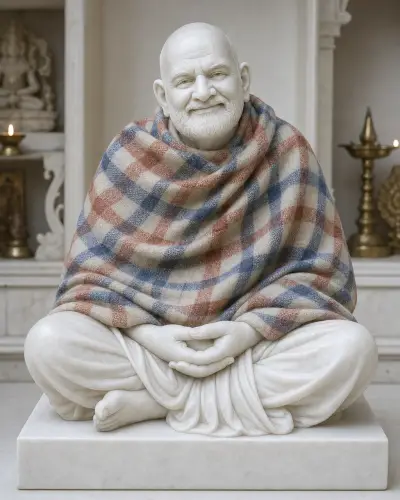
Sculptor-carved Makrana white marble Neem Karoli Baba on a carved takhat, a 30-inch home mandir murti with a hand-painted plaid blanket.
Made to order. The pictures here are concept images. This is not a ready item. We get it made for you as per this design, as close as possible, in the size and stone you choose.
Want this design made for you?
Tell us the size, the stone and where it is going. We will send you a quote and a timeline.
Chat on WhatsAppWe'll respond within 5 minutes
About This Piece
The stone
Makrana white marble comes out of the Makrana belt in Rajasthan's Nagaur district, the same quarries that supplied the Taj Mahal and the Dilwara temples at Mount Abu. It is a dense calcitic stone, bright natural white with the faintest cream undertone, a fine crystalline grain, and only occasional grey hairline veining. It has been the default murti stone in north India for centuries because it holds a crisp carved edge and does not yellow with age. On a piece like this one the stone does two jobs at once. The unpainted areas (the dhoti, the bare feet, the takhat bench and the stepped plinth) read as stone, finished to a satin glow that catches light without the glare of a mirror polish. The painted areas sit on a ground fine enough to take pigment evenly, with no open pores to swallow it.
Who Maharajji is, and how this murti reads him
Neem Karoli Baba, Maharajji to the devotees who filled his ashram at Kainchi Dham in the Kumaon hills, left his body in 1973 and remains one of the most photographed saints in modern India, which makes his likeness a matter of record rather than invention. Four things fix the identity, and all four are carved here: a bare, bald head with no turban and no head cloth; a short trimmed grey-white beard and moustache; the chequered plaid blanket wrapped over both shoulders and around the torso, the blanket that earned him the name Blanket Baba; and a white dhoti below it. The build is his own: stout, broad, heavy through the shoulders and the middle. The face is elderly, warm and faintly amused, the expression his devotees describe rather than an idealised saintly mask.
The takhat, and the hand-painting
He sat on a low wooden bench, a takhat, and the accounts of Kainchi Dham return to it constantly. So it is carved here from the same block rather than added as a separate stand: a plain-topped bench on turned legs with a shallow carved apron, lifting him clear of the floor on a stepped plinth. The blanket is hand-painted in polychrome, a woven tartan check in blue, rust and navy laid over the white ground, the weave picked out finely enough to read as cloth and not as flat pattern. Everything else is left alone. Pigment on marble is a separate skill from carving, applied only after the surface is finished and sealed, and the restraint is the point: paint the blanket, leave the stone as stone, and the piece keeps both.
Placing a 30-inch murti
At 30 inches tall and roughly 20 inches across the knees and bench, this sits at the scale of a principal murti rather than a shelf piece. It suits a home mandir deep enough to take a 16-inch footprint, a meditation room where it can be approached and sat with, or an ashram or satsang hall that needs one clear focal point for a larger gathering. Weight is around 85 kg, so whatever it stands on has to be load-bearing, such as a masonry platform, a stone-topped chowki, or the base of a floor-standing mandir, never a hollow shelf. Seat him facing into the room, low enough that his eyes meet a seated person's; the takhat already supplies the elevation the tradition asks for, so a tall pedestal under it is unnecessary.
Making it yours
Every piece is made to order, so the specification stays open. The same form can be cut at 18, 24, 36 or 48 inches, in Makrana white or another stone from the production palette, and taken either fully hand-painted as shown or left plain white with the blanket's check carved as texture alone. Padukas on the plinth step, a Hanuman carved behind him, or a name and date inscribed on the base for a temple donation are all worked in at the drawing stage. A commissioned statue of this size is carved by the master sculptors TMW works with in Jaipur, and takes 8 to 12 weeks from approved drawing to crated dispatch. Send the size and stone you have in mind on WhatsApp and dimensions, weight and a quote come back.
Specifications
Pose
Seated cross-legged in sukhasana on a low takhat bench carved from the same block, one hand resting on the raised knee and the other open in the lap, bare feet drawn up, wrapped in a chequered plaid blanket over both shoulders and a white dhoti below
Color
Polychrome (hand-painted)
Finish
Hand-painted (polychrome)
Material
Makrana White Marble
Ideal For
Home mandir, Meditation room, Ashram
Weight In Kg
85
Depth In Inches
16
Width In Inches
20
Height In Inches
30
Region Or Tradition
Indian / Kumaoni (Kainchi Dham, Neem Karoli Baba tradition)