Hand-Painted Marble Dust Neem Karoli Baba Murti 12in
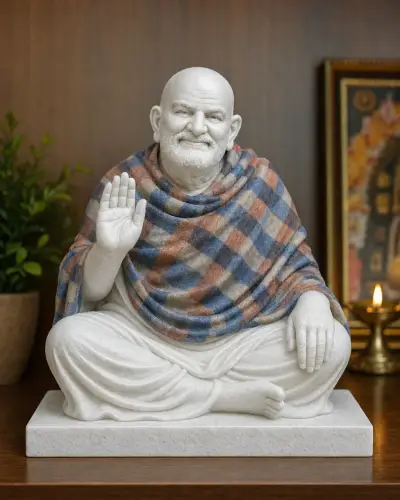
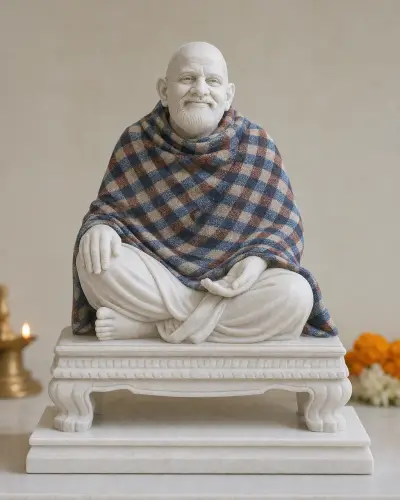
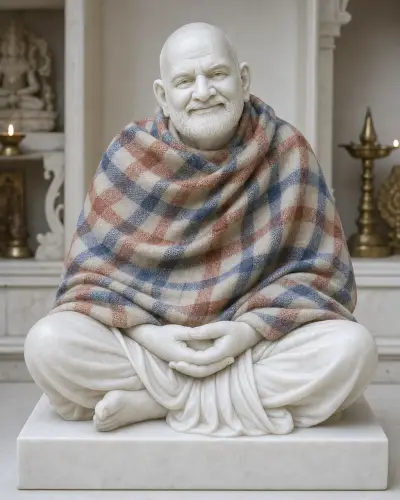
Workshop-finished marble dust Neem Karoli Baba in the lap-hands darshan form, a 1 ft home-mandir murti with a hand-painted plaid blanket. Made in 1 ft and above.
Made to order. The pictures here are concept images. This is not a ready item. We get it made for you as per this design, as close as possible, in the size and stone you choose.
Want this design made for you?
Tell us the size, the stone and where it is going. We will send you a quote and a timeline.
Chat on WhatsAppWe'll respond within 5 minutes
About This Piece
The stone
Marble dust composite is cast rather than quarried: crushed marble bound in a cured resin, set in a mould, then sanded and hand-finished in the Jaipur workshop. It reads as a natural white with the faintest warm cast, and its grain is finer and more even than a quarried block. That evenness is the honest signal that the material is manufactured, not mined. TMW reaches for it where solid Makrana would price a piece out of reach or make it awkward to carry, which is exactly the case for a compact home murti. The cast surface also takes hand-painting well: smooth enough for a fine check pattern to hold its lines, dense enough that colour sits on the surface instead of soaking in. It is a budget-tier material, and this page does not pretend otherwise.
Who this is
Neem Karoli Baba, Maharaj-ji to the people who followed him, kept his ashram at Kainchi Dham in the hills above Nainital, and died there in 1973. He is nearly always shown the same way, because that is how he was seen: bald and bare-headed, a short trimmed grey-white beard, heavy-set, wrapped in a chequered plaid blanket pulled over both shoulders, a white dhoti beneath. This murti keeps to that record. He sits cross-legged in a relaxed sukhasana on a plain plinth, both hands open and resting in the lap, the face elderly and faintly amused. No turban, no knotted head cloth, no saffron robe, no throne: these are the details that separate him from a Sai Baba murti or a seated Buddha, and the ones devotees check first.
The painted blanket
The blanket is the only painted element on the piece. Once the murti is cast, cured and sanded, the check goes in by hand in blue, rust and navy. It reads as a woven plaid rather than a printed graphic, with the darker lines carried across the folds so the pattern stays continuous where the cloth turns. Skin, dhoti and plinth are left as bare stone under a soft satin polish, and that is what gives the murti its contrast: warm painted cloth against untouched white. Painting at this scale is slow work, because the check has to shrink with the drape without losing its grid. It is the step that decides whether a small piece looks finished or looks like a toy.
Sizing it for a home mandir or a shelf
At one foot and roughly five kilograms, this is the smallest size we make this murti in, and the size people buy to keep close rather than to install. It sits on the front ledge of most home mandirs alongside taller murtis, on a study desk or an office shelf without crowding either, and it is still easy to carry home as a gift. Allow a few inches of clear height above the head if you want to garland it. The same form is made to order in 1 ft and above, in marble dust or in Makrana white marble, and the blanket can be repainted in a different colourway.
Specifications
Pose
Seated cross-legged in relaxed sukhasana on a small plain plinth, both hands resting open in the lap, bald and bare-headed with a short trimmed grey-white beard, wrapped in a hand-painted chequered plaid blanket over a white dhoti
Color
Polychrome (hand-painted)
Finish
Hand-painted (polychrome)
Material
Marble Dust Composite
Ideal For
Home mandir, Gifting, Desk
Weight In Kg
5
Depth In Inches
5
Width In Inches
7
Height In Inches
12
Region Or Tradition
Indian / Kumaoni (Kainchi Dham, Uttarakhand; Neem Karoli Baba tradition)