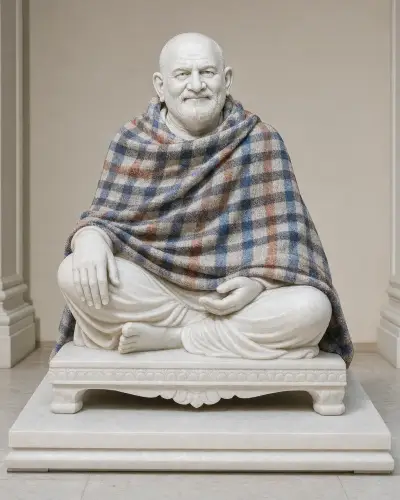
Hand-Painted Marble Dust Neem Karoli Baba on Takhat 12in
Workshop-cast marble dust Neem Karoli Baba on a takhat: a 12-inch pooja-shelf murti with a hand-painted plaid blanket.
Made to order. The pictures here are concept images. This is not a ready item. We get it made for you as per this design, as close as possible, in the size and stone you choose.
Want this design made for you?
Tell us the size, the stone and where it is going. We will send you a quote and a timeline.
Chat on WhatsAppWe'll respond within 5 minutes
About This Piece
The figure and the takhat
Neem Karoli Baba sits the way his devotees remember him: cross-legged in sukhasana on a low takhat bench, wrapped shoulder to knee in the chequered plaid blanket that earned him the name Blanket Baba. One hand rests on the raised knee, the other lies open in the lap. He is bald and bare-headed, with no turban and no head cloth, and has a short trimmed grey moustache and beard, a white dhoti at the waist and legs, and bare feet. The build is deliberately heavy-set rather than idealised, and the face carries the warm, faintly amused expression that the photographic record of Kainchi Dham preserves so well. The takhat is carved as part of the same piece, with turned legs and a moulded edge, and it stands on a stepped plinth so the murti sits raised on the shelf rather than flat against it.
Marble dust composite, and what the paint covers
Marble dust composite is crushed marble bound in resin and cast in a mould, then finished by hand. It is the honest value-tier alternative to a quarried block, and it is what keeps a piece at this size affordable without dropping to plastic or fibre. The surface reads as a fine, even natural white with a faint warm cream undertone and no veining. That evenness is the tell that it is cast rather than quarried, and we do not paint false veins on to disguise it. Colour is applied by hand only where it belongs: the blanket is painted as a woven tartan check in blue, rust and cream, while the body, the dhoti, the takhat and the plinth are left in the natural stone. The contrast is the point. The blanket reads as cloth; everything else reads as stone.
Sizing it for a pooja shelf
At 12 inches tall this murti is sized for a household mandir shelf, a puja almirah or a study desk, not for a floor-standing shrine. The footprint is about 7 inches across the plinth and 6 inches deep, and it weighs roughly 7 kg: light enough to lift down for cleaning, heavy enough to sit stable without a fixing. Leave a hand's width of clear space above the head so the piece reads as a murti rather than as a shelf ornament, and place it where daylight or a lamp falls across the front: the satin surface of the stone and the matt paint of the blanket both need directional light to show their texture. Maharajji is often installed alongside Hanuman, whose temples he founded across the Kumaon hills, so allow room to one side if a Hanuman murti may join him later.
Made to order in Jaipur
Pieces in this size are made to order at our Jaipur workshop, and the usual window is 8 to 12 weeks from confirmation. Casting, hand-finishing, painting and curing each take their own time, and the face is worked by hand at the end rather than left as the mould released it. Size is the most common change buyers ask for: the same seated-on-takhat form is made in Makrana white marble at larger heights for a full home mandir. You can also ask for the piece in plain natural stone with no painting, for a deeper or shallower plinth, or for a name and date cut into the base when the murti is going out as a gift. Message us on WhatsApp with the size and the room it is going into, and we will quote it.
Specifications
Pose
Seated cross-legged in sukhasana on a carved takhat, one hand resting on the raised knee and the other open in the lap, wrapped in his chequered plaid blanket
Color
Polychrome (hand-painted)
Finish
Hand-painted (polychrome)
Material
Marble Dust Composite
Ideal For
Pooja room, Home mandir, Gifting
Weight In Kg
7
Depth In Inches
6
Width In Inches
7
Height In Inches
12
Region Or Tradition
Indian / Kumaoni (Kainchi Dham, Neem Karoli Baba tradition)