Makrana White Marble Dharmachakra Buddha Statue, 30 in
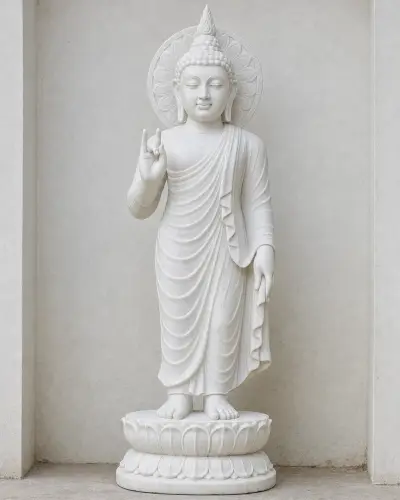
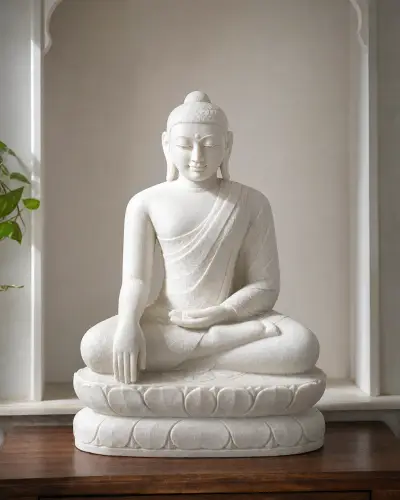
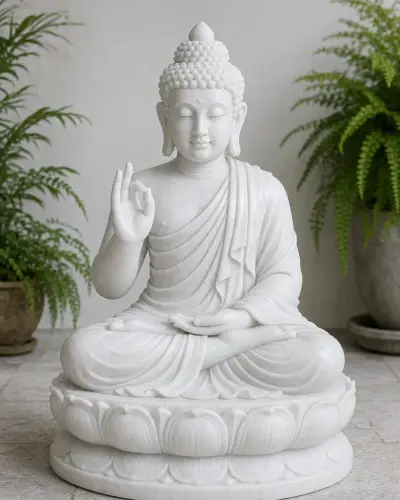
Sculptor-carved Makrana white marble Buddha in dharmachakra mudra, a 30-inch meditation-corner piece on a double lotus plinth.
Made to order. The pictures here are concept images. This is not a ready item. We get it made for you as per this design, as close as possible, in the size and stone you choose.
Want this design made for you?
Tell us the size, the stone and where it is going. We will send you a quote and a timeline.
Chat on WhatsAppWe'll respond within 5 minutes
About This Piece
The gesture of the first sermon
Both of this Buddha's hands are raised to the level of the chest, thumb and index finger meeting on each hand to close a circle while the remaining fingers stay extended. That is the dharmachakra mudra, the turning of the wheel of dharma, and it belongs to one specific moment: the first sermon, given in the deer park at Sarnath outside Varanasi, to the five ascetics who had been his companions. Sculptors of the Gupta period settled the form in the fifth century, and the seated Sarnath Buddha, with its plain robe and lowered gaze, has been the reference ever since. The two closed circles read as the wheel itself, held between the hands rather than carried. It is a teaching posture, and it suits a room where somebody sits and studies rather than one that is simply walked through.
Makrana marble at 30 inches
Makrana white marble comes out of the quarries at Makrana, in Nagaur district, Rajasthan, the same seams that supplied the Taj Mahal and the Dilwara temples. It is a calcite marble: dense, fine-grained, lightly sugary where it catches the light, and neutral white with only the faintest cream undertone rather than the blue-grey cast of Italian stone. That density matters for this form in particular. The raised hands and the free-standing fingers are the most fragile passages in any dharmachakra figure, and a compact, low-porosity block takes that detail without crumbling at the edge. Thin sections of Makrana are also faintly translucent, so light entering the fingertips and the rim of the robe glows back instead of stopping flat at the surface. Grey hairline veining runs through the stone, never wider than a pencil line. It is the signature of natural marble, not a defect.
How the hands are cut
The block is rough-cut to the seated silhouette first, then brought down in stages: the mass of the folded legs, the shoulders and the fall of the robe, and only at the end the hands and the face. The master sculptors we work with in Jaipur finish those last passages entirely by hand (chisel, then rasp, then progressively finer abrasive), because the gap between an extended finger and the palm behind it is exactly where a machine leaves a dead, rounded edge. The double lotus plinth is cut from the same block rather than added underneath, so the grain runs continuously from the base up into the figure. The surface is taken to a soft satin polish: enough to bring up the crystalline structure of the stone, not so much that the face turns glassy under a lamp.
Sizing it for a meditation corner
At 30 inches tall, roughly 15 inches across the knees and 14 deep, this Buddha weighs about 21 kg: heavy enough to want a solid floor or a low plinth, light enough for two people to set in place without equipment. It is a seated-eye-level piece: at that height the face meets the gaze of somebody on a cushion or a low bench, which is the sightline a teaching gesture is composed for. Set it against a plain wall with a clear metre in front of it, and keep everything beside it low (a mat, floor cushions, a squat table) so nothing crowds in above the head. East-facing placement, with the figure looking toward the morning light, is the long-established convention for a Buddha at home. The same scale reads well in a yoga studio or a reading room where people stay seated for long stretches.
Make it yours
Each piece is made to order, so 30 inches is a starting point rather than a fixed specification. This form is also carved at 18 and 48 inches, in black stone or Vietnam white marble, and the plinth can be left plain instead of lotus-carved where the room calls for something quieter. A dedication can be cut into the base for an installation or a temple gift. Tell us the room and we will work backwards from it.
Specifications
Pose
Seated in padmasana with both hands raised to the level of the chest; on each hand the thumb and index finger meet to form a circle while the remaining fingers stay extended, in the wheel-turning gesture of the first sermon
Color
White
Finish
Soft polish (satin)
Material
Makrana White Marble
Ideal For
Meditation corner, Living room, Yoga studio
Weight In Kg
21
Depth In Inches
14
Width In Inches
15
Height In Inches
30
Region Or Tradition
Indian / Sarnath (Gupta-period Buddhist tradition)