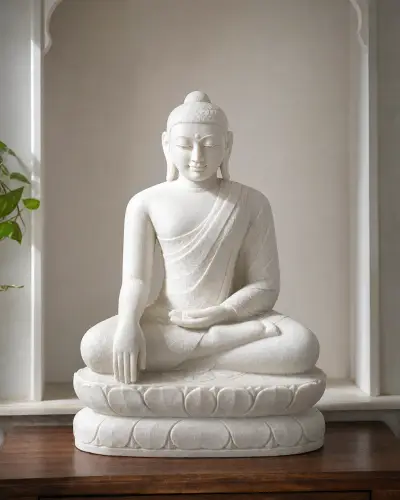
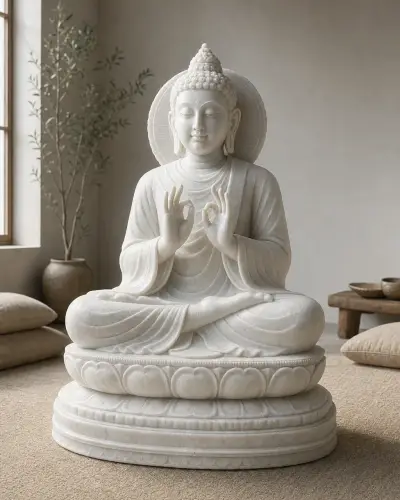
Makrana White Marble Karana Mudra Buddha Statue, 24 in
Sculptor-carved Makrana white marble Buddha in karana mudra, a 24-inch standing figure on a twin lotus base for an entrance niche.
Made to order. The pictures here are concept images. This is not a ready item. We get it made for you as per this design, as close as possible, in the size and stone you choose.
Want this design made for you?
Tell us the size, the stone and where it is going. We will send you a quote and a timeline.
Chat on WhatsAppWe'll respond within 5 minutes
About This Piece
The karana mudra, and what the gesture does
The raised right hand tells you which Buddha this is. The index and little fingers point up, the two middle fingers fold in beneath the thumb, and the palm turns outward. This is the karana mudra, the gesture that wards off and expels negative influence. It is the least common of the classical mudras in Indian marble work, which is why most standing Buddhas you find carry abhaya, the open-palm gesture of fearlessness, instead. The two look similar at a glance and mean quite different things: abhaya reassures, karana repels. The lowered left hand holds a fold of the robe at the side, keeping the figure quiet and vertical so the raised hand carries the whole reading of the piece. The gesture appears across Indian and Southeast Asian traditions, almost always on a standing figure like this one.
Makrana white marble, from Nagaur
Makrana marble is quarried in Nagaur district, Rajasthan, about 100 km from Jaipur, and has been cut there for centuries. It is the stone of the Taj Mahal and of the Dilwara temples. Its character is a brilliant neutral white with a faint cream undertone, not the cool blue-grey of Italian Carrara. The grain is fine, crystalline and lightly sugary, and light travels a short way into the surface before it comes back, which is what keeps a carved face soft instead of chalky. Grey hairline veins run through it sparingly, never wider than a pencil line, and no two blocks carry the same pattern. This piece is finished honed, matte with broad soft highlights and no sharp reflection, so the drapery folds read by shadow rather than by shine.
How the piece is made
The statue is carved to order by the master sculptors we work with in and around Jaipur, most from families who have cut stone for several generations. We select the block with them, brief the form and the gesture, and follow the piece through every stage to your door. The work runs from rough cut to primary shape, then detail carving, then a progressive hand polish. Hands and face are always finished by hand. The karana gesture in particular, where four fingers sit at different depths within a hand only a few inches across, is the part of this statue that decides whether it reads correctly. The lotus pedestal is cut from the same block wherever the stone allows, so base and figure share one grain.
Placing a 24-inch Buddha at an entrance
At 24 inches on its twin lotus base, this stands close to eye level on a console table or a shoe cabinet, and around chest height on a low plinth or a step. It weighs roughly 12 kg, so a wall shelf needs proper anchoring; a solid surface is the simpler answer. The gesture faces outward, which is why an entrance niche or a recess opposite the door suits it: the raised hand meets whoever comes in. Buddha figures are conventionally set facing east, toward the sunrise, and lifted clear of the floor rather than placed on it. Leave about a hand's width of clear wall on either side, and keep the surface behind it plain (lime-washed or plastered) so the white stone separates rather than competing with a pattern.
Making it yours
The same form can be cut at other heights, in Vietnam white marble or black stone, or given a soft satin polish in place of the honed matte. A carved inscription on the base is a common request for a housewarming or a temple donation. Send us your niche measurement on WhatsApp and the proportions are worked around it.
Specifications
Pose
Standing upright on a lotus base with the right hand raised beside the shoulder, the index and little fingers extended upward while the two middle fingers fold in beneath the thumb, in the karana warding gesture; the left hand lowered at the side holding a fold of the robe
Color
White
Finish
Matte (honed)
Material
Makrana White Marble
Ideal For
Entrance, Pooja room, Meditation corner
Weight In Kg
12
Depth In Inches
7
Width In Inches
7
Height In Inches
24
Region Or Tradition
Indian / Mughal (Rajasthan)