Handcrafted Makrana White Marble Gold-Leaf Dome Home Mandir, 48in
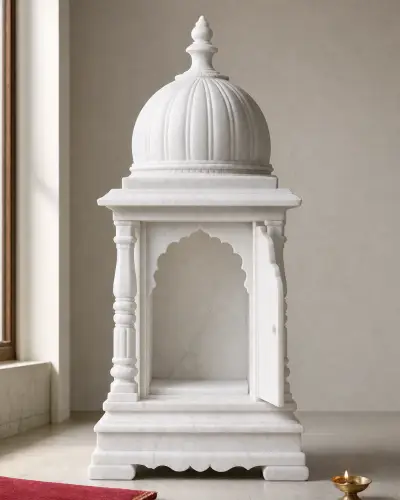
A 48-inch Makrana white marble home mandir: a pillared shrine with a gold-leafed dome, kalash finial and gilded arch border on plain white stone.
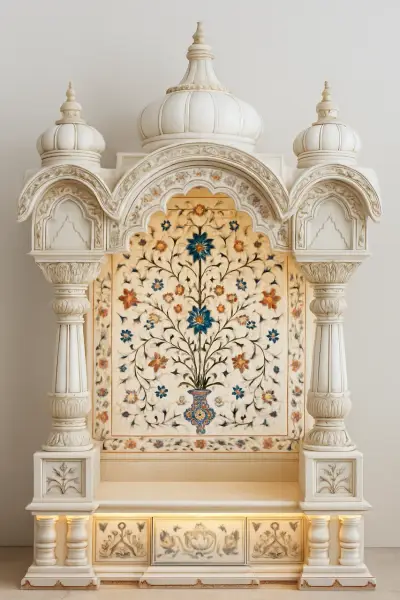
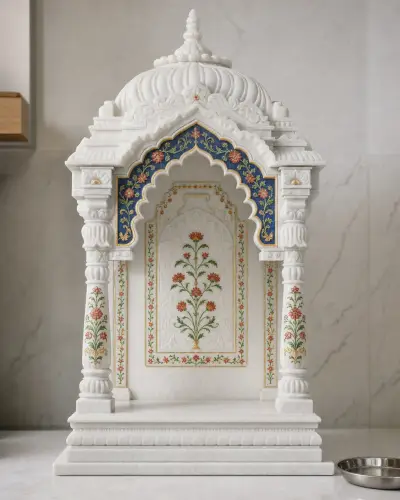
Made to order. The pictures here are concept images. This is not a ready item. We get it made for you as per this design, as close as possible, in the size and stone you choose.
Want this design made for you?
Tell us the size, the stone and where it is going. We will send you a quote and a timeline.
Chat on WhatsAppWe'll respond within 5 minutes
About This Piece
Gold leaf, used sparingly
Gold leaf on marble only works when it is rationed. On this mandir the gilding lands on four elements and stops there: the ribbed dome, the kalash finial above it, the capitals of the four pillars, and the scalloped border of the cusped arch. Everything else stays plain Makrana white: the stepped plinth, the fluted shafts, the moulding, the sanctum walls. The gold then reads as ornament rather than as a coating, and the eye travels up the white shafts to the dome instead of skidding across an all-gold surface.
The leaf itself is beaten gold laid over a prepared ground and burnished down by hand, the method long used on temple domes and on Rajasthani haveli detail. It sits a hair proud of the stone, so under a lamp it holds a warm glow while the honed marble beside it stays flat and quiet. The gilding softens with the years rather than flaking, and it can be relaid.
The Makrana stone
Makrana marble is quarried at Makrana in Nagaur district, Rajasthan, worked continuously for centuries and known above all as the stone of the Taj Mahal. It is dense and calcitic: fine crystalline grain, low porosity, a bright neutral white carrying only the faintest cream undertone. Grey hairline veins cross a small part of any block, never wide enough to read as a pattern.
Two of those properties matter here. The density lets a carver cut an undercut arch and slender pillar shafts without the stone crumbling at the edges. The whiteness gives the gold leaf a ground to sit against. On a warmer or greyer stone the same gilding turns muddy. Surfaces are finished honed, sanded flat to a matte, low-sheen face that shows carving depth instead of throwing highlights back. A honed mandir also stays readable in the low, uneven light of a prayer room, where a mirror polish glares off every moulding.
The form: a pillared chhatri
The silhouette comes from the chhatri, the domed open-sided pavilion that sits on Rajasthani palace roofs and cenotaphs, brought down to household scale. Four pillars rise from a three-step plinth to carry a cusped arch across the front face; above the cornice, a ribbed dome curves up to the kalash. The shafts are fluted, with lotus-petal collars at base and neck and pointed petal moulding running around the plinth.
The sanctum is left open at the front and along the sides. That is deliberate. An open chhatri lets lamp light and incense move through the shrine instead of trapping both behind a closed back panel, and the murti can be seen from more than one angle. The sanctum floor is a single flat slab, so a deity sits directly on it or on a small chowki. The mandir arrives without a deity; the murti is chosen separately.
Sizing it for your pooja room
At 48 inches tall, 24 wide and 15 deep, this is a floor-standing mandir rather than a tabletop shrine. The opening clears a murti of roughly 15 to 18 inches, which covers most household Ganesh, Lakshmi and Balaji murtis; taller than that and the figure begins to crowd the arch. Standing on the floor, the sanctum sits at about knee height, so the deity's face falls near eye level for someone seated on a mat, which is the height most families want for aarti.
It weighs close to 95 kilograms and arrives in sections to be assembled in place, so an upper floor or a wooden platform is worth checking before delivery. Keep oil lamps on a separate chowki to one side rather than on the plinth itself: ghee and lamp soot are the two things that mark a honed white surface over time.
Making it yours
This mandir is made to order, so the specification above is a starting point and not a fixed listing. The height can move up or down, the gilding can extend to the pillar shafts or pull back to the dome alone, and the same design can be cut in Vietnam white marble or Dholpur pink sandstone for a different ground. We design it with you, brief the master sculptor who carves it, and follow the piece through to your door. Send the dimensions of your pooja room and we will come back with a drawing and a quote.
Specifications
Pose
Pillared chhatri canopy with a gold-leafed ribbed dome and kalash finial
Color
White
Finish
Matte (honed)
Material
Makrana White Marble
Ideal For
home mandir, festival centrepiece, premium gifting
Decoration
gold_leaf
Weight In Kg
95
Depth In Inches
15
Width In Inches
24
Height In Inches
48
Region Or Tradition
Indian / Rajasthani (Jaipur marble mandir tradition)