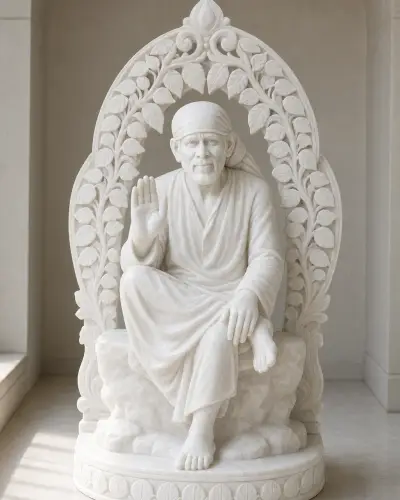
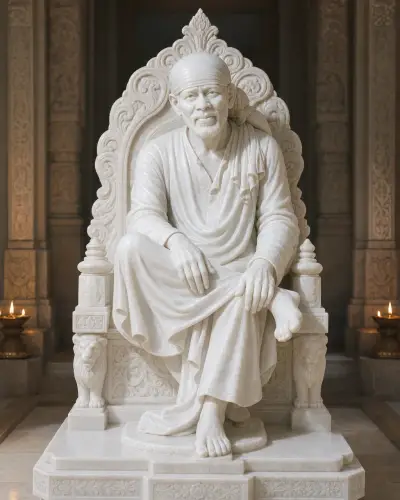
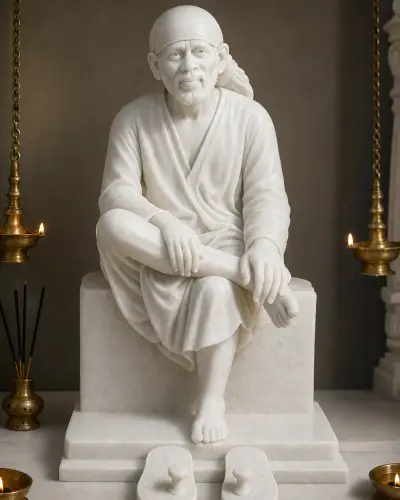
Makrana White Marble Sai Baba with 22k Gold-Leaf Kafni, 30 in
Master-carved Makrana white marble Sai Baba in the Ashirwad blessing form, a 30-inch mandir murti with a 22k gold-leaf robe border.
Made to order. The pictures here are concept images. This is not a ready item. We get it made for you as per this design, as close as possible, in the size and stone you choose.
Want this design made for you?
Tell us the size, the stone and where it is going. We will send you a quote and a timeline.
Chat on WhatsAppWe'll respond within 5 minutes
About This Piece
The Makrana white and where the gilding goes
Makrana marble comes out of the quarries at Makrana in Rajasthan's Nagaur district, the same belt that supplied the Taj Mahal and the older havelis of Jaipur. It is a dense, tight-grained calcite stone that takes a satin polish without turning glassy, and it holds a bright natural white instead of drifting yellow with age, which matters for a figure meant to be looked at every morning under lamp light. On this 30-inch Sai Baba the plain white body of the stone does most of the work, and the gilding is held to a narrow border so the carving stays legible rather than crowded.
How the murti is made and gilded
Every piece is made to order. We design the murti with you (the proportions, how far the gold leaf runs, the height of the plinth), then brief the sculptor and follow the work through to your door. The block is roughed out, the seated mass and the fall of the kafni are shaped, and the face, the hands and the folds of the robe are finished entirely by hand; no machine touches those surfaces. After the marble is polished, 22k gold leaf is laid along the robe border, the head-cloth edge and the plinth mouldings by a gilder who does only that work.
The Ashirwad blessing form
The Ashirwad form is the one most families recognise from Shirdi: the right hand raised palm-out in blessing, the left hand open on the knee, the right leg crossed over the left, a full-sleeved ankle-length kafni and a head cloth wrapped and knotted over the left shoulder. It follows the marble murti installed at the Samadhi Mandir in Shirdi in 1954, sculpted by Balaji Vasant Talim, which set the visual template nearly every marble Sai Baba has followed since. The close-cropped beard and the level, unhurried gaze are what keep the figure recognisably Sai Baba rather than a generic seated sadhu.
Placing it, lighting the gold, and other sizes
At 30 inches the murti anchors a room rather than decorating a shelf. Give it a mandir platform or a console with roughly four feet of clear wall behind it, at a seat height that brings the face close to eye level when you are standing. Light is worth planning for: gold leaf only comes alive when something rakes across it, so a recessed cove or a small spot set slightly off to one side does far more than a bright overhead lamp. Most families keep the home mandir toward the north-east of the house with the murti facing west or north.
Sizes from tabletop to floor-standing, other stones, and the extent of the gilding are all open. Some households ask for the robe border only, while others take it across the head cloth and plinth as well. A name or an installation date can be engraved into the plinth when the piece is going as a gift. Send us the shelf dimensions on WhatsApp and we will work back from there.
Specifications
Pose
Seated Ashirwad blessing form — right hand raised palm-out in blessing, left hand open on the knee, right leg crossed over the left; full-sleeved ankle-length kafni robe with the head cloth knotted over the left shoulder
Color
Natural White with 22k Gold Leaf
Finish
Soft polish (satin)
Material
Makrana White Marble
Ideal For
Premium home mandir, Festival sthapana, Premium devotional gift
Weight In Kg
21
Depth In Inches
14
Width In Inches
15
Height In Inches
30
Region Or Tradition
Indian / Maharashtrian (Shirdi Sai tradition)