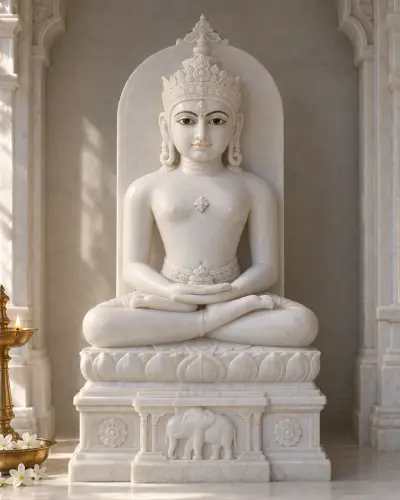
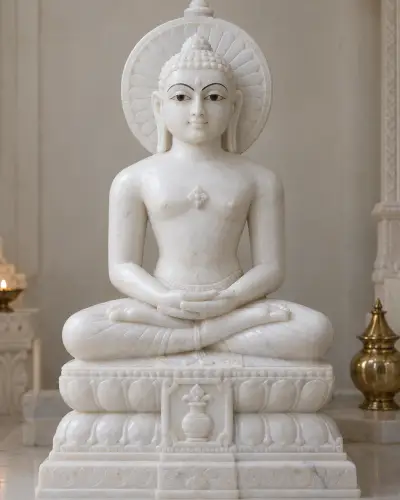
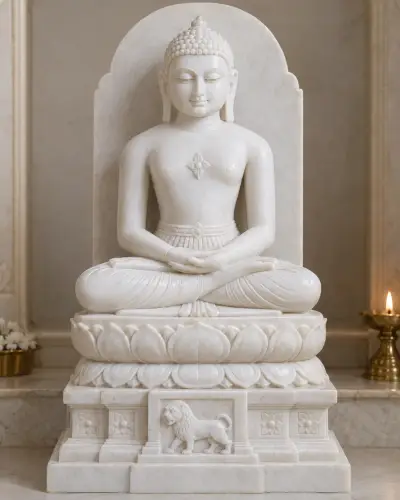
Makrana White Marble Shankheshwar Parshvanath Murti, 21in
Sculptor-carved Makrana white marble Shankheshwar Parshvanath: a 21-inch derasar murti under a seven-hooded naga canopy.
Made to order. The pictures here are concept images. This is not a ready item. We get it made for you as per this design, as close as possible, in the size and stone you choose.
Want this design made for you?
Tell us the size, the stone and where it is going. We will send you a quote and a timeline.
Chat on WhatsAppWe'll respond within 5 minutes
About This Piece
Why Makrana marble suits a Jina
Makrana marble is quarried in the Nagaur district of Rajasthan, a few hours north-west of the Jaipur workshop that carves this piece. It is the same calcite-rich stone that faces the Taj Mahal, and what recommends it for a murti is ordinary physics rather than reputation: it is dense, very low in porosity and almost free of iron, so daily abhishek, kesar and dhoop do not stain it and it does not yellow the way a softer, more absorbent white stone will. Light enters the surface a millimetre or two before it comes back, which is why a Jina's face carved in Makrana holds a soft inner glow under a single ghee lamp instead of going flat and chalky. It also holds a crisp arris, which matters on a form built from fine edges such as snake scales, pleats and the srivatsa.
The seven-hooded form of Parshvanath
Parshvanath is the twenty-third Tirthankar, and the serpent canopy above his head is what names him on sight. Jain tradition tells of the naga Dharanendra and his consort Padmavati rising to shelter Parshvanath from a storm sent to break his meditation, and the carved hoods, seven of them fanned in an arc, record that moment. His lanchhana, the emblem that identifies which of the twenty-four a murti depicts, is the snake, cut here into the face of the pedestal. The Shankheshwar form takes its name from the tirth at Shankheshwar in Patan district, Gujarat, one of the most-visited Parshvanath pilgrimage places in western India, and it is the form most often asked for as the mulnayak of a Shvetambar home derasar.
What the carving says
Everything on this murti follows Shvetambar Murtipujak convention, and none of it is decorative licence. He sits in padmasana with both palms stacked flat and open in the lap, right over left, in dhyana. The srivatsa is cut on the chest and the gaze is set to the nose-tip (nasagradrishti, the mark of attention turned inward), while the eyes themselves are carved open and prominent, the chakshus convention that lets a devotee stand before a living Tirthankar. A kandora waistband sits above the pleated kachota, kundals hang at the elongated earlobes, and the serpent's coils are worked into the back and sides of the seat so the canopy reads as one continuous body. A Tirthankar murti is iconographically fixed; getting it right is the whole job.
How it is carved
A squared block is roughed down to the seated silhouette first, then the stepped pedestal and the coiled seat are blocked in, and only after that does the detail work start. The naga canopy is the difficult part: seven hoods carved from the same block as the head, undercut so daylight passes behind them without leaving the stone thin enough to chip. The face, the stacked palms, the kandora and the scale work on the hoods are cut entirely by hand; no machine finishing touches them. The surface is then brought up through progressively finer abrasives to a soft satin polish that reads warm and matte-bright rather than glassy, so lamplight sits on the form instead of glaring off it.
Placing a 21-inch mulnayak
Twenty-one inches is the step above a small home murti and below a community-derasar scale. It works as the presiding murti of a ghar-mandir or a dedicated pooja room, seen from four or five feet away, at which distance the hoods, the srivatsa and the snake on the pedestal all stay legible. Allow roughly two feet of clear width and about a foot of depth, plus room in front for a thali. A plain pale wall or a simple wooden ghar-mandir behind it serves the stone better than a patterned backdrop. The same form can be commissioned taller for a derasar, cut in black stone or Vietnam white, or given a full parikar with a toran arch and attendant figures. Some pieces are already carved and can be photographed for you before dispatch, with no carving wait; a fresh commission runs eight to twelve weeks from the day the drawing is approved.
Specifications
Pose
Seated padmasana beneath a seven-hooded naga canopy fanned above the head, hands stacked flat in the lap right over left, srivatsa on the chest, kandora waistband with pleated kachota, kundals at the earlobes, serpent coils forming the seat back, gaze to the nose-tip, snake lanchhana carved on the stepped pedestal
Color
White
Finish
Soft polish (satin)
Material
Makrana White Marble
Ideal For
Home derasar, Community derasar
Weight In Kg
45
Depth In Inches
10
Width In Inches
12
Height In Inches
21
Region Or Tradition
Indian / Jain Shvetambar Murtipujak (Shankheshwar tirth, Gujarat)