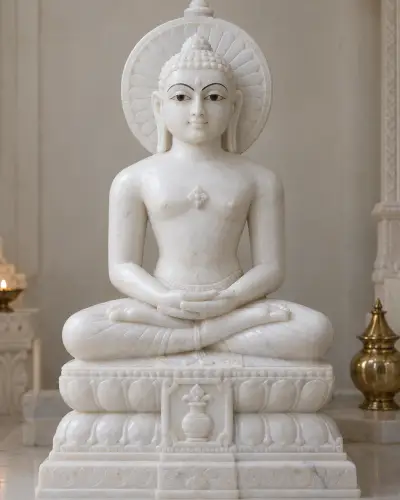
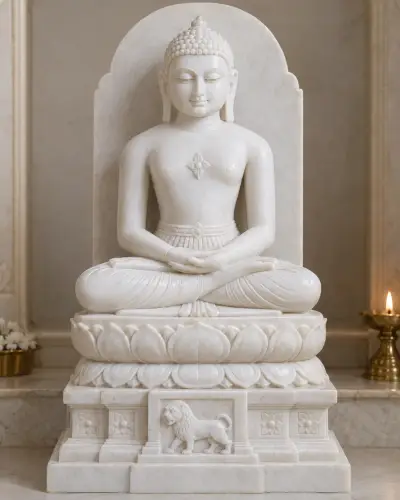
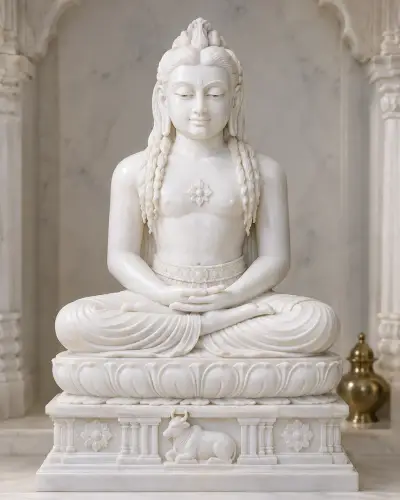
Makrana White Marble Shantinath Murti with Parikar, 24in
Artisan-carved Makrana white marble Shantinath within a full parikar, a 24-inch derasar mulnayak with the deer lanchhana on the pedestal.
Made to order. The pictures here are concept images. This is not a ready item. We get it made for you as per this design, as close as possible, in the size and stone you choose.
Want this design made for you?
Tell us the size, the stone and where it is going. We will send you a quote and a timeline.
Chat on WhatsAppWe'll respond within 5 minutes
About This Piece
The stone
This murti is cut from Makrana white marble, quarried in Rajasthan's Nagaur district and carted the 350-odd kilometres to Jaipur in block form. A parikar asks more of a stone than a plain murti does: the toran arch is pierced and undercut, the pilaster niches are hollowed out behind their miniature figures, and the lotus medallion behind the head is cut to a few millimetres in places. Makrana's grain is tight, calcite-rich and almost non-porous, so it takes that kind of undercut without splintering at the edge and carries its own weight across the arch. It is also the stone that stays white. Decades of ghee lamps, dhoop and daily abhishek leave it satin rather than yellowed, which is why Jain temple-builders at Dilwara and Ranakpur chose it in the first place.
What the parikar adds
A parikar is the carved throne-back that surrounds a Jina, the frame that turns a murti into a shrine in its own right. On this piece it rises from a stepped singhasan through two flanking pilasters, each carrying miniature seated Tirthankars in their own niches, up into a toran arch closed by a tiered chhatra at the crown. Elephants stand at the pilaster feet and again on the pedestal face; a lotus-medallion bhamandala fills the space behind the head. These are not decorative additions. They are the ashtapratiharya, the eight attendant marks a kevalin is described as having, and a derasar installing a mulnayak generally expects to see them.
Reading the iconography
Shantinath is the sixteenth Tirthankar, born at Hastinapur and a chakravartin (a universal sovereign) before he renounced the throne. His name means peace, and he is the figure Jains turn to in the Bruhat Shanti recited at the close of a ritual. What identifies him here is the lanchhana cut into the pedestal: the deer, which belongs to him alone among the twenty-four. The rest follows Shvetambar Murtipujak convention exactly: padmasana on a lotus cushion, palms stacked flat in the lap right over left, the srivatsa on the bare chest, a kandora waistband above the pleated kachota, and prominent open eyes rather than lowered ones, so a devotee stands before a Tirthankar who is looking back.
Where a 24-inch murti sits
Twenty-four inches is mulnayak scale, the principal murti of a small derasar or the centrepiece of a serious home shrine rather than a shelf piece. Budget for more width than the height suggests: the parikar carries the piece to roughly sixteen inches across and nine deep, and it wants another hand's width of clear space on either side so the arch reads as a frame and not as a wall. A plain pale backdrop suits it; a patterned one fights the pierced work. Seen from about four feet away at seated eye level, the deer, the srivatsa and the niche figures all stay legible, which is the distance most derasar darshan actually happens from.
Commissioning it
The same murti can be taken up to community-derasar scale, cut in black stone or Vietnam white instead of Makrana, simplified to a plain arched stele if the parikar is more than the shrine has room for, or set on a taller stepped singhasan. We design the piece with you, brief it, and stay with it until it reaches your derasar; the carving itself is done by the master sculptors we work with in Jaipur, who cut Tirthankar murtis to Shvetambar convention as routine work. Tell us your shrine's internal height and the date you would like it installed by; a piece at this scale runs eight to twelve weeks from approved drawing, plus crating and transit.
Specifications
Pose
Seated padmasana on a lotus-petal cushion within a full parikar — flanking pilasters with miniature Tirthankar niches, a toran arch closed by a tiered chhatra, a lotus-medallion bhamandala behind the head and elephants at the base; hands stacked flat in the lap right over left, srivatsa on the bare chest, kandora waistband over pleated kachota, prominent open eyes, deer lanchhana carved on the stepped pedestal
Color
White
Finish
Soft polish (satin)
Material
Makrana White Marble
Ideal For
Derasar mulnayak, Home derasar, Pooja room
Weight In Kg
62
Depth In Inches
9
Width In Inches
16
Height In Inches
24
Region Or Tradition
Indian / Jain (Shvetambar Murtipujak derasar tradition)