Makrana White Marble Siddhivinayak of Siddhatek on Gold-Leaf Singhasan, 24 in
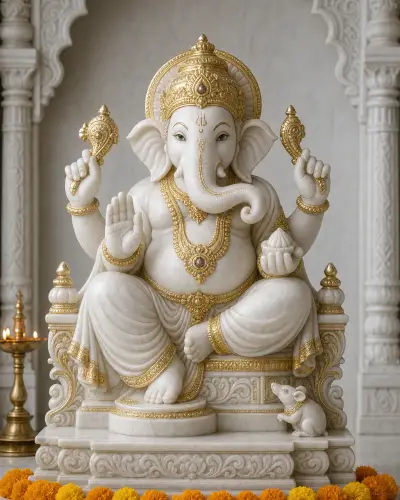
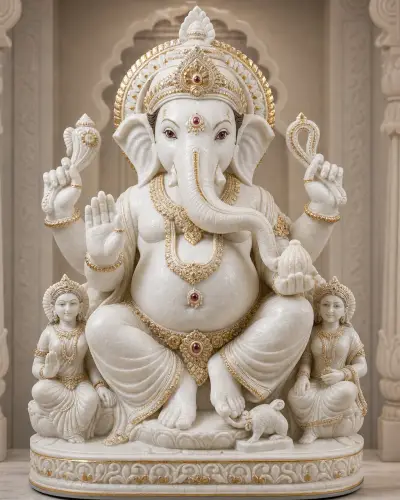
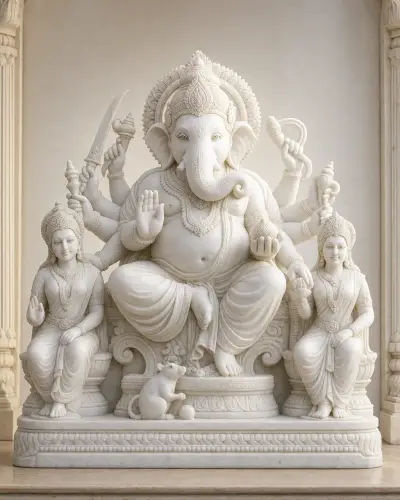
The Siddhatek swaroop with its right-turned trunk, in 24 inches of Makrana white marble under a gold-leaf mukut and jewelled singhasan.
Made to order. The pictures here are concept images. This is not a ready item. We get it made for you as per this design, as close as possible, in the size and stone you choose.
Want this design made for you?
Tell us the size, the stone and where it is going. We will send you a quote and a timeline.
Chat on WhatsAppWe'll respond within 5 minutes
About This Piece
Siddhatek, the second halt of the Ashtavinayak
Siddhatek stands on the north bank of the Bhima in Ahmednagar district, off the Pune-Solapur road, and its Ganpati is the second of the eight swaroops on the Ashtavinayak circuit. The sthala purana ties the place to Vishnu, who is said to have gained siddhi (accomplishment, the thing that finishes what is started) after invoking Ganesha on this hillock before facing Madhu and Kaitabha. The name of the sanctum comes from that, and it is why this swaroop is the one people turn to when what they want is for something already begun to actually hold.
Why the trunk turns to his right
Of the eight Ashtavinayak murtis, Siddhatek is the one whose trunk turns to the deity's own right: ujavya sondecha Ganpati, the valampuri form. Seen from the front that reads across to your left, and it is the first thing worth checking on any murti sold under this name, because the great majority of Ganpati murtis made for the home turn the other way. Tradition treats the right-turned form as the stricter of the two: exact in its ritual, less forgiving of a lapsed routine, and correspondingly generous to a household that keeps it properly. Choosing it is a decision about how you intend to keep the murti, not only about how it looks.
Gold leaf over a white ground
The body is cut from Makrana white marble and finished to a soft satin polish, so the belly and the folds of the dhoti carry a low even glow rather than a hard shine. The mukut, the necklaces, the armlets and the border of the singhasan are laid in gold leaf over that white ground. The pairing is deliberate: the stone stays the brighter of the two surfaces, so the gold reads as detail sitting on it rather than competing with it. At lamp height in a mandir the crown and the jewelled work take the light first while the body holds an even tone behind them.
The figure and the throne
He is four-armed and seated on a jewelled singhasan. The upper right hand is raised palm-out in abhaya; the lower right cups a modak, and the trunk curls down to meet it. The ankush and the pash are held on the left. The single broken tusk sits on his right (ekadanta, one of the marks that has to be there), and the mushak is carved at the foot of the throne. The whole piece rises from a stepped plinth, which keeps the murti at height in a mandir instead of flat on a shelf.
What 24 inches asks of a room
At two feet the murti becomes the presiding figure of a home mandir rather than one object among several standing on it. It weighs roughly 48 kg finished, so it wants a masonry shelf, a stone chowki or a solid wooden platform, not a wall-mounted bracket. Allow about 15 inches of width and 11 of depth for the throne and plinth, and leave clear space above the crown; nothing should sit or hang over the murti's head.
Making yours
Every piece is carved to order by the master sculptors we work with, and nothing here is fixed. Height moves up or down, the gold leaf can go heavier across the throne or be pulled back to the mukut and ornaments alone, and the plinth can be stepped, plain or lotus-cut. Send us the measurements of your mandir and how you want it finished; we will design it with you, brief the sculptor, follow the carving through, and deliver it to your door.
Specifications
Pose
Seated four-armed Siddhivinayak of Siddhatek on a jewelled singhasan throne, his trunk turned to his own right (appearing on the viewer's left) and curling down toward the modak cupped in his lower right hand; the upper right hand raised palm-out in abhaya, ankush and pash held in the two left hands, a single broken right tusk, broad potbelly, gold-leaf mukut and ornaments, and the mushak at the foot of the throne on a stepped plinth
Color
White
Finish
Soft polish (satin)
Material
Makrana White Marble
Ideal For
Home mandir, Family temple, Housewarming
Weight In Kg
48
Depth In Inches
11
Width In Inches
15
Height In Inches
24
Region Or Tradition
Indian / Maharashtrian (Siddhatek, Ashtavinayak tradition)