Makrana White Marble Simandhar Swami Murti with Mugat, 18in
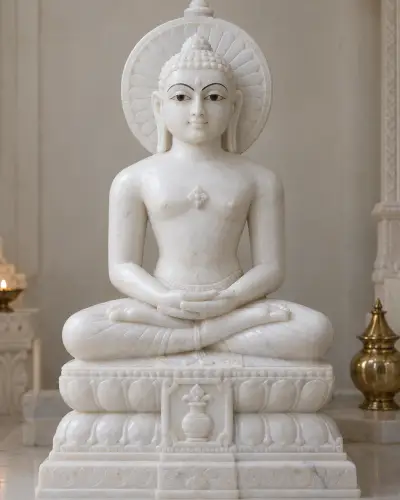
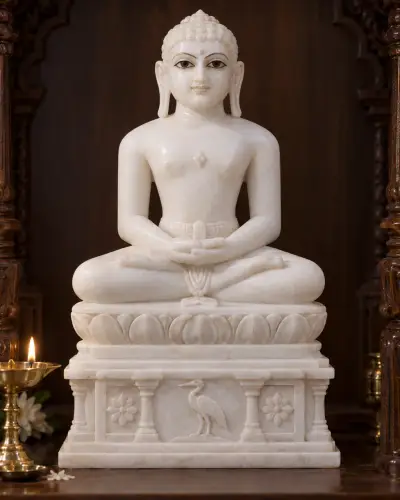
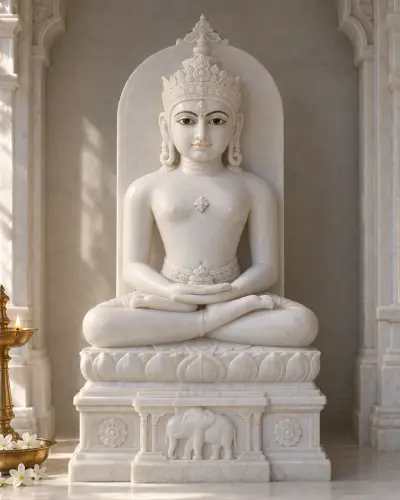
An 18-inch Simandhar Swami in Makrana white marble, crowned with a tiered mugat and standing in kayotsarga.
Made to order. The pictures here are concept images. This is not a ready item. We get it made for you as per this design, as close as possible, in the size and stone you choose.
Want this design made for you?
Tell us the size, the stone and where it is going. We will send you a quote and a timeline.
Chat on WhatsAppWe'll respond within 5 minutes
About This Piece
Who Simandhar Swami is
The twenty-four Tirthankaras a Jain devotee usually stands before, Adinath through Mahavir, have all attained siddhahood and passed beyond the world. Simandhar Swami has not, and that is the whole point of him. He is a viharman Tirthankara, one of the Jinas presently present and still teaching, and he presides in Mahavideh Kshetra, a land where the descending wheel of time does not turn and a living Tirthankara is therefore never absent. Worshipping him is worshipping someone alive and preaching at this moment, in another part of the universe rather than in another age of it. The Akram Vignan following established by Dada Bhagwan made him their central murti for exactly that reason, and most households that ask us for a Simandhar Swami murti (in Gujarat, in Maharashtra, and across the American and East African diaspora) are asking from inside that tradition.
The mugat, and why it belongs here
This murti is crowned. The mugat sits over the head in three pierced tiers rising to a central finial, and it is the feature that tells you at a glance which Jina you are looking at. Crowned and adorned Jinas have a long, documented history inside Shvetambara Murtipujak practice, where carved ornament on a Tirthankara is entirely conventional. It is the Digambara lane that keeps the figure wholly unadorned, and the two are not interchangeable. Everything else on the piece follows the shared Jina canon without deviation: the srivatsa diamond cut into the bare chest, the kandora waistband with its kachota pleats at the hips, the arms hanging straight and held clear of the torso in kayotsarga, and the nasagradrishti gaze settled toward the tip of the nose. The eyes are carved prominently open, the chakshus convention, so the devotee stands in front of a Tirthankara who is awake. The lotus plinth is left plain; a lanchhana or an inscribed base can be carved instead if your derasar expects one.
The stone
Makrana white marble is quarried in Nagaur district, Rajasthan, and it is the material Jain patronage has favoured for the better part of a thousand years; the Chaumukha temple at Ranakpur is cut from the same family of seams. What recommends it for a murti at this scale is grain. The crystal is fine and tightly packed, so an edge stays crisp instead of crumbling, which is what lets the beaded rim of a kandora or the openwork of a crown survive the carve at all. The colour is a bright natural white with only the faintest warm undertone and occasional grey veins no wider than a pencil line. Because calcite is slightly translucent, light sinks a short distance in and returns from underneath, so the fingertips and the thin edges of the crown glow rather than sitting flat.
What the carve has to get right
At eighteen inches the crown is the hard part. The three tiers of the mugat have to be pierced right through in places, each opening cut from both sides so the walls meet cleanly, and the marble left between them is a matter of millimetres. There is no second attempt if a tier breaks. Under it the face carries the entire mood of the piece and is worked and polished entirely by hand, never machine-finished, as are the hands and the pleated fall of the kachota. The arms are released from the block along their full length with no supporting strut behind them, which is the other place a single wrong stroke ends the block. The body itself is modelled deliberately quietly: a shallow chest, an even weight on both feet, no tension held anywhere. Kayotsarga means the abandonment of the body, and the sculptor is really carving away anything that argues with that.
Placing an eighteen-inch murti
The piece stands 18 inches from the underside of the lotus plinth to the tip of the finial, about 8 inches across and 6 inches deep, and weighs roughly 9 kilograms. That is squarely a ghar-derasar size. On a household shrine chowki, or in a niche with a shelf at chest height, it brings the carved eyes close to a standing adult’s own, which is the reason the chakshus convention exists, without demanding the wall clearance a three-foot murti needs. Allow a hand’s breadth of clear space behind the crown so the finial reads against the wall rather than touching it, and keep the plinth seat level; a standing kayotsarga figure shows even a small tilt immediately.
Commissioning and care
Every piece is carved to order by the master sculptors we have worked with in Jaipur for three generations, so the height, the surface finish and the sect convention are settled before the block is opened. A crowned standing murti of this size takes eight to twelve weeks through carving, crown detailing, finishing and crating. The surface here is a soft satin polish, which holds the depth of the stone without the hard specular glare of a mirror finish; a fully matte honed surface or a high polish can be specified instead, as can a taller version for a full derasar installation. Care is undemanding: dust with a soft dry cloth, wipe spills promptly, and keep acidic cleaners and lime-scale removers away from the marble, since calcite etches on contact. If the murti receives abhishek, dry the plinth afterwards so water does not sit in the lotus petals.
Specifications
Pose
Standing upright in kayotsarga with a tiered mugat crown, arms hanging straight and free of the body, srivatsa on the chest, kandora waistband and kachota pleats, prominent open chakshus eyes with the gaze to the nose-tip, plain lotus plinth
Color
White
Finish
Soft polish (satin)
Material
Makrana White Marble
Ideal For
Ghar-derasar home shrine, Derasar side-shrine or niche
Weight In Kg
9
Depth In Inches
6
Width In Inches
8
Height In Inches
18
Region Or Tradition
Indian / Shvetambara Jain (Akram Vignan, Mahavideh viharman Tirthankara tradition)