Makrana White Marble Tulsi Vrindavan Planter with Jali Panels, 36in
Master-carved Makrana white marble tulsi vrindavan: a 36-inch open-top planter with pierced jali sides and a lotus-petal plinth.
Made to order. The pictures here are concept images. This is not a ready item. We get it made for you as per this design, as close as possible, in the size and stone you choose.
Want this design made for you?
Tell us the size, the stone and where it is going. We will send you a quote and a timeline.
Chat on WhatsAppWe'll respond within 5 minutes
About This Piece
What a tulsi vrindavan is for
In much of India the tulsi plant is not kept in an ordinary pot. It is given a raised, built structure of its own (a tulsi vrindavan in the north and west, a tulsi katta in Maharashtra, a tulsi manch in Bengal and Odisha), set in the courtyard where the household passes it every morning. This piece carries that form over into marble instead of plastered brick. The vessel is square, open at the top, and deep enough to hold a working volume of soil, so a mature tulsi can root properly rather than sit in a shallow tray. The rim is wide and moulded, which keeps the daily watering and the pouring easy without crowding the plant.
Makrana white marble
Makrana marble is quarried in the Nagaur district of Rajasthan and has been worked there for centuries; it is the stone the Taj Mahal was faced with. For a piece that lives outdoors, what counts is that it is dense and low-porosity, with a compact, lightly sugary crystalline grain rather than a soft, absorbent stone, so a courtyard tulsi vrindavan holds its white and weathers slowly and evenly. The colour is a bright natural white with the faintest warm undertone, crossed by fine grey hairline veins that shift from panel to panel; no two blocks read alike, so the veining on the piece that reaches you will be its own. The surface is taken to a soft satin polish, which keeps the carving legible without turning the marble into a mirror.
The jali panels and the lotus plinth
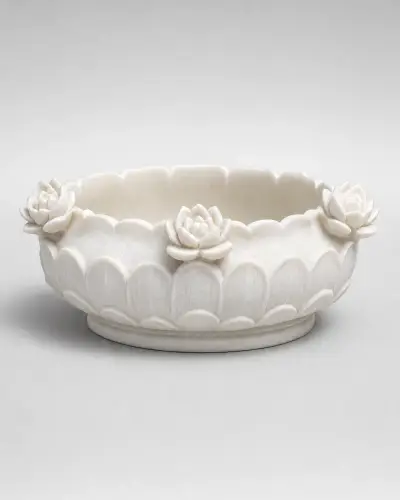
Each of the planter's four sides carries a pierced jali screen, cut clean through the marble so light and air pass between the openings. Jali is a Rajasthani and Mughal discipline: the pattern is set out, drilled, then opened and cleaned by hand with fine chisels and rifflers, because ribs this thin cannot be finished mechanically without chipping. The panels sit inside a plain moulded frame, which gives the eye somewhere to rest and gives the screen its strength. Below them runs a carved lotus-petal moulding, and under that a two-step square plinth that lifts the vessel clear of a wet floor. It is carved for you by the master sculptors we work with in Jaipur, the body from a single block and the plinth cut separately and seated beneath it.
Placing it, planting it, caring for it
At 36 inches tall on a 22-inch square plinth this is a courtyard or terrace piece rather than a tabletop one, and at roughly 175 kg it wants a solid floor and three or four hands to set it down. Households commonly place a tulsi vrindavan to the north or east of an open courtyard, where the plant takes the morning sun. The base is drilled for drainage; the cavity takes a layer of gravel and then soil. Marble etches on contact with acid, so the feed and the cleaning matter more than the stone does. Rinse with plain water and a soft cloth, keep lemon, vinegar and descaling liquids away from it, and wipe up spilled fertiliser rather than letting it stand in the moulding.
Making it yours
Every tulsi vrindavan is made to order in Jaipur, so none of this is fixed. The same design scales down to a balcony-sized 18 or 24 inches and up to a larger courtyard piece; the jali can be cut as a finer or a bolder lattice; the plinth can be left plain rather than lotus-moulded; the drainage hole can be omitted if you would rather drop a liner pot inside. A name or a date can be cut into the plinth face, which is a common request when it is going as a housewarming gift. Tell us the courtyard, the tulsi you already keep and where the sun falls, and we will size it around them.
Specifications
Base
Two-step square plinth with carved lotus-petal moulding, integral to the piece
Color
White
Finish
Soft polish (satin)
Material
Makrana White Marble
Ideal For
home courtyard, balcony, pooja space, gifting
Set Or Pair
Single
Primary Size
36 inch tall × 22 inch square plinth
Weight In Kg
175
Depth In Inches
22
Width In Inches
22
Height In Inches
36
Region Or Tradition
Indian / Rajasthani (Makrana marble jali-carving tradition)
Motif Or Iconography
Pierced jali lattice with lotus-petal plinth moulding