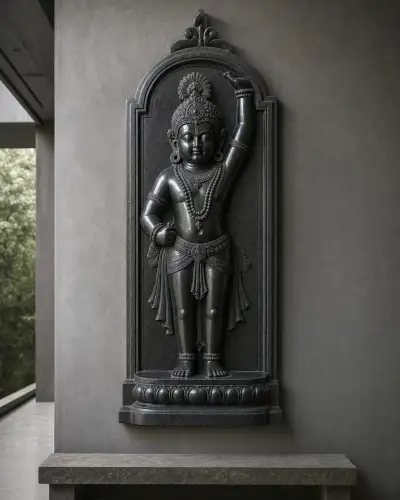
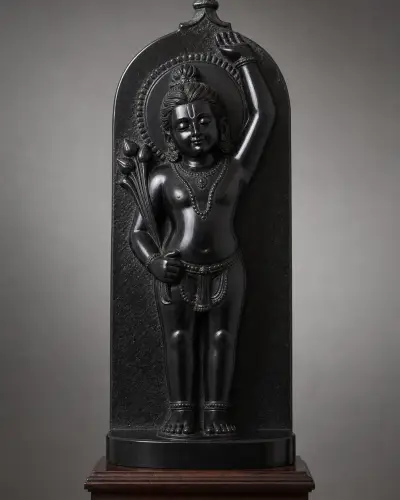
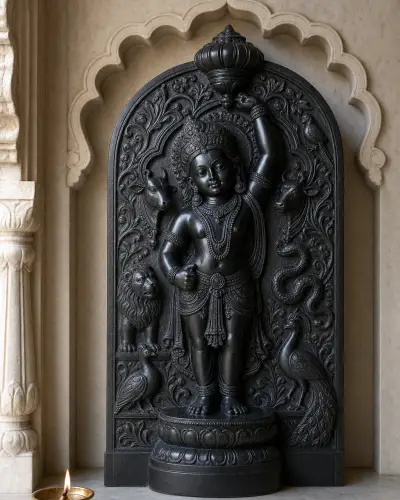
Shrinathji Pichwai Marble Relief with Cows, 36 in
Sculptor-carved black marble Shrinathji pichwai relief: a 36-inch arched stele with two cows, a lotus pond and a kadamb-worked arch.
Made to order. The pictures here are concept images. This is not a ready item. We get it made for you as per this design, as close as possible, in the size and stone you choose.
Want this design made for you?
Tell us the size, the stone and where it is going. We will send you a quote and a timeline.
Chat on WhatsAppWe'll respond within 5 minutes
About This Piece
From painted pichwai cloth to carved stone
Pichwai began as cloth. In Nathdwara, the Mewar town in Rajasthan where the Shrinathji swaroop has been enshrined since 1672, painters have hung large painted backdrops behind the deity for centuries, each one carrying the season's scene of cows, lotus ponds and kadamb trees. This panel takes that composition off the cloth and cuts it into stone. It is worked in black marble, the dark stone traditionally associated with the Nathdwara svarupa, and at 36 inches it reads as a single arched stele rather than a framed picture.
Carving the registers, and the rules behind the form
The panel is carved for you by the master sculptors TMW works with in Jaipur. Work starts from one slab: the arch outline and the figure's silhouette are cut first, then the depth registers are established, with the deity forward of the ground, the cows a step behind him, and the lotus pond raised only a few millimetres off the base course. Faces, hands, the cows' muzzles and the beaded ornament are all finished by hand, with no machine pass anywhere near them. The last stage is a progressive polish that takes black marble to a mirror surface, which is what makes shallow carved shadows read from across a room.
Every element here is fixed by the Pushtimarg tradition rather than chosen for effect. Shrinathji is Krishna at about seven years old, his left arm raised above his head (appearing on the viewer's right) where it once held up Govardhan. The hill itself is never depicted; the raised arm alone carries it, and a carved boulder would turn the piece into a different form altogether. His right hand rests as a closed fist at the waist, both feet stand flat and frontal, the eyes are half-closed and downcast, and he holds no flute. The two cows at his feet and the lotus pond along the lower register are pichwai vocabulary, standing in for the pastoral world of Braj.
Mounting 120 kg of black marble on a wall
At 36 inches tall and roughly 120 kg, this is a wall piece that wants masonry or concrete behind it and a proper anchor plate, not a plasterboard partition. Hung with its base near chest height it sits at darshan level and leaves the arch room to breathe above. Plan for a single raking light from one side, as in the photograph: the relief is deliberately shallow, and side light is what pulls the carving out of the black surface. It works as the centrepiece of a shrine wall, and equally as a standalone piece in a living room where a painting would otherwise hang.
Other sizes, and lighter stones for the scene
Sizes above and below 36 inches are possible, as is the same composition in Makrana white marble or Dholpur pink sandstone if you want the pichwai scene to read lighter. TMW designs the panel with you, briefs the sculptor, and follows the piece through to your door. Send us your wall dimensions and we will work back from there.
Specifications
Pose
Pichwai-style bas-relief on an arched stele — standing frontal, his left arm raised to the arch (appearing on the viewer's right), right hand a closed fist at the waist, two cows at his feet and a lotus pond along the lower register
Color
Jet Black
Finish
Mirror polish
Material
Black Marble
Ideal For
Wall mounted, Living room, Collector piece
Weight In Kg
120
Depth In Inches
4
Width In Inches
22
Height In Inches
36
Region Or Tradition
Indian / Rajasthani (Nathdwara, Pushtimarg pichwai tradition)