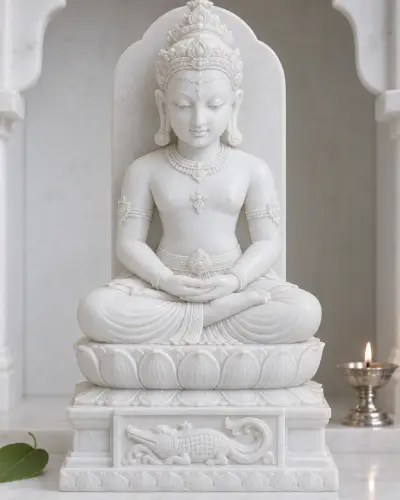
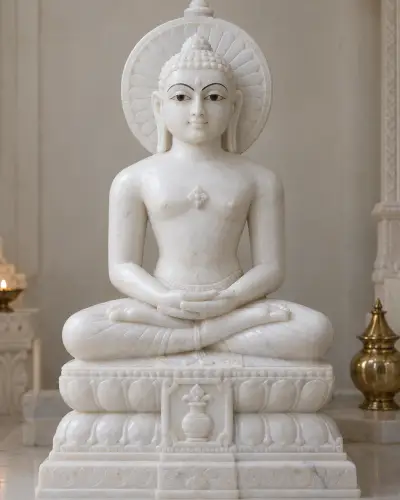
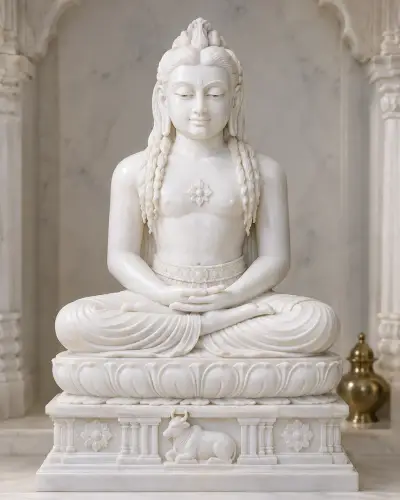
Vietnam White Marble Chandraprabhu Swami Murti, 12in
A 12-inch Chandraprabhu Swami murti in cool Vietnam white marble, seated padmasana with the crescent-moon lanchhana carved on the pedestal.
Made to order. The pictures here are concept images. This is not a ready item. We get it made for you as per this design, as close as possible, in the size and stone you choose.
Want this design made for you?
Tell us the size, the stone and where it is going. We will send you a quote and a timeline.
Chat on WhatsAppWe'll respond within 5 minutes
About This Piece
The stone
Vietnam White Marble is quarried in the Thanh Hoa belt of northern Vietnam and reaches Jaipur in blocks that cut noticeably cooler than Makrana. Makrana settles into a warm ivory as it ages; this stone holds a clean, near-porcelain white with only the faintest grey-blue in the shadow side. That is the reason it was chosen for Chandraprabhu Swami, whose canonical complexion in the Jain texts is white. The grain is fine and crystalline, so it carries small detail without crumbling at the edges: the beaded aureole, the pleats of the kachota, the crescent cut into the pedestal front. Finished to a soft satin polish rather than a mirror, the surface reads as stone under a derasar lamp instead of throwing back reflections that swallow the carving. Light passing through the thin edges glows faintly from within, the subsurface scatter that tells real marble apart from cast composite.
The eighth Tirthankara, and how to recognise him
The twenty-four Jinas are carved to look almost alike on purpose, because a Tirthankara is shown as a liberated soul, not as a portrait. So the figure alone will not tell you which one you are standing before. The lanchhana, the emblem cut into the pedestal, is what identifies him. Chandraprabhu Swami, the eighth Tirthankara, carries the crescent moon, and it sits on the front face of the lotus base on this murti. His name means "moon-light", he is traditionally held to have been born at Chandrapuri near Varanasi, and the white complexion assigned to him in the canon is the single reason a devotee will ask for the coolest available stone rather than a cream one. For a home derasar this matters twice over: the identification is correct at a glance, and the colour is right.
Śvetāmbara carving conventions on this murti
This piece follows the Śvetāmbara Murtipujak convention, and the differences from a Digambara Jina are small, fixed and easy to check. The lower body carries a carved kandora waistband with the pleated kachota below it. Kundal earrings and carved ornament are present. The eyes are wide and open, following the applied chakshus convention adopted between the fifteenth and seventeenth centuries so the devotee stands before a living Tirthankara rather than a sleeping one. What both sects share is here too: the srivatsa diamond on the bare chest, the seated padmasana, the hands stacked flat in the lap right over left, and the gaze drawn down to the nose tip. If your derasar follows the Digambara convention instead, say so at the enquiry stage and the brief is changed before any stone is cut.
Sizing it for a home derasar
At twelve inches tall, roughly six across and five deep, this sits on a standard derasar shelf or a marble chowki without crowding the lamps and the thali beside it. Expect around eight kilos, which is heavy enough to stay put and light enough for one person to lift into place during cleaning. Twelve inches is the size most families settle on for a daily home derasar: large enough that the srivatsa, the lanchhana and the fold of the kachota are all legible from a seated position on the floor, small enough that it does not need its own cabinet. Other heights are carved from the same brief: nine inches for a shelf shrine, eighteen or twenty-four for a room given over to the derasar. Message on WhatsApp with the height and the sect and you will get a quote.
Specifications
Pose
Seated padmasana, hands stacked flat in the lap right over left, srivatsa on the chest, kandora waistband and kachota pleats, crescent-moon lanchhana on the pedestal
Sect
Śvetāmbara (Murtipujak)
Color
White
Finish
Soft polish (satin)
Material
Vietnam White Marble
Ideal For
home derasar, pooja room
Weight In Kg
8
Depth In Inches
5
Width In Inches
6
Height In Inches
12
Region Or Tradition
Indian / Śvetāmbara Jain (Gujarat–Rajasthan derasar tradition)