Vietnam White Marble Jain Derasar with Gold-Leaf Shikhar — 30 in
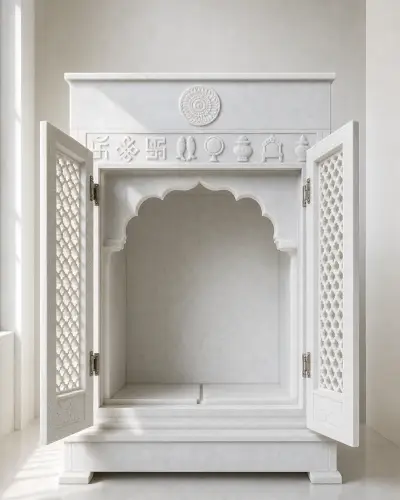
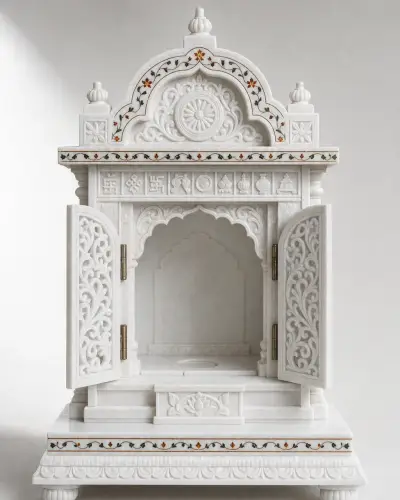
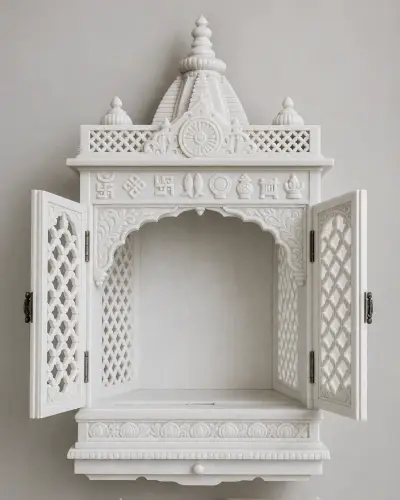
Hand-carved Vietnam white marble ghar derasar: a 30-inch single-door shrine under a gold-leaf shikhar with gilded kalash and dhwaja.
Made to order. The pictures here are concept images. This is not a ready item. We get it made for you as per this design, as close as possible, in the size and stone you choose.
Want this design made for you?
Tell us the size, the stone and where it is going. We will send you a quote and a timeline.
Chat on WhatsAppWe'll respond within 5 minutes
About This Piece
A gold-leaf shikhar over a white stone sanctum
Gilding on a derasar is usually an all-or-nothing decision, and both extremes cost the piece something: bare stone can read plain in a large pooja room, while a fully gilded shrine stops looking like marble at all. Here the gold leaf is confined to the spire. The tiered shikhar, the kalash finial above it and the dhwaja flagstaff that crowns the whole thing are laid in genuine gold leaf over the carved stone, and a single thin bead line of gilding runs around the door surround to tie the two together. Everything below (the ashtamangal lintel, the pillars, the doors, the plinth) stays bare Vietnam white marble. The effect a family notices first is separation: the gold reads as the sky above the sanctum, the stone stays unmistakably stone, and the carving keeps its own shadows instead of disappearing under metal.
Vietnam white marble, and how it differs from Makrana
Vietnam white comes out of the Thanh Hoa quarries in the north of that country and reaches the Jaipur workshops as block, where it is cut and carved exactly the way Rajasthani stone is. What sets it apart is the temperature of its colour rather than its quality: against Makrana's faint cream undertone, Vietnam white reads cool and clean, closer to a neutral grey-white, with very little veining to interrupt a carved surface. That matters on a piece like this one. A warm-toned stone under gold leaf tends to blur into the gilding at a distance, where a cool white holds a clear line against it. The marble is finished honed rather than polished, so the surface stays matte under a pooja-room lamp, takes daily handling and washing without showing wear, and never throws a hard reflection back at whoever is standing in front of it.
The sanctum and its doors
Two hinged doors close the gabhara: carved jali panels on brass hinges that swing fully clear of the pillars, so the shrine can be shut at night and opened for darshan without anything being lifted out. Cut into the sanctum floor is a shallow prakshal channel draining forward, which keeps water from the daily abhishek moving off the stone instead of pooling against it. Across the lintel runs the frieze of eight ashtamangal: the swastika with its three dots and the crescent siddhashila, the shrivatsa, the nandyavarta, the paired fish, the mirror, the water-pot, the bhadrasana throne and the vardhamanaka powder-vase. A carved siddhachakra medallion sits above the door arch. The single gokhla is proportioned for one seated Tirthankar pratima of roughly nine to eleven inches, chosen and installed separately as most families prefer.
Where a 30-inch derasar sits
Thirty inches tall, about seventeen wide and twelve deep, is the size that suits a dedicated pooja room in a flat or a converted closet shrine in a US home. It is tall enough to carry a real spire, and small enough that it needs no room built around it. Set on a chowki or a marble platform roughly eighteen inches high, the gokhla lands close to eye level for someone seated on the floor, which is what matters during aarti. Leave a hand's width clear on either side so the doors open fully. The weight works out near 43 kg, which a solid wooden chowki or a stone slab carries without trouble on an upper floor. Proportions, the depth of the gokhla, the extent of the gilding and an engraved family name along the plinth can all be adjusted. Message on WhatsApp with your space and the pratima you intend to install.
Specifications
Pose
Single-door shikharbandhi derasar — a tiered shikhar spire finished in gold leaf with a gilded kalash finial and dhwaja flagstaff above it, one central gokhla closed by two hinged carved jali doors, an ashtamangal frieze across the lintel, a carved siddhachakra medallion over the door arch, turned corner pillars and a stepped plinth
Color
Natural White
Finish
Matte (honed)
Material
Vietnam White Marble
Ideal For
Ghar derasar in a US home, Paryushan and festival installation, Milestone gifting
Decoration
gold_leaf
Weight In Kg
43
Depth In Inches
12
Width In Inches
17
Height In Inches
30
Decoration Detail
Genuine gold leaf laid over the carved shikhar spire, the kalash finial and the dhwaja flagstaff, with a thin gilded bead line along the door surround; every other surface left as bare white marble
Region Or Tradition
Indian / Gujarati (Shvetambar Murtipujak ghar derasar tradition)