Vietnam White Marble Jain Tabletop Derasar with Toran Arch — 18 in
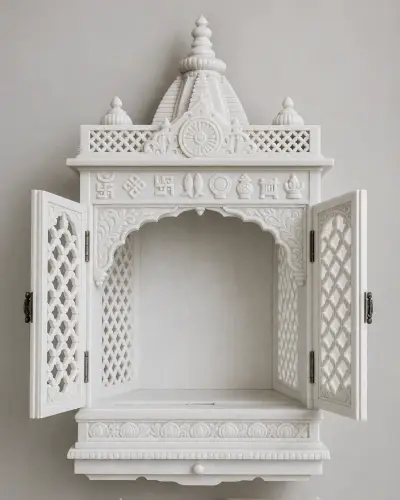
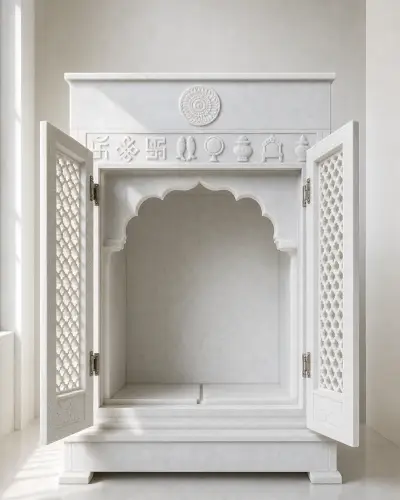
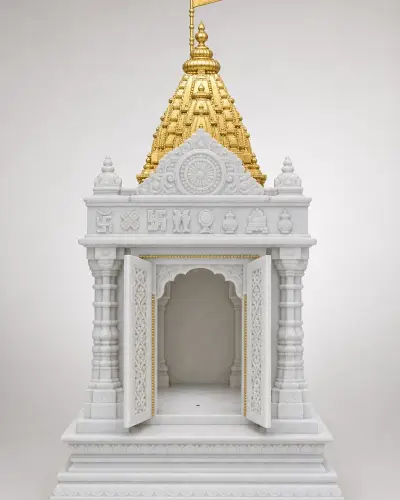
Tabletop Jain derasar in cool Vietnam white marble. 18 inches, one gokhla beneath a carved toran arch with a coloured-stone inlay border.
Made to order. The pictures here are concept images. This is not a ready item. We get it made for you as per this design, as close as possible, in the size and stone you choose.
Want this design made for you?
Tell us the size, the stone and where it is going. We will send you a quote and a timeline.
Chat on WhatsAppWe'll respond within 5 minutes
About This Piece
A cooler white, and why it matters at this size
At eighteen inches the whole shrine sits inside a single glance, so the stone is not a backdrop here; it is most of what the eye reads. Vietnam white marble is chosen for exactly that. It is a fine, compact, crystalline white with a clean cool undertone rather than the faint cream of Makrana, and that neutrality is what lets it hold its colour under the mixed light a living room actually has: a warm ceiling lamp, a screen glowing across the room, a window at the far end. A warmer stone tips yellow in that light, and a piece this small has no mass to absorb the shift. The surface is left honed rather than mirror-polished, so the carving reads as shape and shadow instead of a row of hard highlights, and a matte face does not show the handling a shrine on a console gets every day.
The toran arch, and the one line of colour
Over the sanctum the piece carries a toran, the scalloped arch hung across a temple threshold at an auspicious moment, cut here in stone instead of strung in marigold and mango leaf. Its profile is what gives a shelf-sized derasar presence without a tall shikhar, which at this scale would only make the shrine read top-heavy on a console. Running the curve of that arch, and again around the plinth below, is a slender inlay border: small cut pieces of coloured stone, deep green and red-brown, bedded flush into channels chiselled into the white and ground back level. This is the Jaipur pachikari technique the city has worked since the Mughal ateliers. Inlay at this size is slow, exacting work, and it is deliberately the only colour on the shrine. Everything else is white marble and shadow, which is why the line reads as a line rather than as ornament piled on ornament.
A complete sanctum, not a scaled-down one
Small does not mean simplified. The gabhara closes behind two hinged carved doors, drawn open on their hinges here. Each leaf is jali-cut, so the pierced pattern is ornament whether the shrine stands open for darshan or shut overnight. The sanctum floor carries a shallow prakshal channel falling to an outlet at the front lip, so the morning ablution drains clear instead of standing against the pedestal; leaving that out is the usual shortcut on a tabletop shrine, and it is why so many end up water-stained inside a few years. Above the doorway a carved frieze of the eight ashtamangal crosses the lintel (the swastika with its three dots and the crescent siddhashila above it, the shrivatsa, the nandyavarta, the paired fish, the mirror, the water-pot, the throne and the powder-vase), with a circular siddhachakra medallion set into the arch above. Nothing on the piece is borrowed from another tradition: no Ganesh at the threshold, no Om, no trishul, no conch-and-discus and no Nandi carved anywhere.
Where a shrine this size actually goes
At eighteen inches tall, about twelve across and eight deep, this is sized for a console table, a shelf in a puja niche, or the top of a low cabinet: the places a family has when there is no room to give a derasar its own floor. It runs to roughly sixteen kilos, which is heavy enough to sit dead still while the doors are swung and light enough for two people to move without a trolley. Allow a hand's width clear on each side so the leaves open fully, and a little height above the finial rather than tucking it under a low shelf. It is a shape that has become common for Jain families in apartments and condominiums, in Mumbai and Ahmedabad as much as in New Jersey or the Bay Area, where the shrine has to share a room and still be unmistakably a derasar rather than a decorative box.
Changing it, and what the commission involves
Every part of this is drawn to the piece being installed. The gokhla can be sized to a particular mulnayak murti rather than the other way round, the inlay palette changed or dropped for plain white, the jali on the door leaves taken denser or more open, a lock fitted, and a family name or a pratishtha date engraved into the plinth. It can also be carved in Makrana white if a warmer stone suits the room better. A shrine of this size usually takes eight to twelve weeks with the Jaipur sculptors before crating, and it ships worldwide in a braced wooden case. Send the shelf or console dimensions and the height of the murti going inside, and the drawing is worked around them.
Specifications
Pose
Compact tabletop ghar derasar — a single gokhla set beneath a carved toran arch, a slender coloured-stone inlay border running the arch and the plinth, two hinged jali-cut doors on the gabhara shown standing open, a shallow prakshal drainage channel in the sanctum floor, an ashtamangal frieze across the lintel with a carved siddhachakra medallion above the door arch, all on a low stepped base scaled for a console or a shelf
Color
Natural White
Finish
Matte (honed)
Material
Vietnam White Marble
Ideal For
Condo or apartment derasar, Console or shelf shrine, Small US home
Decoration
stone_inlay
Weight In Kg
16
Depth In Inches
8
Width In Inches
12
Height In Inches
18
Decoration Detail
Slender inlay border of coloured stone — deep green and red-brown — bedded flush into channels chiselled along the toran arch and around the plinth in the Jaipur pachikari technique; the only colour on an otherwise all-white shrine
Region Or Tradition
Indian / Gujarati (Shvetambar Murtipujak ghar derasar tradition)