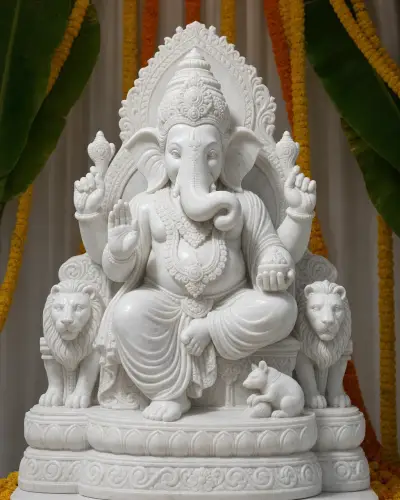
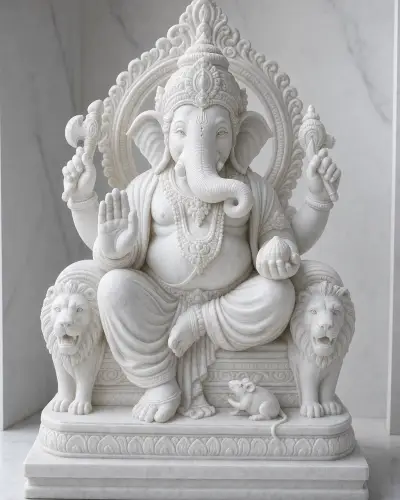
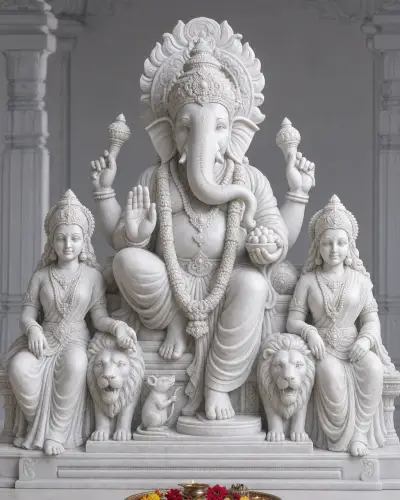
Vietnam White Marble Lalbaugcha Raja on Grand Throne with Gold Leaf, 5 ft
Master-carved Vietnam white marble Lalbaugcha Raja on a lion-flanked throne, a 5ft mandir-hall murti crowned in 22k gold leaf.
Made to order. The pictures here are concept images. This is not a ready item. We get it made for you as per this design, as close as possible, in the size and stone you choose.
Want this design made for you?
Tell us the size, the stone and where it is going. We will send you a quote and a timeline.
Chat on WhatsAppWe'll respond within 5 minutes
About This Piece
Why Vietnam white marble carries gold leaf well
Five feet of cool, milky-white stone seated squarely on a lion-flanked simhasan: the Lalbaug Ganpati read at the scale the form was made for. The marble is Vietnam White, quarried in Thanh Hoa province and an export staple in Indian sculpture yards since the 2000s. It runs a shade cooler and whiter than Makrana: a bright neutral field with hairline warm-grey veining held under three percent of the surface. That cool ground is exactly why it carries gold well. Against it, the 22k leaf on the mukut and the jewelled collar reads as gold rather than a yellow smear.
The carving order, from rough block to gilding
Carving runs through the independent master sculptors TMW commissions in Jaipur, in the order the stone demands: a rough block cut to the throne's silhouette, the primary masses of belly, shoulder and knee blocked out, and then the slow work of ear folds, the trunk's curl, the lions' manes, and the ornament beds that will later take leaf. Nothing on the face, hands or drapery is machine-finished; those surfaces are chiselled and hand-rubbed through progressive grits to a satin polish. The gold leaf is laid last, by hand, after the stone is sealed.
What marks this as the Lalbaug murti
Every marker of the Lalbaugcha Raja form is present and deliberate. The throne is the giveaway: a simhasan flanked by carved lions, the detail that separates the Lalbaug murti from a generic seated Ganpati. Above it, the tall tiered mukut. Four arms (the right palm raised in abhaya, a modak held low on the left), the single broken right tusk, the trunk curled to the deity's left, and the mushak at the plinth's front edge. The Lalbaug mandal has installed its Ganpati in this royal, throne-seated register since 1934; this piece follows that lineage rather than reinventing it.
Siting a 5-foot murti in a hall
At 60 inches on a carved plinth, this is a community-scale murti, not a shelf piece. It wants a hall: a mandal's mandir, a trust's prayer room, an institutional lobby shrine, or a large private mandir with a double-height wall behind it. Allow roughly eight feet of clear wall so the crown has air above it, and ten feet of viewing distance for the throne and lions to resolve. Floor loading matters at this weight: a levelled masonry pedestal or a solid stone base plate is the usual answer. Set it facing the room's main approach so devotees meet the abhaya hand head-on.
The same murti can be cut at 36 or 48 inches for a home mandir, or commissioned larger as a bespoke piece. The gold leaf is optional. Some mandals keep the crown in plain white stone, while others ask for a full hand-painted finish. Send us your hall dimensions on WhatsApp and we will come back with sizing and a lead time.
Specifications
Pose
Monumental seated four-armed Lalbaugcha Raja Ganpati on a grand lion-flanked simhasan throne in cool milky-white marble, 22k gold-leaf mukut and gilded jewelled ornaments, temple-hall scale on a raised carved stone plinth, trunk curled left, broken right tusk, modak and abhaya blessing, mushak at the base
Color
Milky White with Gold Leaf
Finish
Soft polish (satin)
Material
Vietnam White Marble
Ideal For
Community mandir, Institutional installation, Grand home shrine
Weight In Kg
450
Depth In Inches
30
Width In Inches
33
Height In Inches
60
Region Or Tradition
Indian / Maharashtrian (Lalbaug, Mumbai Ganeshotsav tradition)