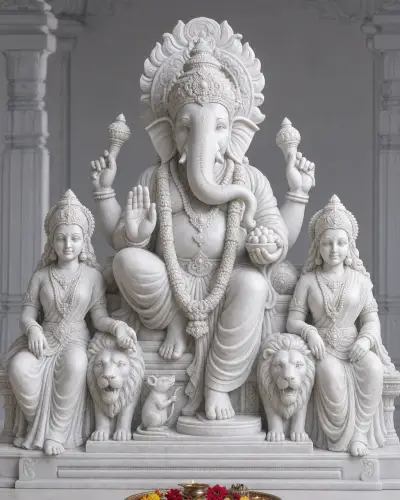
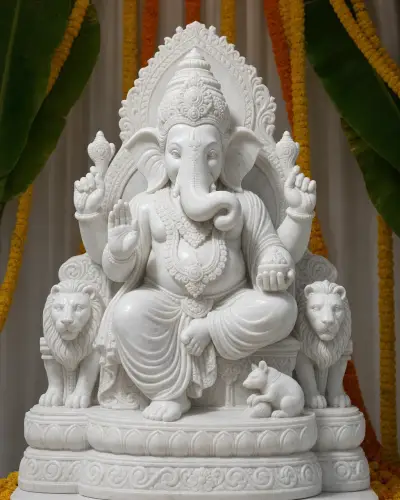
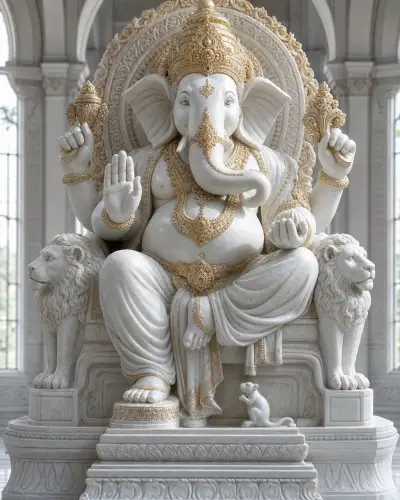
Vietnam White Marble Lalbaugcha Raja on Lion Throne, 15 in
Hand-carved Vietnam white marble Lalbaugcha Raja on a lion-flanked simhasan, a 15-inch altar piece with satin-polished cool-white stone.
Made to order. The pictures here are concept images. This is not a ready item. We get it made for you as per this design, as close as possible, in the size and stone you choose.
Want this design made for you?
Tell us the size, the stone and where it is going. We will send you a quote and a timeline.
Chat on WhatsAppWe'll respond within 5 minutes
About This Piece
Why Vietnam white marble holds the undercuts
Lalbaugcha Raja's lion-flanked throne is the detail that sets this murti apart, and it is carved here in Vietnam White Marble, a bright, cool-toned stone quarried in Thanh Hoa province and one of the most widely exported white marbles since the early 2000s. Where Makrana reads warm and creamy, this stone stays close to a clean porcelain white with only hairline grey veining, so the deep undercuts of the mukut, the prabhavali arch behind the head and the two lions hold their shadow lines crisply instead of muddying into the surface.
How the lions and the mukut are carved
Carving begins with a rough block dressed down to the seated silhouette. After that, the independent master sculptors we work with in Jaipur move to the detail stages: the crown scrollwork, the necklaces layered over the chest, the drapery folds pooling across the throne seat, and the two lions worked as a mirrored pair so they sit symmetrically at the flanks. The face, the trunk, the palms and the mushak are finished entirely by hand; no machine tooling touches them. A progressive polish takes the surface to a satin sheen that reflects light softly rather than throwing hard highlights.
The 1934 Lalbaug original and its iconography
The form follows the Mumbai original. Since 1934, when the traders and mill workers around Lalbaug's Peru Chawl market installed their first Ganpati in fulfilment of a vow, the Lalbaugcha Raja has been seated upright on a broad throne with carved lions at either side. That vow is the reason devotees know him as Navsacha Ganpati, the Ganpati of the vow. The iconography is kept intact: four arms, a modak held in one, the abhaya blessing raised in another, the trunk curling to the deity's left, a single broken right tusk marking him as Ekadanta, and the mushak seated at the foot of the plinth.
Shelf space and lighting for a 15-inch Raja
At 15 inches the piece is scaled for an apartment pooja shelf or a modern home mandir rather than a floor installation. Allow roughly 20 inches of clear height above the shelf so the mukut and arch are not visually cramped, and about 9 inches of depth for the plinth. Cool, indirect daylight suits this stone best; a north-facing ledge, or a soft warm LED washed from above, reads well, while a hard downlight placed directly overhead flattens the carving. Many families position Ganpati so he faces into the room the household gathers in.
Other sizes, stones and finishes
Sizes from 9 to 36 inches are made to order, and the same lion-throne form can be carved in Makrana white marble or given the gold-leaf and hand-painted treatments seen on the Lalbaug pandal murti. A mirror polish, a taller carved prabhavali, or a family name engraved into the plinth can be added. Message us on WhatsApp with your shelf dimensions and we will work back from there.
Specifications
Pose
Seated four-armed Lalbaugcha Raja Ganpati on a lion-flanked simhasan throne, tall ornate mukut, trunk curled left, broken right tusk, modak and abhaya blessing, mushak at the base
Color
Milky White
Finish
Soft polish (satin)
Material
Vietnam White Marble
Ideal For
Apartment pooja shelf, Modern home mandir, Devotional gift
Weight In Kg
18
Depth In Inches
8
Width In Inches
9
Height In Inches
15
Region Or Tradition
Indian / Maharashtrian (Mumbai, Lalbaug Ganeshotsav tradition)